Story Immersion of Videogames for Youth Health Promotion: A Review of Literature
- PMID: 24416639
- PMCID: PMC3833363
- DOI: 10.1089/g4h.2011.0012
Story Immersion of Videogames for Youth Health Promotion: A Review of Literature
Abstract
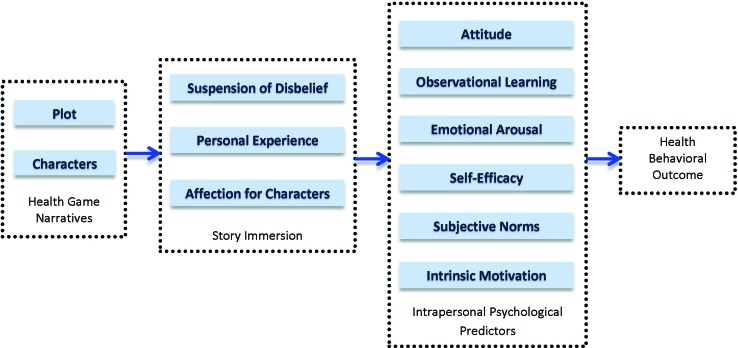
This article reviews research in the fields of psychology, literature, communication, human-computer interaction, public health, and consumer behavior on narrative and its potential relationships with videogames and story immersion. It also reviews a narrative's role in complementing behavioral change theories and the potential of story immersion for health promotion through videogames. Videogames have potential for health promotion and may be especially promising when attempting to reach youth. An understudied characteristic of videogames is that many contain a narrative, or story. Story immersion (transportation) is a mechanism through which a narrative influences players' cognition, affect, and, potentially, health behavior. Immersion promotes the suspension of disbelief and the reduction of counterarguments, enables the story experience as a personal experience, and creates the player's deep affection for narrative protagonists. Story immersion complements behavioral change theories, including the Theory of Planned Behavior, Social Cognitive Theory, and Self-Determination Theory. Systematic investigations are needed to realize the powerful potential of interactive narratives within theory-driven research.
Figures
References
-
- Kaiser Family Foundation. Generation M2: Media in the Lives of 8- to 18-Year-Olds. Menlo Park, CA: Kaiser Family Foundation; 2010.
-
- Biddiss E. Irwin J. Active video games to promote physical activity in children and youth: A systematic review. Arch Pediatr Adolesc Med. 2010;164:664–672. - PubMed
-
- Foley L. Maddison R. Use of active video games to increase physical activity in children: A (virtual) reality? Pediatr Exerc Sci. 2010;22:7–20. - PubMed
-
- Bailey BW. McInnis K. Energy cost of exergaming: A comparison of the energy cost of 6 forms of exergaming. Arch Pediatr Adolesc Med. 2011;165:597–602. - PubMed
-
- Baranowski T. Baranowski J. Cullen KW, et al. Squire's Quest!: Dietary outcome evaluation of a multimedia game. Am J Prev Med. 2003;24:52–61. - PubMed
Publication types
Grants and funding
LinkOut - more resources
Full Text Sources