Methodological challenges in determining longitudinal associations between anticholinergic drug use and incident cognitive decline
- PMID: 24417438
- PMCID: PMC4233958
- DOI: 10.1111/jgs.12632
Methodological challenges in determining longitudinal associations between anticholinergic drug use and incident cognitive decline
Abstract
Objectives: To compare the effect of using different anticholinergic drug scales and different models of cognitive decline in longitudinal studies.
Design: Longitudinal cohort study.
Setting: Outpatient clinics, Quebec, Canada.
Participants: Individuals aged 60 and older without dementia or depression (n = 102).
Measurements: Using baseline and 1-year follow-up data, four measures of anticholinergic burden (anticholinergic component of the Drug Burden Index (DBI-Ach), Anticholinergic Cognitive Burden (ACB), Anticholinergic Drug Scale (ADS), and Anticholinergic Risk Scale (ARS)) were applied. Three models of cognitive decline (worsening of raw neuropsychological test scores, Reliable Change Index (RCI), and a standardized regression based measure (SRB)) were compared in relation to Diagnostic and Statistical Manual of Mental Disorders, Fifth Edition (DSM-V) criteria for the onset of a new mild neurocognitive disorder. The consistency of associations was examined using logistic regression.
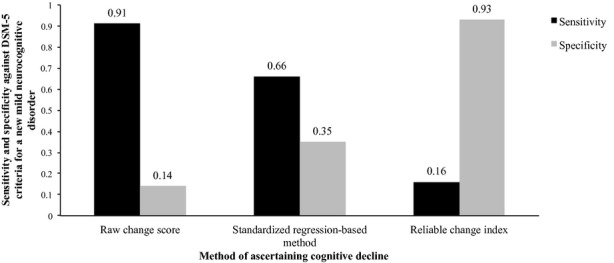
Results: The frequency of identifying individuals with an increase in anticholinergic burden over 1 year varied from 18% with the DBI-Ach to 23% with the ACB. The frequency of identifying cognitive decline ranged from 8% to 86% using different models. The raw change score had the highest sensitivity (0.91), and the RCI the highest specificity (0.93) against DSM-V criteria. Memory decline using the SRB method was associated with an increase in ACB (odds ratio (OR) = 5.3, 95% confidence interval (CI) = 1.1-25.8), ADS (OR = 5.7, 95% CI = 1.1-27.7), and ARS (OR = 6.5, 95% CI = 1.34-32.3). An increase in the DBI-Ach was associated with a decline on memory testing using the raw change score method (OR = 4.2, 95% CI = 1.8-15.4) and on the Trail-Making Test Part B using SRB (OR = 2.9, 95% CI = 1.1-8.0). No associations were observed using the DSM-V criteria or RCI method.
Conclusion: The choice of different methods for defining drug exposure and cognitive decline will have a significant effect on the results of pharmacoepidemiological studies.
Keywords: anticholinergic drug exposure; cognitive decline; longitudinal study; methods; older adults.
© 2014, Copyright the Authors. Journal compilation © 2014, The American Geriatrics Society.
Figures
References
-
- Terry AV, Jr, Buccafusco JJ. The cholinergic hypothesis of age and Alzheimer's disease-related cognitive deficits: Recent challenges and their implications for novel drug development. J Pharmacol Exp Ther. 2003;306:821–827. - PubMed
-
- Paquette A, Gou P, Tannenbaum C. Systematic review and meta-analysis: Do clinical trials testing antimuscarinic agents for overactive bladder adequately measure central nervous system adverse events? J Am Geriatr Soc. 2011;59:1332–1339. - PubMed
-
- Wagg A, Dale M, Tretter R, et al. Randomised, multicentre, placebo-controlled, double-blind crossover study investigating the effect of solifenacin and oxybutynin in elderly people with mild cognitive impairment: The SENIOR Study. Eur Urol. 2013;64:74–81. - PubMed
Publication types
MeSH terms
Substances
Grants and funding
LinkOut - more resources
Full Text Sources
Other Literature Sources