. 2014 Mar;184(3):592-9.
doi: 10.1016/j.ajpath.2013.11.029. Epub 2014 Jan 11.

Gut commensal bacteria and regional Wnt gene expression in the proximal versus distal colon

Affiliations

Gut commensal bacteria and regional Wnt gene expression in the proximal versus distal colon

Philipp-Alexander Neumann et al. Am J Pathol. 2014 Mar.

Abstract

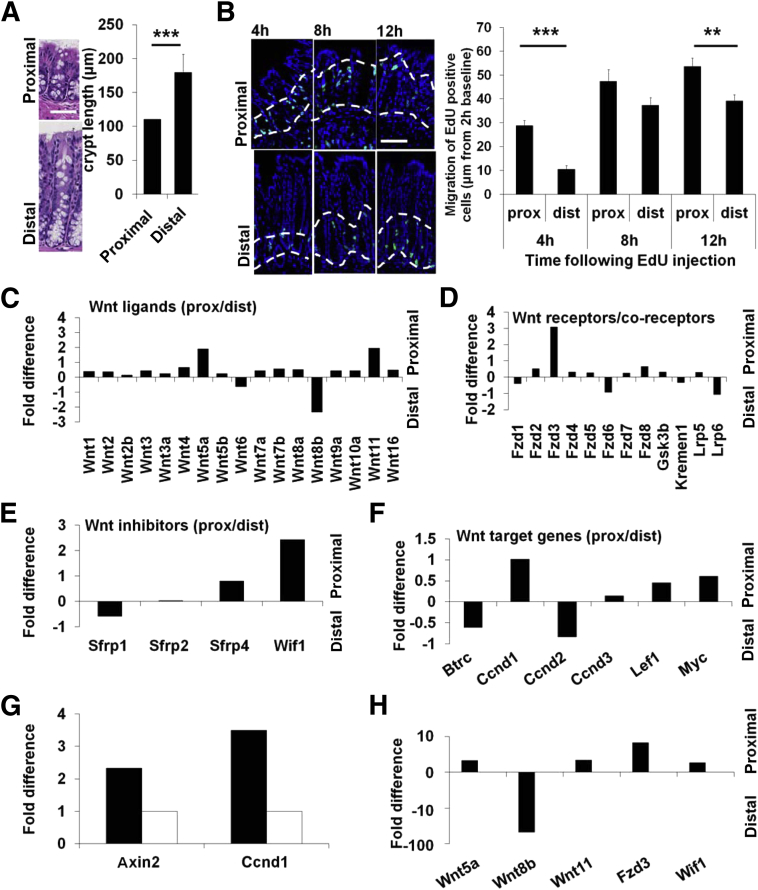
Regional expression of Wingless/Int (Wnt) genes plays a central role in regulating intestinal development and homeostasis. However, our knowledge of such regional Wnt proteins in the colon remains limited. To understand further the effect of Wnt signaling components in controlling intestinal epithelial homeostasis, we investigated whether the physiological heterogeneity of the proximal and distal colon can be explained by differential Wnt signaling. With the use of a Wnt signaling-specific PCR array, expression of 84 Wnt-mediated signal transduction genes was analyzed, and a differential signature of Wnt-related genes in the proximal versus distal murine colon was identified. Several Wnt agonists (Wnt5a, Wnt8b, and Wnt11), the Wnt receptor frizzled family receptor 3, and the Wnt inhibitory factor 1 were differentially expressed along the colon length. These Wnt signatures were associated with differential epithelial cell proliferation and migration in the proximal versus distal colon. Furthermore, reduced Wnt/β-catenin activity and decreased Wnt5a and Wnt11 expression were observed in mice lacking commensal bacteria, an effect that was reversed by conventionalization of germ-free mice. Interestingly, myeloid differentiation primary response gene 88 knockout mice showed decreased Wnt5a levels, indicating a role for Toll-like receptor signaling in regulating Wnt5a expression. Our results suggest that the morphological and physiological heterogeneity within the colon is in part facilitated by the differential expression of Wnt signaling components and influenced by colonization with bacteria.


Figures

Figure 1
Figure 1
Heterogeneity of the proximal and distal colon is accompanied by distinct Wnt signaling expression patterns. A: Morphology of proximal and distal colonic crypts exhibit notable histomorphologic differences (representative H&E image in left panel). Quantification of crypt length shows significant differences between the proximal and distal colonic crypts with a mean crypt length of 106.3 ± 1.78 μm in the proximal colon and 203.2 ± 2.63 μm in the distal colon (P < 0.0001). B: IEC migration along the crypt-luminal axis was measured with an EdU pulse-chase experiment [EdU-positive cells in green; nuclear staining (TO-PRO-3)]; migration distance was measured from 2-hour baseline in proximal and distal colonic crypts at 4 hours (proximal, 28.8 ± 2.3 μm; distal, 10.5 ± 1.6 μm; P < 0.0001), 8 hours (proximal, 47.4 ± 5 μm; distal, 37.3 ± 3.3 μm), and 12 hours (proximal, 53.7 ± 3.5 μm; distal, 39.2 ± 2.7 μm; P = 0.0025) after flash label with EdU. CF: A qPCR array was used to analyze Wnt signaling-related gene expression in the proximal colon compared with the distal colon. Wnt5a, Wnt8b, Wnt11, Fzd3, and WIF1 showed significantly different expression patterns in the proximal colon compared with the distal colon (positive fold differences indicate higher expression in the proximal colon; negative fold differences indicate higher expression in the distal colon). G: Wnt target gene expression (Axin2, Ccnd1) indicates higher Wnt/β-catenin activity in the proximal (black bars) colon than in the distal (white bars) colon (difference: Axin2, 2.33-fold; Ccnd1 3.5-fold). H: qPCR verification of the array results. Data are expressed as means ± SEM and represent three experiments with three mice per group. ∗∗P < 0.01 and ∗∗∗P < 0.001. Scale bars: 50 μm (A and B). Original magnification: ×20 (A and B). Btrc, β-transducin repeat containing protein; Dist, distal; Gsk3b, glycogen synthase kinase 3 β; h, hour; Kremen1, kringle containing transmembrane protein 1; Lef1, lymphoid enhancer binding factor 1; Lrp, low-density lipoprotein receptor-related protein; Myc, (alias c-myc) myelocytomatous oncogene; prox, proximal; Sfrp, secreted frizzled-related protein.
Figure 2
Figure 2
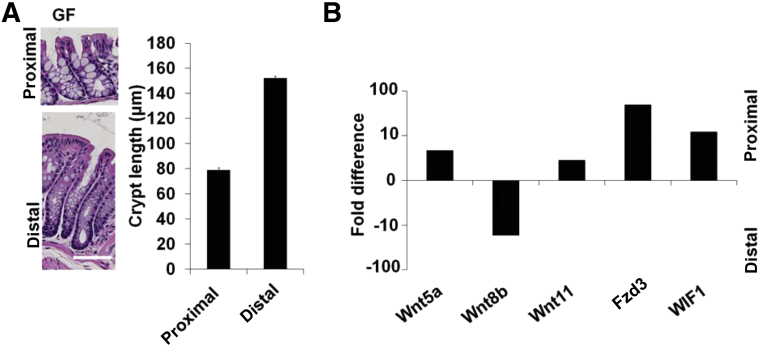
GF mice show differences in crypt morphology in the proximal colon compared with the distal colon but resemble Wnt gene expression patterns of SPF mice. A: Crypt morphology in the proximal (79.08 ± 1.72 μm) versus the distal (152.10 ± 2.57 μm) colon of GF mice. B: Results of qPCR for Wnt signaling genes in GF mice were Wnt5a (difference, 4.65-fold), Wnt11 (difference, 2.82-fold), Fzd3 (difference, 49.51-fold), and WIF1 (difference, 12.17-fold) in the proximal colon and Wnt8b (difference, 16.95-fold) in the distal colon. Data are expressed as means ± SEM. Scale bar = 50 μm (A).
Figure 3
Figure 3
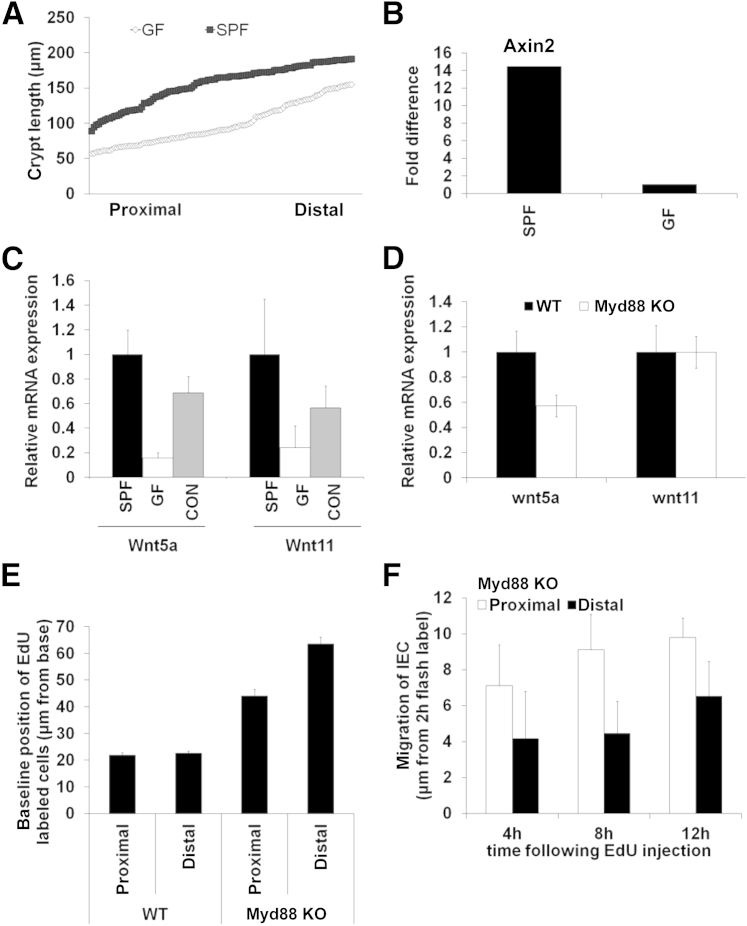
Mice raised in GF conditions exhibit shorter intestinal crypt length and altered Wnt gene expression levels compared with SPF mice. A: Total crypt length from proximal to distal colon of mice raised in GF conditions compared with SPF mice. B: Axin2 mRNA expression was used as a surrogate marker for active Wnt/β-catenin signal transduction. Axin2 expression (difference, 14.46-fold) was higher in SPF mice than in GF mice. C: Gene expression levels of the Wnt ligands were Wnt5a (difference, −6.41-fold) and Wnt11 (difference, −4.18-fold) compared with WT controls. Conventionalization of GF mice for 4 weeks induces expression of Wnt5a (difference, 4.4-fold) and Wnt11 (difference, 2.36-fold). D: Gene expression of Wnt5a (difference, −1.75-fold) but not Wnt11 is markedly decreased in Myd88 KO mice. E: Detection of EdU-positive cells in crypt-luminal axis in the baseline state (2 hours after flash label) was 44.2 ± 2.2 μm proximal and 63.5 ± 2.6 μm distal in Myd88 KO mice compared with 21.9 ± 0.9 μm proximal and 22.7 ± 0.6 μm distal in WT controls, measured from crypt base. F: IEC migration in Myd88 KO mice, measured as distance from 2-hour baseline position, at 4 hours was 7.1 ± 2 μm proximal and 4.2 ± 1.8 μm distal, at 8 hours was 9.2 ± 1.1 μm proximal and 4.5 ± 1.9 μm distal, and at 12 hours was 9.8 ± 1.5 μm proximal and 6.5 ± 1.8 μm distal after the EdU flash label. Data are expressed as means ± SEM and represent three experiments with three mice per group. CON, conventionalized; h, hour.

References

    1. Nusse R. Wnt signaling in disease and in development. Cell Res. 2005;15:28–32. - PubMed
    1. Pinto D., Gregorieff A., Begthel H., Clevers H. Canonical Wnt signals are essential for homeostasis of the intestinal epithelium. Genes Dev. 2003;17:1709–1713. - PMC - PubMed
    1. Nava P., Koch S., Laukoetter M.G., Lee W.Y., Kolegraff K., Capaldo C.T., Beeman N., Addis C., Gerner-Smidt K., Neumaier I., Skerra A., Li L., Parkos C.A., Nusrat A. Interferon-gamma regulates intestinal epithelial homeostasis through converging beta-catenin signaling pathways. Immunity. 2010;32:392–402. - PMC - PubMed
    1. Lickert H., Kispert A., Kutsch S., Kemler R. Expression patterns of Wnt genes in mouse gut development. Mech Dev. 2001;105:181–184. - PubMed
    1. Tai C.C., Sala F.G., Ford H.R., Wang K.S., Li C., Minoo P., Grikscheit T.C., Bellusci S. Wnt5a knock-out mouse as a new model of anorectal malformation. J Surg Res. 2009;156:278–282. - PMC - PubMed

Publication types

LinkOut - more resources