


The family partners for health study: a cluster randomized controlled trial for child and parent weight management
- PMID: 24418827
- PMCID: PMC3904082
- DOI: 10.1038/nutd.2013.42
The family partners for health study: a cluster randomized controlled trial for child and parent weight management
Abstract
Objective: The purpose of this study was to test a two-phased nutrition and exercise education, coping skills training, and exercise intervention program for overweight or obese low-income ethnic minority 2nd to 4th grade children and their parents in rural North Carolina, USA.
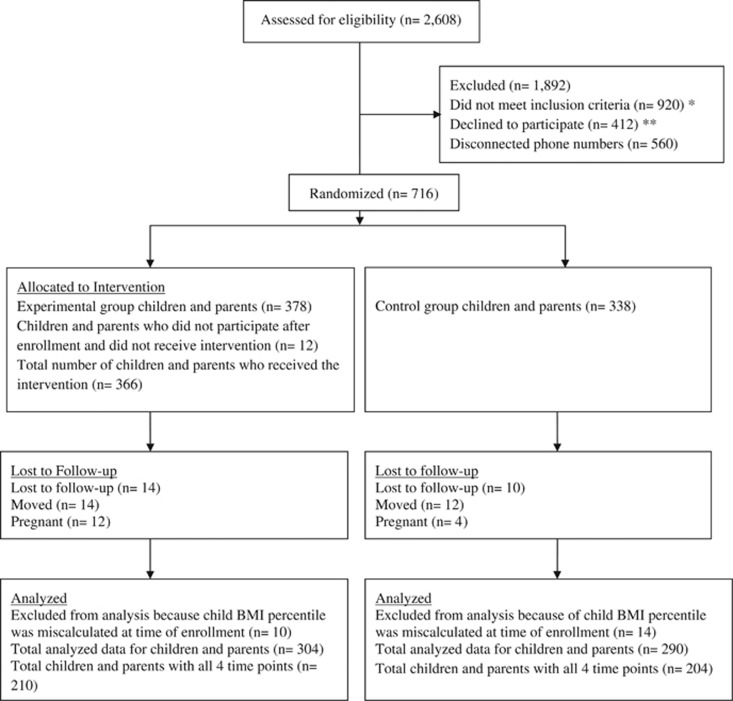
Methods: A cluster randomized controlled trial was carried out with 358 children (7-10 years) and a parent for each child (n=358). General linear mixed models were used to determine the effects of the intervention on weight, adiposity, health behaviors, and eating and exercise self-efficacy by examining changes in children and parents from baseline to completion of the study (18 months).
Results: At 18 months, children in the experimental group did not have a significantly decreased body mass index (BMI) percentile (P=0.470); however, they showed a reduction in the growth rate of their triceps (P=0.001) and subscapular skinfolds (P<0.001) and an improvement in dietary knowledge (P=0.018) and drank less than one glass of soda per day (P=0.052) compared with the control group. Parents in the experimental group had decreased BMI (P=0.001), triceps (P<0.001) and subscapular skinfolds (P<0.001) and increased nutrition (P=0.003) and exercise (P<0.001) knowledge and more often drank water or unsweetened drinks (P=0.029). At 18 months, children in the experimental group did not show significant improvement in eating (P=0.956) or exercise self-efficacy (P=0.976). Experimental parents demonstrated improved socially acceptable eating self-efficacy (P=0.013); however, they did not show significant improvement in self-efficacy pertaining to emotional eating (P=0.155) and exercise (P=0.680).
Conclusion: The results suggest that inclusion of children and parents in the same intervention program is an effective way to decrease adiposity and improve nutrition behaviors in both children and parents and improve weight and eating self-efficacy in parents.
Figures
References
-
- Centers for Disease Control and Prevention Estimated County-Level Prevalence of Diabetes and Obesity-United States, 2007. Morbidity and Mortality Weekly Report. 2009;58:1259–1263. - PubMed
-
- Behan DF, Cox SH, Lin Y, Pai J, Pedersen HW, Yi M. Obesity and its relation to mortality and morbidity costs. Society of Actuaries. 2010. pp. 1–61.
Grants and funding
LinkOut - more resources
Full Text Sources
Other Literature Sources
Molecular Biology Databases
