


Structures of pattern recognition receptors reveal molecular mechanisms of autoinhibition, ligand recognition and oligomerization
- PMID: 24419035
- PMCID: PMC3944054
- DOI: 10.1016/j.coi.2013.10.009
Structures of pattern recognition receptors reveal molecular mechanisms of autoinhibition, ligand recognition and oligomerization
Abstract
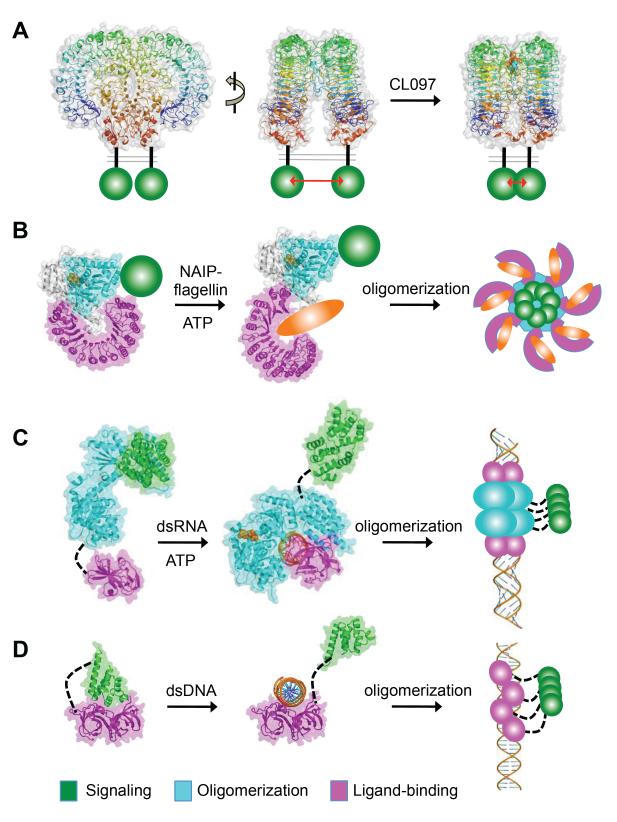
Pattern recognition receptors (PRRs) are essential sentinels for pathogens or tissue damage and integral components of the innate immune system. Recent structural studies have provided unprecedented insights into the molecular mechanisms of ligand recognition and signal transduction by several PRR families at distinct subcellular compartments. Here we highlight some of the recent discoveries and summarize the common themes that are emerging from these exciting studies. Better mechanistic understanding of the structure and function of the PRRs will improve future prospects of therapeutic targeting of these important innate immune receptors.
Published by Elsevier Ltd.
Figures
References
-
- Janeway CA, Medzhitov R. Innate immune recognition. Annu. Rev. Immunol. 2002;20:197–216. - PubMed
-
- Kang JY, Lee J-O. Structural biology of the Toll-like receptor family. Annu. Rev. Biochem. 2011;80:917–941. - PubMed
-
-
Yoon S-I, Kurnasov O, Natarajan V, Hong M, Gudkov AV, Osterman AL, Wilson IA. Structural basis of TLR5-flagellin recognition and signaling. Science. 2012;335:859–864. The authors report the first structure of TLR5 in complex with its protein ligand flagellin, which demonstrates a novel 2:2 hetero-tetrameric complex.
-
-
-
Tanji H, Ohto U, Shibata T, Miyake K, Shimizu T. Structural Reorganization of the Toll-Like Receptor 8 Dimer Induced by Agonistic Ligands. Science. 2013;339:1426–1429. Here the structures of the native TLR8 extracellular domain are reported, which illustrate a surprising TLR8 dimer rearrangement upon association with small chemical agonists. TLR8 is also cleaved at the “Z-loop”, the cleavage of which in TLR7 and TLR9 was shown to be essential for activation.
-
Publication types
MeSH terms
Substances
Grants and funding
LinkOut - more resources
Full Text Sources
Other Literature Sources
