


Patient's Anastrozole Compliance to Therapy (PACT) Program: Baseline Data and Patient Characteristics from a Population-Based, Randomized Study Evaluating Compliance to Aromatase Inhibitor Therapy in Postmenopausal Women with Hormone-Sensitive Early Breast Cancer
- PMID: 24419247
- PMCID: PMC3683950
- DOI: 10.1159/000350777
Patient's Anastrozole Compliance to Therapy (PACT) Program: Baseline Data and Patient Characteristics from a Population-Based, Randomized Study Evaluating Compliance to Aromatase Inhibitor Therapy in Postmenopausal Women with Hormone-Sensitive Early Breast Cancer
Abstract
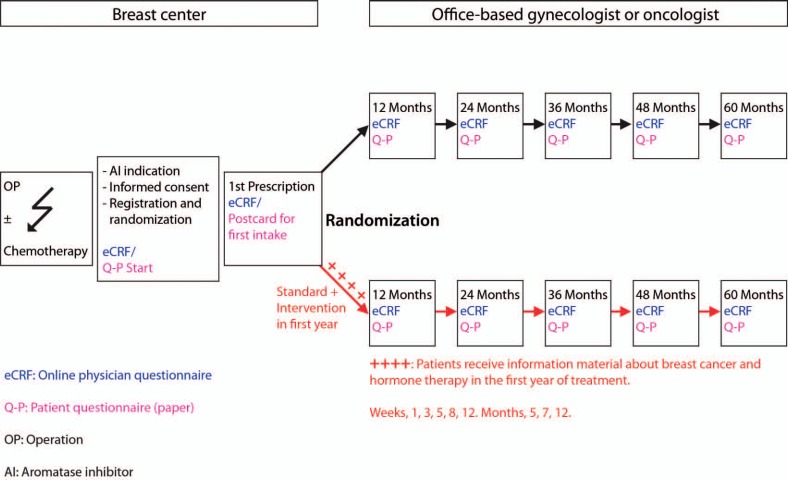
Background: The Patient's Anastrozole Compliance to Therapy (PACT) program is a large randomized study designed to assess whether the provision of educational materials (EM) could improve compliance with aromatase inhibitor therapy in postmenopausal women with early, hormone receptor-positive breast cancer.
Patients and methods: The PACT study presented a large, homogeneous dataset. The baseline analysis included patient demographics and initial treatments and patient perceptions about treatment and quality of life.
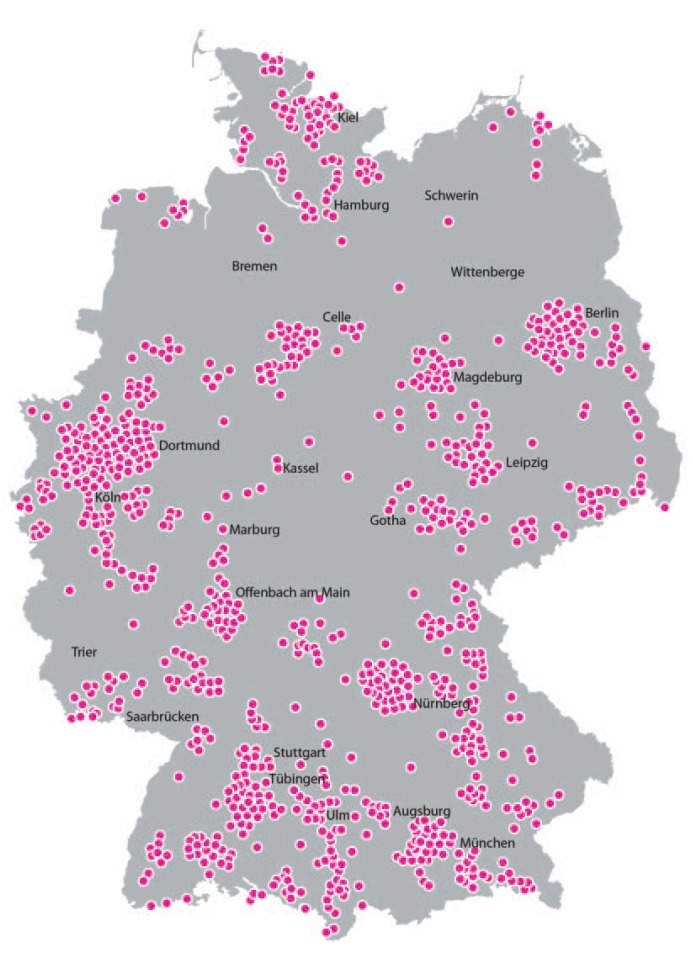
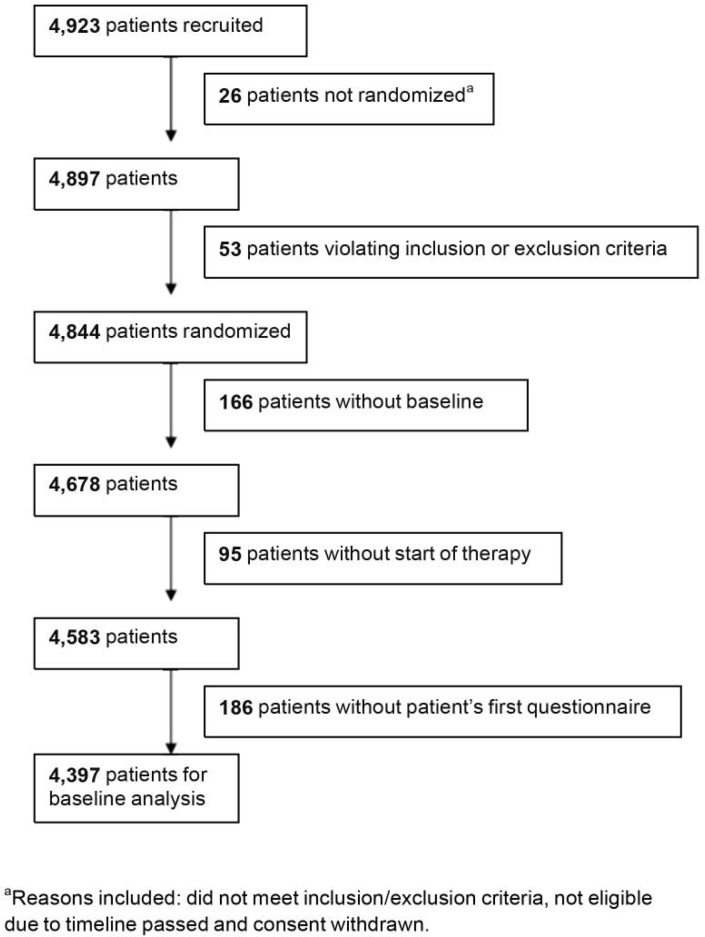
Results: Overall, 4,923 patients were enrolled at 109 German breast cancer centers/clinics in cooperation with 1,361 office-based gynecologists/oncologists. 4,844 women were randomized 1:1 to standard therapy (n = 2,402) or standard therapy plus EM (n = 2,442). Prior breast-conserving surgery and mastectomy had been received by 76% and 24% of the patients, respectively. Radiotherapy was scheduled for 85% of the patients, adjuvant chemotherapy for 38%. Reflecting the postmenopausal, hormone-sensitive nature of this population, only 285 patients (7%) had received neoadjuvant chemotherapy.
Conclusions: A comparison with epidemiological data from the West German Breast Center suggests that the patients in the PACT study are representative of a general postmenopausal early breast cancer population and that the findings may be applicable to 'real-world' Germany and beyond. Compliance data from PACT are eagerly anticipated.
Hintergrund: Das Programm Patienten-Compliance bei Anastrozoltherapie (PACT) ist eine große randomisierte Studie, die evaluieren soll, ob die regelmäßige Bereitstellung von Informationsmaterialien (EM) die Compliance unter einer adjuvanten Aromataseinhibitor-Therapie bei postmenopausalen Patientinnen mit frühem, hormonrezeptor-positivem Mammakarzinom verbessern könnte.
Patientinnen und methoden: PACT stellt ein großes, homogenes Patientinnenkollektiv dar. Die hier dargestellte Baseline-Analyse beschreibt Demographie und Erstbehandlung sowie die Patientinnen-Selbsteinschätzung in Hinsicht auf Therapie und Lebensqualität.
Ergebnisse: Insgesamt wurden 4923 Patientinnen an 109 deutschen Brustzentren und Kliniken in Kooperation mit 1361 niedergelassenen Gynäkologen und Onkologen in die Studie eingeschlossen. 4844 Patientinnen wurden 1:1 zu Standardtherapie (n = 2402) bzw. Standardtherapie mit zusätzlichen EM (n = 2442) randomisiert. 76% der Patientinnen erhielten vor Studieneinschluss eine brusterhaltende Therapie und 24% eine Mastektomie. Eine Strahlentherapie war für 85% der Patientinnen geplant und eine Chemotherapie für 38%. Wie in dieser postmenopausalen Krankenpopulation mit endokrin empfindlichen Tumoren zu erwarten war, erhielten nur 285 Patientinnen (7%) eine neoadjuvante Chemotherapie.
Schlussfolgerungen: Der Vergleich mit den epidemiologischen Daten des Westdeutschen Brustzentrums zeigt, dass die Patientengruppe der PACT-Studie repräsentativ für die allgemeine postmenopausale Patientenpopulation ist. Dies legt nahe, dass die Ergebnisse der PACT-Studie sehr gut auf die reale Behandlungssituation in Deutschland und darüber hinaus übertragbar sein werden. Die Ergebnisse zur Compliance in der PACT-Studie werden daher dringend erwartet.
Keywords: Aromatase inhibitors; Breast cancer; Breast-conserving surgery; Compliance; Mastectomy.
Figures
References
-
- Jemal A, Bray F, Center MM, Ferlay J, Ward E, Forman D. Global cancer statistics. CA Cancer J Clin. 2011;61:69–90. - PubMed
-
- Kaatsch P, Spix C, Katalinic A, Hentschel S, Baras N, Barnes B, Bertz J, Dahm S, Haberland J, Kraywinkel K, Laudi A, Wolf U. Berlin: Robert Koch-Institut; 2012. Krebs in Deutschland 2007/2008. Gesundheitsberichterstattung des Bundes 2012.
-
- Carlson RW, Allred DC, Anderson BO, Burstein HJ, Edge S, Farrar WB, Forero A, Hermes Giordano S, Goldstein LJ, Gradishar W, Hayes D, Hudis CA, Isakoff SJ, Ljung BM, Marcom PK, Mayer IA, McCormick B, Pierce L. Fort Washington: National Comprehensive Cancer Network; 2012. NCCN Clinical Practice Guidelines in Oncology: Breast Cancer (Version 3.2012) - PMC - PubMed
-
- Davies C, Godwin J, Gray R, Clarke M, Cutter D, Darby S, McGale P, Pan HC, Taylor C, Wang YC, Dowsett M, Ingle J, Peto R. Relevance of breast cancer hormone receptors and other factors to the efficacy of adjuvant tamoxifen: patient-level meta-analysis of randomised trials. Lancet. 2011;378:771–784. - PMC - PubMed
-
- Burstein HJ, Prestrud AA, Seidenfeld J, Anderson H, Buchholz TA, Davidson NE, Gelmon KE, Giordano SH, Hudis CA, Malin J, Mamounas EP, Rowden D, Solky AJ, Sowers MR, Stearns V, Winer EP, Somerfield MR, Griggs JJ. American Society of Clinical Oncology clinical practice guideline: update on adjuvant endocrine therapy for women with hormone receptor-positive breast cancer. J Clin Oncol. 2010;28:3784–3796. - PMC - PubMed
Publication types
LinkOut - more resources
Full Text Sources
Other Literature Sources
Miscellaneous
