


Impact of brief exercise on circulating monocyte gene and microRNA expression: implications for atherosclerotic vascular disease
- PMID: 24423463
- PMCID: PMC4101903
- DOI: 10.1016/j.bbi.2014.01.003
Impact of brief exercise on circulating monocyte gene and microRNA expression: implications for atherosclerotic vascular disease
Abstract
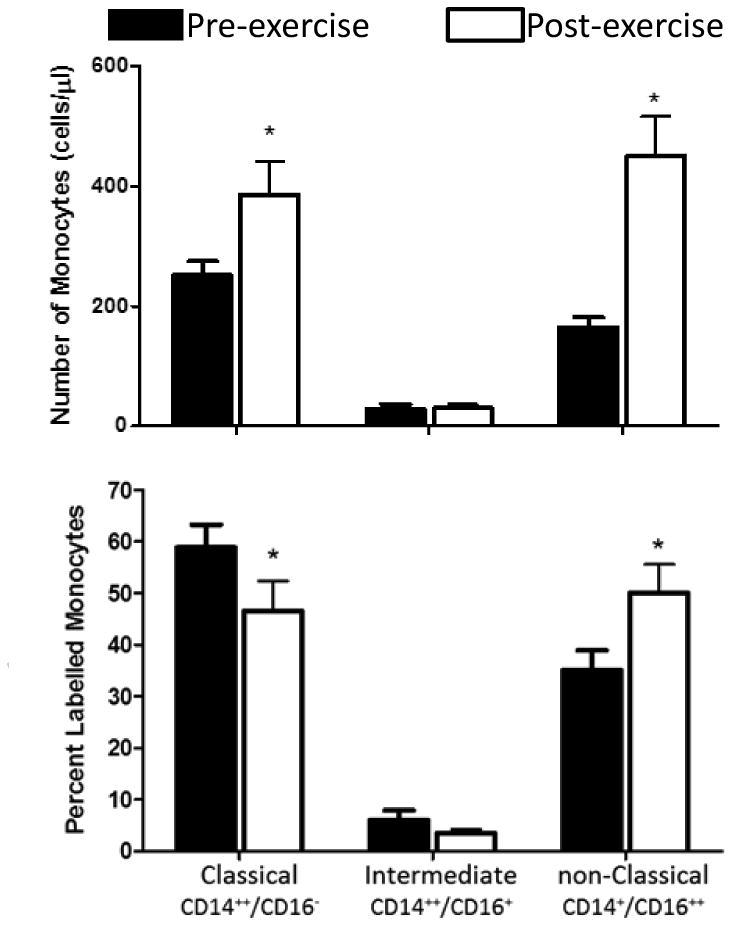
Physical activity can prevent and/or attenuate atherosclerosis, a disease clearly linked to inflammation. Paradoxically, even brief exercise induces a stress response and increases inflammatory cells like monocytes in the circulation. We hypothesized that exercise would regulate the expression of genes, gene pathways, and microRNAs in monocytes in a way that could limit pro-inflammatory function and drive monocytes to prevent, rather than contribute to, atherosclerosis. Twelve healthy men (22-30year old) performed ten 2-min bouts of cycle ergometer exercise at a constant work equivalent to an average of 82% of maximum O2 consumption interspersed with 1-min rest. Blood was drawn before and immediately after the exercise. Monocytes were isolated from peripheral blood mononuclear cells. Flow cytometry was used to identify monocyte subtypes. We used Affymetrix U133 + 2.0 arrays for gene expression and Agilent Human miRNA V2 Microarray for miRNAs. A stringent statistical approach (FDR <0.05) was used to determine that exercise significantly altered the expression of 894 annotated genes and 19 miRNAs. We found distinct gene alterations that were likely to direct monocytes in an anti-inflammatory, anti-atherogenic pathway, including the downregulation of monocyte TNF, TLR4, and CD36 genes and the upregulation of EREG and CXCR4. Exercise significantly altered a number of microRNAs that likely influence monocytes involvement in vascular health. Exercise leads to a novel genomic profile of circulating monocytes, which appears to promote cardiovascular health despite the overall stress response.
Keywords: Epigenetics; Exercise immunology; Gene array; Genomics; Immune system; Leukocytes.
Published by Elsevier Inc.
Figures
References
-
- Ahmed HM, Blaha MJ, Nasir K, Rivera JJ, Blumenthal RS. Effects of physical activity on cardiovascular disease. Am J Cardiol. 2012;109:288–295. - PubMed
-
- Berg KE, Ljungcrantz I, Andersson L, Bryngelsson C, Hedblad B, Fredrikson GN, Nilsson J, Bjorkbacka H. Elevated CD14++ Circ Cardiovasc Genet. 2012;5:122–131. - PubMed
-
- Berger S, Dyugovskaya L, Polyakov A, Lavie L. Short-term fibronectin treatment induces endothelial-like and angiogenic properties in monocyte-derived immature dendritic cells: involvement of intracellular VEGF and MAPK regulation. Eur J Cell Biol. 2012;91:640–653. - PubMed
-
- Bles N, Di PL, Boeynaems JM, Communi D. ATP confers tumorigenic properties to dendritic cells by inducing amphiregulin secretion. Blood. 2010;116:3219–3226. - PubMed
Publication types
MeSH terms
Substances
Grants and funding
LinkOut - more resources
Full Text Sources
Other Literature Sources
Medical
Molecular Biology Databases
