


Validity of US norms for the Bayley Scales of Infant Development-III in Malawian children
- PMID: 24423629
- PMCID: PMC4019333
- DOI: 10.1016/j.ejpn.2013.11.011
Validity of US norms for the Bayley Scales of Infant Development-III in Malawian children
Abstract
Objective: Most psychometric tests originate from Europe and North America and have not been validated in other populations. We assessed the validity of United States (US)-based norms for the Bayley Scales of Infant and Toddler Development-III (BSID-III), a neurodevelopmental tool developed for and commonly used in the US, in Malawian children.
Methods: We constructed BSID-III norms for cognitive, fine motor (FM), gross motor (GM), expressive communication (EC) and receptive communication (RC) subtests using 5173 tests scores in 167 healthy Malawian children. Norms were generated using Generalized Additive Models for location, scale and shape, with age modeled continuously. Standard z-scores were used to classify neurodevelopmental delay. Weighted kappa statistics were used to compare the classification of neurological development using US-based and Malawian norms.
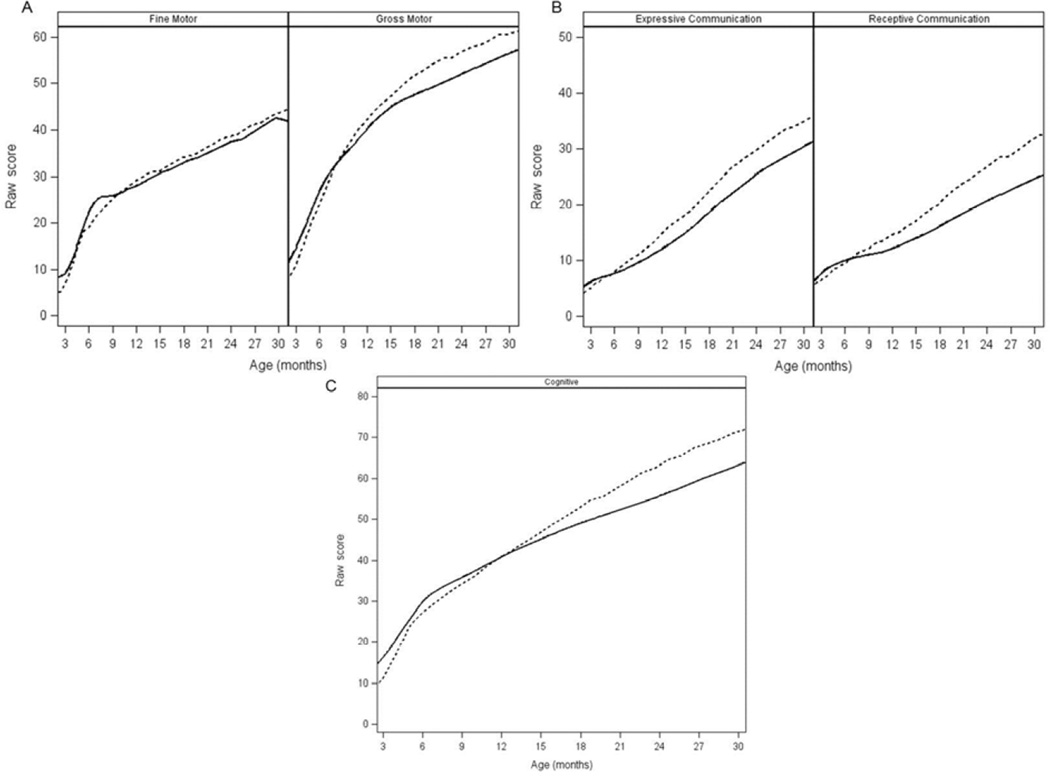
Results: For all subtests, the mean raw scores in Malawian children were higher than the US normative scores at younger ages (approximately <6 months) after which the mean curves crossed and the US normative mean exceeded that of the Malawian sample and the age at which the curves crossed differed by subtest. Weighted kappa statistics for agreement between US and Malawian norms were 0.45 for cognitive, 0.48 for FM, 0.57 for GM, 0.50 for EC, and 0.44 for RC.
Conclusion: We demonstrate that population reference curves for the BSID-III differ depending on the origin of the population. Reliance on US norm-based standardized scores resulted in misclassification of the neurological development of Malawian children, with the greatest potential for bias in the measurement of cognitive and language skills.
Keywords: Child development; Cross-cultural testing bias; Testing norms.
Copyright © 2013 European Paediatric Neurology Society. Published by Elsevier Ltd. All rights reserved.
Conflict of interest statement
Figures

References
-
- Grantham-McGregor S, Baker-Henningham H. Review of the evidence linking protein and energy to mental development. Public Health Nutrition. 2005;8(7A):1191–1201. - PubMed
-
- Le Doare K, Bland R, Newell ML. Neurodevelopment in children born to HIV-infected mothers by infection and treatment status. Pediatrics. 2012;130(5):e1326–e1344. - PubMed
-
- Grantham-McGregor SM, Ani CC. Undernutrition and mental development. Nestle Nutrition workshop series. Clinical & Performance Programme. 2001;5:1–14. discussion 14–18. - PubMed
Publication types
MeSH terms
Grants and funding
LinkOut - more resources
Full Text Sources
Other Literature Sources
Medical
