


Sociodemographic differences in fast food price sensitivity
- PMID: 24424384
- PMCID: PMC3963142
- DOI: 10.1001/jamainternmed.2013.13922
Sociodemographic differences in fast food price sensitivity
Abstract
Importance: Fiscal food policies (eg, taxation) are increasingly proposed to improve population-level health, but their impact on health disparities is unknown.
Objective: To estimate subgroup-specific effects of fast food price changes on fast food consumption and cardiometabolic outcomes.
Design, setting, and participants: Twenty-year follow-up (5 examinations) in a biracial US prospective cohort: Coronary Artery Risk Development in Young Adults (CARDIA) (1985/1986-2005/2006, baseline N = 5115). Participants were aged 18 to 30 years at baseline; design indicated equal recruitment by race (black vs white), educational attainment, age, and sex. Community-level price data from the Council for Community and Economic Research were temporally and geographically linked to study participants' home address at each examination.
Main outcomes and measures: Participant-reported number of fast food eating occasions per week, body mass index (BMI), and homeostasis model assessment insulin resistance (HOMA-IR) from fasting glucose and insulin concentrations. Covariates included individual-level and community-level social and demographic factors.
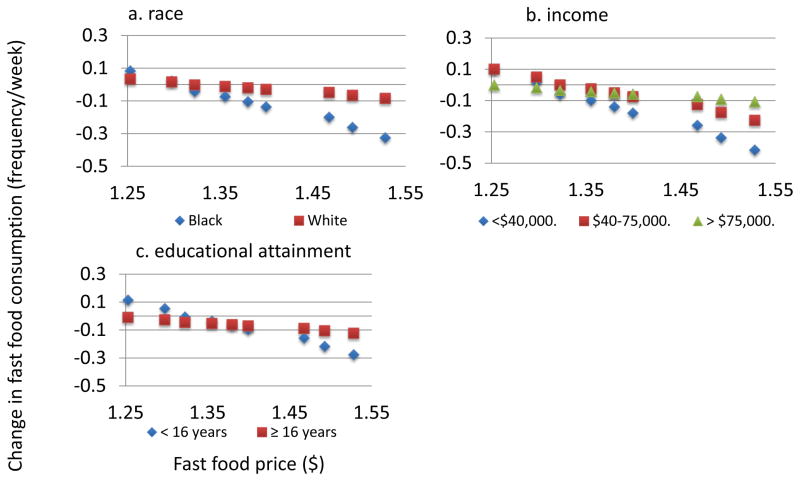
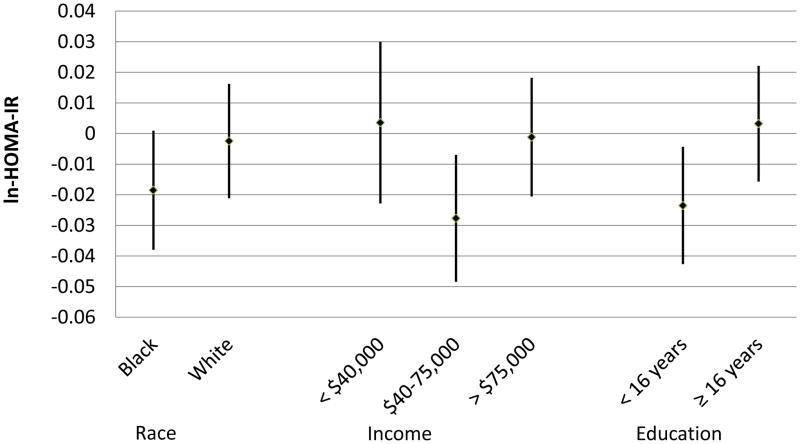
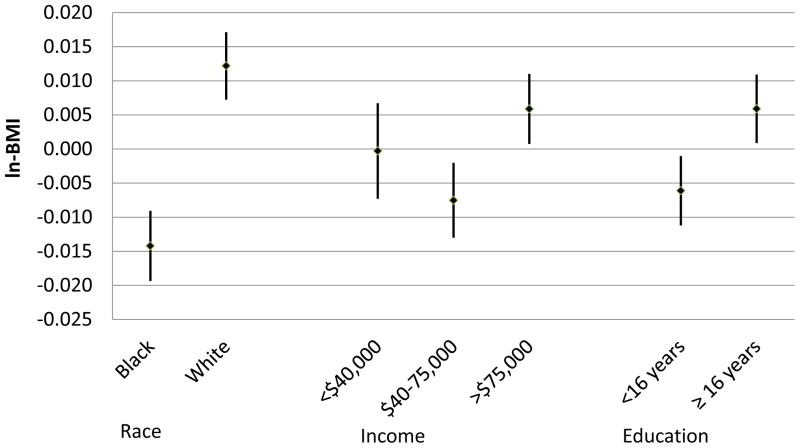
Results: In repeated measures regression analysis, multivariable-adjusted associations between fast food price and consumption were nonlinear (quadratic, P < .001), with significant inverse estimated effects on consumption at higher prices; estimates varied according to race (interaction P = .04), income (P = .07), and education (P = .03). At the 10th percentile of price ($1.25/serving), blacks and whites had mean fast food consumption frequency of 2.20 (95% CI, 2.07-2.33) and 1.55 (1.45-1.65) times/wk, respectively, whereas at the 90th percentile of price ($1.53/serving), respective mean consumption estimates were 1.86 (1.75-1.97) and 1.50 (1.41-1.59) times/wk. We observed differential price effects on HOMA-IR (inverse for lower educational status only [interaction P = .005] and at middle income only [interaction P = .02]) and BMI (inverse for blacks, less education, and middle income; positive for whites, more education, and high income [all interaction P < .001]).
Conclusions and relevance: We found greater fast food price sensitivity on fast food consumption and insulin resistance among sociodemographic groups that have a disproportionate burden of chronic disease. Our findings have implications for fiscal policy, particularly with respect to possible effects of fast food taxes among populations with diet-related health disparities.
Conflict of interest statement
The authors have no financial or other conflicts of interest to disclose.
Figures
Comment in
-
Why the cost of fast food matters.JAMA Intern Med. 2014 Mar;174(3):442. doi: 10.1001/jamainternmed.2013.13875. JAMA Intern Med. 2014. PMID: 24424285 No abstract available.
References
-
- Popkin B. The World is Fat--the Fads, Trends, Policies, and Products that are Fattening the Human Race. New York: Avery-Penguin Group; 2008.
Publication types
MeSH terms
Grants and funding
- AG0005/AG/NIA NIH HHS/United States
- HHSN268201300025C/HL/NHLBI NIH HHS/United States
- HHSN268201300027C/HL/NHLBI NIH HHS/United States
- R01 HL114091/HL/NHLBI NIH HHS/United States
- ImNIH/Intramural NIH HHS/United States
- R24HD050924/HD/NICHD NIH HHS/United States
- R01 HL104580/HL/NHLBI NIH HHS/United States
- HHSN268201300026C/HL/NHLBI NIH HHS/United States
- HHSN268200900041C/HL/NHLBI NIH HHS/United States
- HHSN268201300028C/HL/NHLBI NIH HHS/United States
- R24 HD050924/HD/NICHD NIH HHS/United States
- HHSN268201300029C/HL/NHLBI NIH HHS/United States
LinkOut - more resources
Full Text Sources
Other Literature Sources
Medical
