Review
. 2014 Sep;33(2-3):399-411.
doi: 10.1007/s10555-013-9471-3.

AR function in promoting metastatic prostate cancer

Affiliations
Review

AR function in promoting metastatic prostate cancer

Michael A Augello et al. Cancer Metastasis Rev. 2014 Sep.

Abstract

Prostate cancer (PCa) remains a leading cause of cancer-related death in the USA. While localized lesions are effectively treated through radical prostatectomy and/or radiation therapy, treatment for metastatic disease leverages the addiction of these tumors on the androgen receptor (AR) signaling axis for growth and disease progression. Though initially effective, tumors resistant to AR-directed therapeutics ultimately arise (a stage of the disease known as castration-resistant prostate cancer) and are responsible for PCa-specific mortality. Importantly, an abundance of clinical and preclinical evidence strongly implicates AR signaling cascades in the development of metastatic disease in both early and late stages, and thus a concerted effort has been made to delineate the AR-specific programs that facilitate progression to metastatic PCa. A multitude of downstream AR targets as well as critical AR cofactors have been identified which impinge upon both the AR pathway as well as associated metastatic phenotypes. This review will highlight the functional significance of these pathways to disseminated disease and define the molecular underpinnings behind these unique, AR-driven, metastatic signatures.


Figures
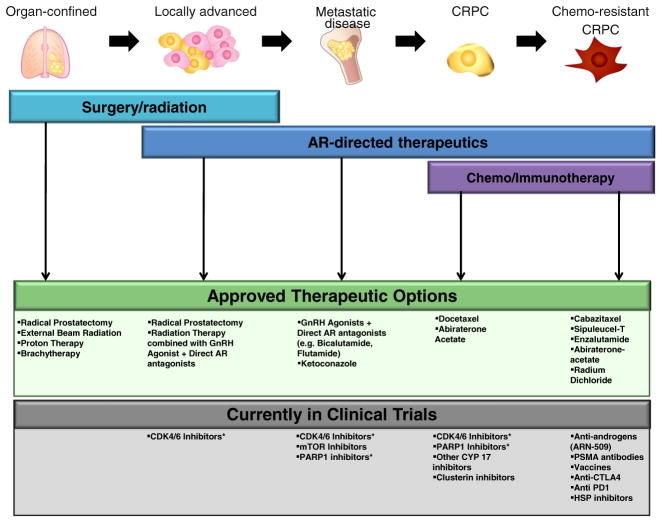
Fig. 1
Fig. 1
Therapeutic options for patients diagnosed with prostate cancer. Therapeutic options for localized PCa often involve surgery in combination with some form of radiation therapy. In contrast, advanced or metastatic disease leverages the requirement of androgens for tumor growth, utilizing systemic therapy to limit androgen production and directly inhibit AR activity. Once resistant to first-line hormonal therapy, options to limit tumor growth and progression are limited, and consist of second-line hormonal therapy or taxane-based chemotherapeutics. While there are several options which are providing benefit in the chemotherapy-resistant space, a number of clinical trials are currently ongoing which offer promise for earlier intervention to help thwart progression to lethal CRPC [, , , , –129]. Trials can be found online at www.clinicalrials.gov: trial #NCT01171898, NCT01414283, NCT01695044, NCT00694551, NCT00705835, NCT01804465, NCT00113984, NCT01420965, NCT01078662, NCT00471432, NCT01548807, and NCT01546987. *Clinical trials are currently in the planning stages at the University of Michigan and Thomas Jefferson University
Fig. 2
Fig. 2
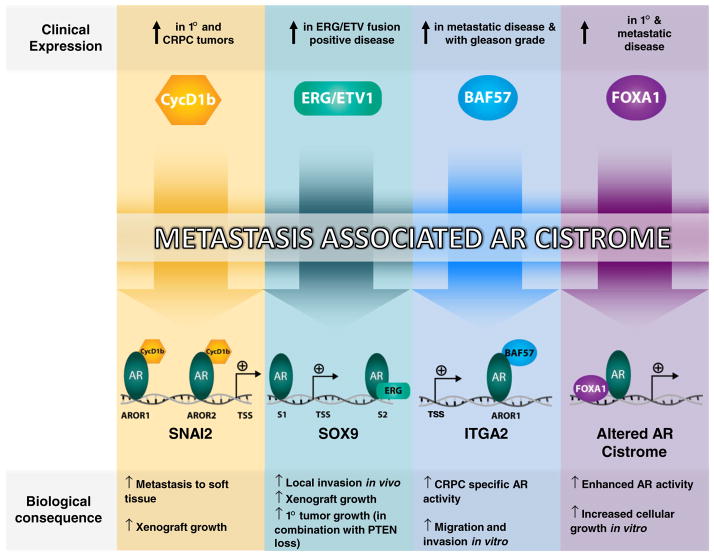
Cofactor-induced AR cistromes that promote metastatic phenotypes. A multitude of disease-associated AR cofactors have been identified in both primary and metastatic disease, which can impinge upon the AR cistrome to promote divergent AR binding events, culminating in transcriptional programs responsible for metastatic phenotypes. From left to right; (1) cyclin D1b co-occupied SNAI2 regulatory loci (Androgen Receptor Occupied Region 1—AROR1 and AROR2) with AR, promoting both AR occupancy and chromosomal looping, resulting in enhanced Slug expression and metastatic progression (Transcriptional Start Site—TSS) [94]; (2) in fusion-positive disease, ERG binding at a 3′ SOX9 enhancer region (site 2–S2) facilitates AR recruitment to this site, resulting in enhanced SOX9 expression and increased invasion and tumor growth in vivo [124]; (3) tumor-associated elevation of BAF57 levels promote AR occupancy within an intronic enhancer of the ITGA2 gene (AROR1) in a ligand-independent manner, recruiting necessary SWI/SNF subunits to promote ITGA2 transcription and facilitate invasive and migratory phenotypes in vitro [82]; (4) Elevated levels of FOXA1 localize to sites on chromatin and restrict the total number of AR binding events genome wide. AR binding events, in this context, are thus enriched for FOXA1 binding motifs, and are associated with tumor-specific programs of growth and survival [68]

References

    1. Siegel R, Naishadham D, Jemal A. Cancer statistics. CA A Cancer Journal for Clinicians. 2012;62:10–29. - PubMed
    1. Klein EA, Ciezki J, Kupelian PA, Mahadevan A. Outcomes for intermediate risk prostate cancer: are there advantages for surgery, external radiation, or brachytherapy? Urologic Oncology. 2009;27:67–71. - PubMed
    1. Klotz L. Combined androgen blockade: an update. The Urologic Clinics of North America. 2006;33:161–166. v–vi. - PubMed
    1. Knudsen KE, Scher HI. Starving the addiction: new opportunities for durable suppression of AR signaling in prostate cancer. Clinical Cancer Research. 2009;15:4792–4798. - PMC - PubMed
    1. Loblaw DA, Virgo KS, Nam R, et al. Initial hormonal management of androgen-sensitive metastatic, recurrent, or progressive prostate cancer: 2006 update of an American Society of Clinical Oncology practice guideline. Journal of Clinical Oncology. 2007;25:1596–1605. - PubMed

Substances