


Who needs laboratories and who needs statins?: comparative and cost-effectiveness analyses of non-laboratory-based, laboratory-based, and staged primary cardiovascular disease screening guidelines
- PMID: 24425701
- PMCID: PMC3971865
- DOI: 10.1161/CIRCOUTCOMES.113.000397
Who needs laboratories and who needs statins?: comparative and cost-effectiveness analyses of non-laboratory-based, laboratory-based, and staged primary cardiovascular disease screening guidelines
Abstract
Background: Early detection and treatment of cardiovascular disease (CVD) risk factors produces significant clinical benefits, but no consensus exists on optimal screening algorithms. This study aimed to evaluate the comparative and cost-effectiveness of staged laboratory-based and non-laboratory-based total CVD risk assessment.
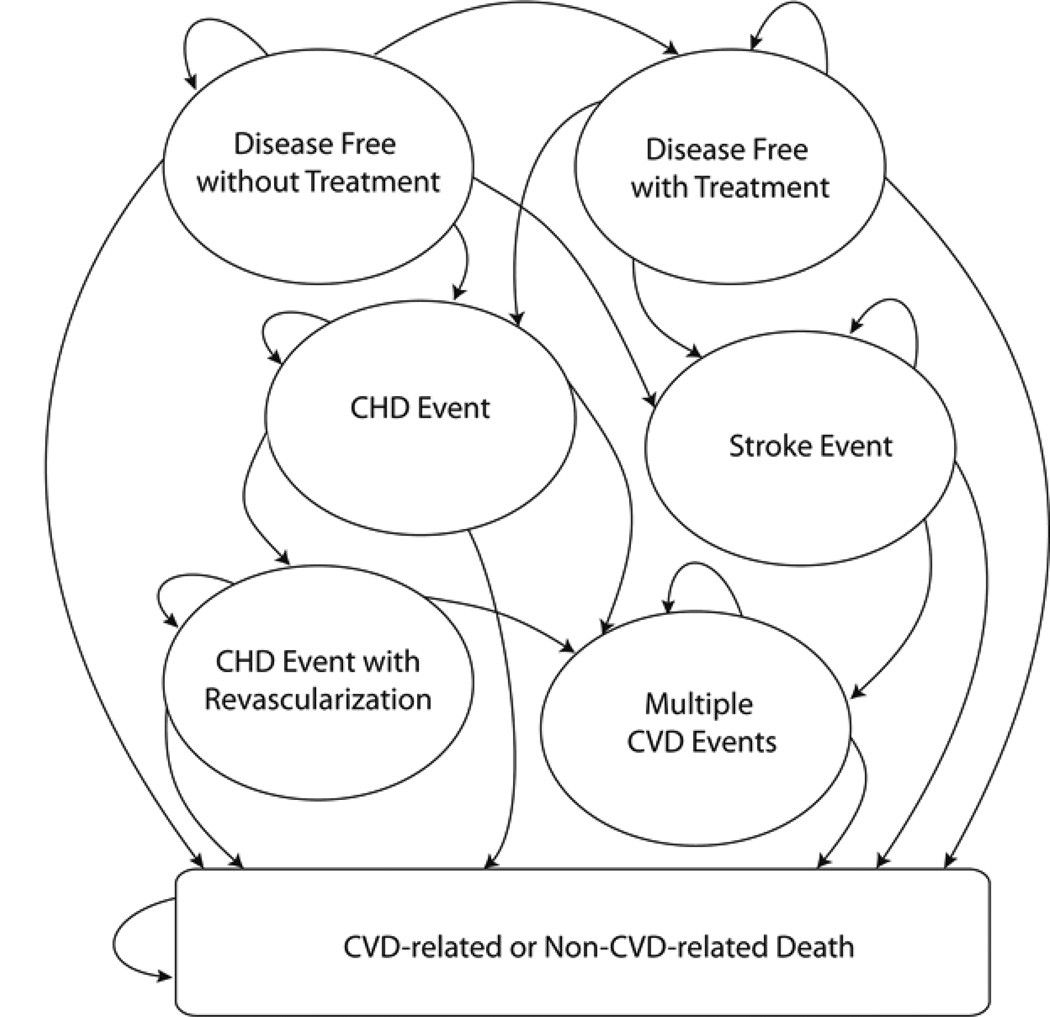
Methods and results: We used receiver operating characteristic curve and cost-effectiveness modeling methods to compare strategies with and without laboratory components and used single-stage and multistage algorithms, including approaches based on Framingham risk scores (laboratory-based assessments for all individuals). Analyses were conducted using data from 5998 adults in the Third National Health and Nutrition Examination Survey without history of CVD using 10-year CVD death as the main outcome. A microsimulation model projected lifetime costs, quality-adjusted life years (QALYs), and incremental cost-effectiveness ratios for 60 Framingham-based, non-laboratory-based, and staged screening approaches. Across strategies, the area under the receiver operating characteristic curve was 0.774 to 0.780 in men and 0.812 to 0.834 in women. There were no statistically significant differences in area under the receiver operating characteristic curve between multistage and Framingham-based approaches. In cost-effectiveness analyses, multistage strategies had incremental cost-effectiveness ratios of $52,000/QALY and $83,000/QALY for men and women, respectively. Single-stage/Framingham-based strategies were dominated (higher cost and lower QALYs) or had unattractive incremental cost-effectiveness ratios (>$300,000/QALY) compared with single-stage/non-laboratory-based and multistage approaches.
Conclusions: Non-laboratory-based CVD risk assessment can be useful in primary CVD prevention as a substitute for laboratory-based assessments or as the initial component of a multistage approach. Cost-effective multistage screening strategies could avoid 25% to 75% of laboratory testing used in CVD risk screening with predictive power comparable with Framingham risks.
Keywords: diagnosis; economics; primary prevention.
Conflict of interest statement
Figures



References
-
- Mosca L. Guidelines for prevention of cardiovascular disease in women: A summary of recommendations. Prev Cardiol. 2007;10(Suppl 4):19–25. - PubMed
-
- Graham I, Atar D, Borch-Johnsen K, Boysen G, Burell G, Cifkova R, Dallongeville J, De Backer G, Ebrahim S, Gjelsvik B, Herrmann-Lingen C, Hoes A, Humphries S, Knapton M, Perk J, Priori SG, Pyorala K, Reiner Z, Ruilope L, Sans-Menendez S, Op Reimer WS, Weissberg P, Wood D, Yarnell J, Zamorano JL, Walma E, Fitzgerald T, Cooney MT, Dudina A, Vahanian A, Camm J, De Caterina R, Dean V, Dickstein K, Funck-Brentano C, Filippatos G, Hellemans I, Kristensen SD, McGregor K, Sechtem U, Silber S, Tendera M, Widimsky P, Altiner A, Bonora E, Durrington PN, Fagard R, Giampaoli S, Hemingway H, Hakansson J, Kjeldsen SE, Larsen L, Mancia G, Manolis AJ, Orth-Gomer K, Pedersen T, Rayner M, Ryden L, Sammut M, Schneiderman N, Stalenhoef AF, Tokgozoglu L, Wiklund O, Zampelas A. European guidelines on cardiovascular disease prevention in clinical practice: Full text. Fourth joint task force of the european society of cardiology and other societies on cardiovascular disease prevention in clinical practice (constituted by representatives of nine societies and by invited experts) Eur J Cardiovasc Prev Rehabil. 2007;14(Suppl 2):S1–S113. - PubMed
Publication types
MeSH terms
Substances
Grants and funding
LinkOut - more resources
Full Text Sources
Other Literature Sources
Medical
