Antiemetic efficacy of capsicum plaster on acupuncture points in patients undergoing thyroid operation
- PMID: 24427460
- PMCID: PMC3888847
- DOI: 10.4097/kjae.2013.65.6.539
Antiemetic efficacy of capsicum plaster on acupuncture points in patients undergoing thyroid operation
Abstract
Background: Postoperative nausea and vomiting (PONV) occurs in up to 63-84% of patients after thyroid surgery. This study aims to assess the effects of using a capsicum plaster to reduce PONV after thyroid surgery at either the Chinese acupuncture point (acupoint) Pericardium 6 (P6) or Korean hand acupuncture point K-D2.
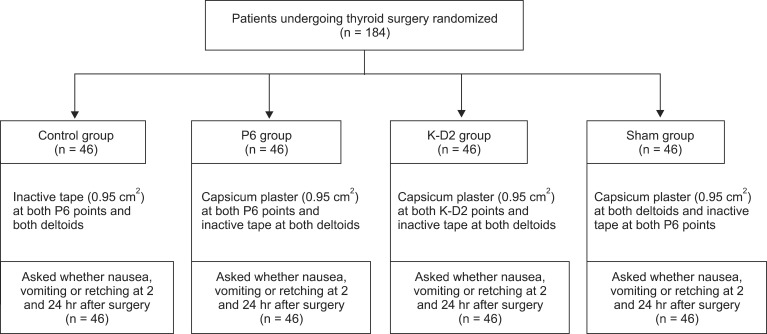
Methods: One-hundred eighty-four patients who underwent thyroid surgery were randomized in four groups (n = 46 each): control group = inactive tape at P6 acupoints and on both shoulders as a nonacupoint; P6 group = capsicum plaster at P6 points and inactive tape on both shoulders; K-D2 group = capsicum plaster at K-D2 acupoints and inactive tape on both shoulders; Sham group = capsicum plaster on both shoulders and inactive tape at P6 acupoints. The capsicum plaster was applied before the induction of anesthesia and removed at 8 hr after surgery.
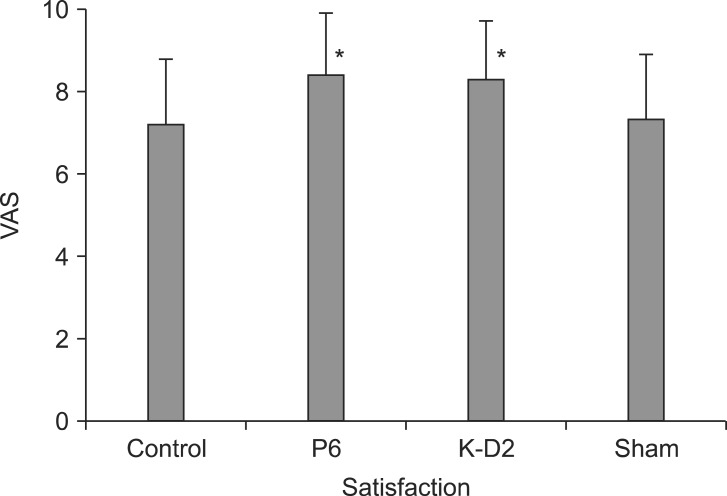
Results: The incidence and severity of nausea and vomiting and the need for rescue antiemetics were decreased in the patients in the P6 and K-D2 groups compared to the patients in the control and sham groups (P < 0.001). The patients in the P6 and K-D2 groups also reported that they were more satisfied (P < 0.05).
Conclusions: We conclude that the capsicum plaster at the P6 and K-D2 acupoint was a promising antiemetic method for the patients undergoing thyroid surgery.
Keywords: Acupuncture; Capsaicin; Nausea and vomiting; Thyroid surgery.
Figures


References
-
- Macario A, Weinger M, Camey S, Kim A. Which clinical anaesthesia outcomes are important to avoid? The perspective of patients. Anesth Analg. 1999;89:652–658. - PubMed
-
- Kerger H, Turan A, Kredel M, Stuckert U, Alsip N, Gan TJ, et al. Patients' willingness to pay for antiemetic treatment. Acta Anaesthesiol Scand. 2007;51:38–43. - PubMed
-
- Ewalenko P, Janny S, Dejonckheere M, Andry G, Wyns C. Antiemetic effect of subhypnotic doses of propofol after thyroidectomy. Br J Anaesth. 1996;77:463–467. - PubMed
-
- Sonner JM, Hynson JM, Clark O, Katz JA. Nausea and vomiting following thyroid and parathyroid surgery. J Clin Anesth. 1997;9:398–402. - PubMed
LinkOut - more resources
Full Text Sources
Other Literature Sources
Research Materials