. 2014 Apr;11(2):85-97.
doi: 10.1089/zeb.2013.0937. Epub 2014 Jan 15.

Enhanced cell-specific ablation in zebrafish using a triple mutant of Escherichia coli nitroreductase

Affiliations

Enhanced cell-specific ablation in zebrafish using a triple mutant of Escherichia coli nitroreductase

Jonathan R Mathias et al. Zebrafish. 2014 Apr.

Abstract

Transgenic expression of bacterial nitroreductase (NTR) facilitates chemically-inducible targeted cell ablation. In zebrafish, the NTR system enables studies of cell function and cellular regeneration. Metronidazole (MTZ) has become the most commonly used prodrug substrate for eliciting cell loss in NTR-expressing transgenic zebrafish due to the cell-specific nature of its cytotoxic derivatives. Unfortunately, MTZ treatments required for effective cell ablation border toxic effects, and, thus, likely incur undesirable nonspecific effects. Here, we tested whether a triple mutant variant of NTR, previously shown to display improved activity in bacterial assays, can solve this issue by promoting cell ablation in zebrafish using reduced prodrug treatment regimens. We generated several complementary transgenic zebrafish lines expressing either wild-type or mutant NTR (mutNTR) in specific neural cell types, and assayed prodrug-induced cell ablation kinetics using confocal time series imaging and plate reader-based quantification of fluorescent reporters expressed in targeted cell types. The results show that cell ablation can be achieved in mutNTR expressing transgenic lines with markedly shortened prodrug exposure times and/or at lower prodrug concentrations. The mutNTR variant characterized here can circumvent problematic nonspecific/toxic effects arising from low prodrug conversion efficiency, thus increasing the effectiveness and versatility of this selective cell ablation methodology.


Figures
<b>FIG. 1.</b>
FIG. 1.
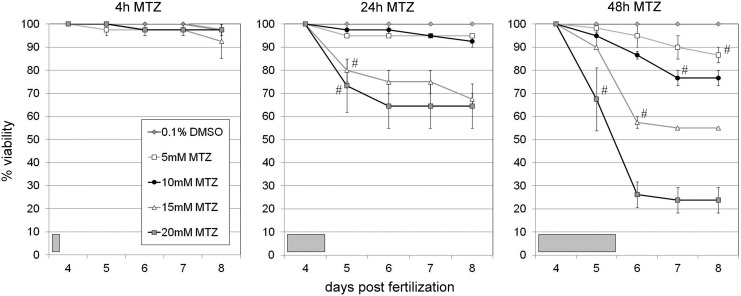
MTZ-induced toxicity/lethality. Wild-type (nontransgenic) larvae were treated at 4 dpf with the indicated concentrations of MTZ for 4, 24, or 48 h (shaded boxes, lower left). The number of viable fish was counted each day through 8 dpf; the percent of viable fish for each day is shown. Data are averages from two to three trials; error bars are SEM. Data were analyzed by chi-square analysis: no significant differences (χ2>0.05) were evident between conditions after 4 h treatments (left panel); # marks the first data point in each data series that is significantly different (χ2≤0.05) from corresponding untreated control data points (0.1% DMSO), with all subsequent data points in each series also being significantly different; all other data points are not significantly different from untreated controls. DMSO, dimethyl sulfoxide; dpf, days postfertilization; MTZ, metronidazole.
<b>FIG. 2.</b>
FIG. 2.
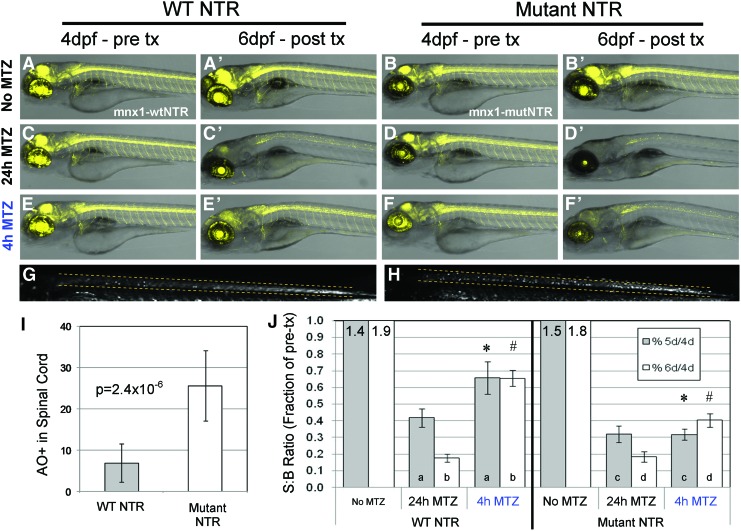
Improved MTZ-induced ablation of spinal motor neurons by mutNTR. (A–F’) Comparison of ablation efficiency between complementary wtNTR (A, C, E: mnx1:wtNTR line) and mutNTR (B, D, F: mnx1:mutNTR line) expressing transgenic lines using confocal time series imaging. Pretreatment images of labeled spinal motor neuron and uncharacterized brain neuron subpopulations were captured at 4 dpf (A–F), post-treatment images at 6 dpf, thus at ≥1 day after the indicated MTZ treatments (A’–F’). (A, A’, B, B’) Control larvae treated in 0.1% DMSO for 24 h yielded no decrease in YFP expression. (C, C’, D, D’) Larvae treated in 10 mM MTZ for 24 h (with 1 day of recovery) yielded a loss of fluorescence in labeled cell types, demonstrating that both NTR types are competent to induce ablation under these conditions. (E, E’, F, F’) Larvae treated in 10 mM MTZ for 4 h showed little, if any, effect on spinal motor neurons expressing wtNTR (E, E’). In contrast, appreciable ablation of labeled cells was evident in mutNTR expressing fish (F, F’). (G, H) Acridine Orange labeling of apoptotic cells after 4 h of MTZ and 6 h of recovery, spinal cord regions labeled by dashed lines; (G) mnx1:wtNTR, (H) mnx1:mutNTR showed increased numbers of dying cells (bright dots) in mutNTR expressing larvae. (I) Quantification of Acridine Orange-labeled apoptotic cells in spinal cord regions after 4 h of MTZ or vehicle control, and 6 h recovery. (J) Quantification of TagYFP fluorescence by plate reader after MTZ treatment of mnx1:wtNTR and mnx1:mutNTR lines; S:B ratios were calculated from individual larvae at 4 dpf (pretreatment), 5 dpf and 6 dpf, then plotted as the fraction of individual pretreatment values. Data were analyzed by Student's t-tests: all MTZ-treated samples yielded significant differences (p≤0.05) when compared with corresponding untreated (No MTZ) controls, and there was no significant difference between wild-type and mutant 24 h MTZ treatment data at 6 days, or mutant 4 h MTZ data at 5 and 6 days; p-values between data pairs: *=3.4×10⁻³, #=3.8×10⁻⁴, a,b,d ≤0.05, c>0.05. All error bars denote SEM. NTR, nitroreductase; mutNTR, mutant NTR; S:B, signal to background; wtNTR, wild-type NTR. Color images available online at www.liebertpub.com/zeb
<b>FIG. 3.</b>
FIG. 3.
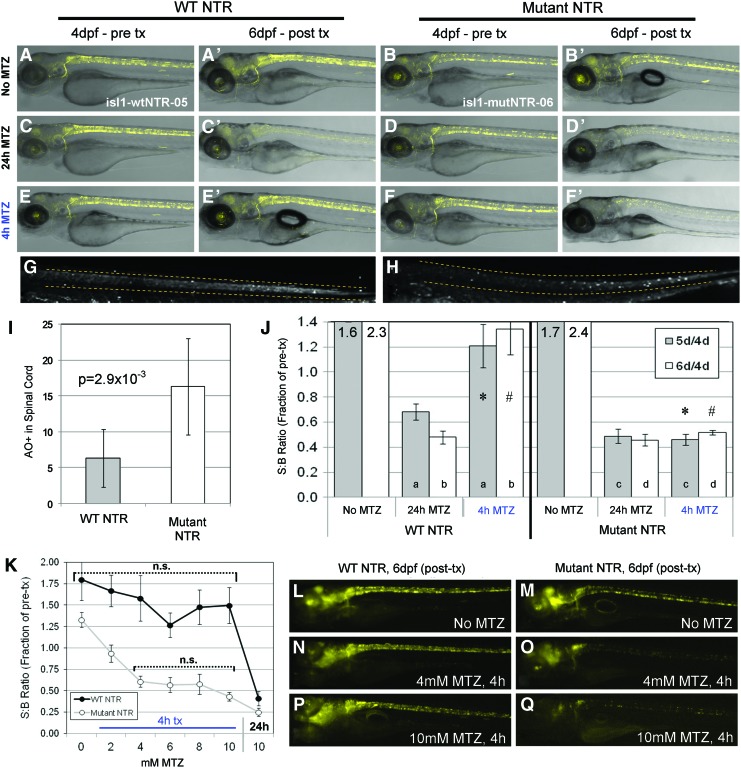
Improved MTZ-induced ablation of interneurons by mutNTR. (A–F’) Comparison of ablation efficiency between complementary wtNTR (A, C, E: isl1-wtNTR-05 line) and mutNTR (B, D, F: isl1-mutNTR-06 line) expressing transgenic lines using confocal time series imaging. Pretreatment images of labeled spinal interneuron subpopulations were captured at 4 dpf (A–F) and at 6 dpf, following the indicated MTZ treatments (A’–F’). (A, A’, B, B’) Control larvae exposed to 0.1% DMSO for 24 h showed no decreases in YFP expression. (C, C’, D, D’) Larvae treated with 10 mM MTZ for 24 h (with 1 day of recovery) yielded a loss of fluorescence in labeled cell types, again demonstrating that both NTR types are competent to induce ablation under these conditions. (E, E’, F, F’) Larvae treated with 10 mM MTZ for 4 h revealed little to no effect on labeled interneurons expressing wtNTR (E, E’); however, ablation of mutNTR expressing interneurons (F, F’) occurred equivalently to 24 h MTZ-treated larvae (compare C’ and D’ with F’). (G, H) Acridine Orange labeling of apoptotic cells after 4 h MTZ exposure and 24 h of recovery, spinal cord regions indicated by dashed lines; (G) isl1-wtNTR-05, (H) isl1-mutNTR-06. (I) Quantification of Acridine Orange labeled apoptotic cells. (J) Quantification of TagYFP fluorescence by plate reader after MTZ treatment of isl1-wtNTR-05 and isl1-mutNTR-06 lines; S:B ratios were calculated from individual larvae at 4 dpf (pretreatment), 5 dpf and 6 dpf, then plotted as the fraction of individual pretreatment values. Data were analyzed by Student's t-tests: All MTZ-treated samples yielded significant (p≤0.05) differences when compared with corresponding untreated (No MTZ) controls, and there was no significant difference between wild-type and mutant 24 h MTZ treatment data at 6 days; p-values between data pairs: *=3.2×10⁻⁴, #=4.9×10⁻⁴, a,b≤0.05, c,d>0.05. (K) Quantification of TagYFP fluorescence by plate reader (as in panel J) after MTZ titration; S:B ratios were plotted as the fraction of post-treatment (6 dpf) over pretreatment (4 dpf) values, at indicated MTZ concentrations. Data were analyzed by Student's t-tests: all 4 h treatment data points between wtNTR and mutNTR were significantly different; within wild-type and mutant datasets, data points that are not significantly (n.s.) different from the 4 h/10 mM MTZ treatment data are indicated with brackets. (L–Q) Representative images of 6 dpf larvae after the plate reader assay in panel (K). (L, N, P) isl1-wtNTR-05, (M, O, Q) isl1-mutNTR-06; (L, M) No MTZ, (N, O) treated 4 h with 4 mM MTZ, (P, Q) treated 4 h with 10 mM MTZ. All error bars denote SEM. Color images available online at www.liebertpub.com/zeb
<b>FIG. 4.</b>
FIG. 4.
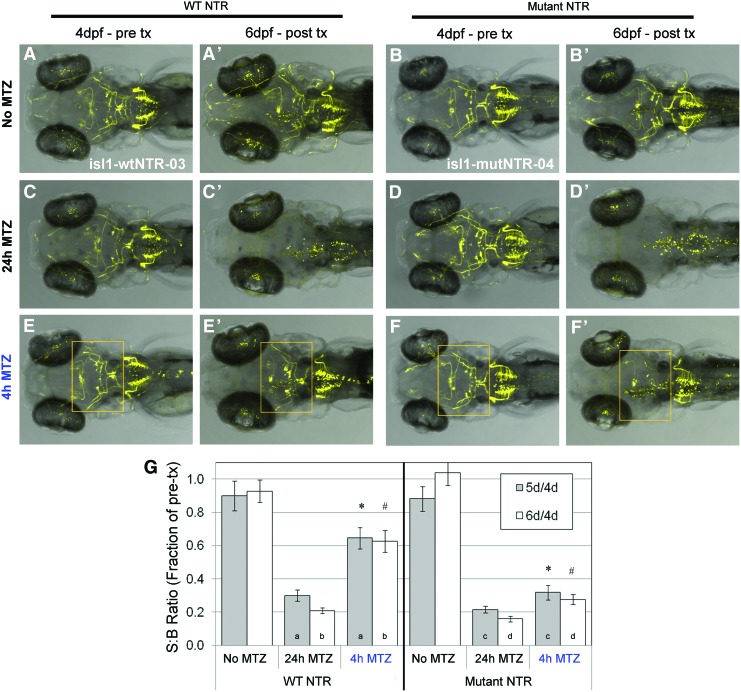
Improved MTZ-induced ablation of cranial motor neurons by mutNTR. (A–F’) Comparison of ablation efficiency between complementary wtNTR (A, C, E: isl1-wtNTR-03 line) and mutNTR (B, D, F: isl1-mutNTR-04 line) expressing transgenic lines by confocal time series imaging. Pretreatment images of cranial motor neuron subpopulations in individual larvae were captured at 4 dpf (A–F) and at 6 dpf, after MTZ treatment (A’–F’). (A, A’, B, B’) Control larvae treated with 0.1% DMSO for 24 h yielded no decrease in YFP expression. (C, C’, D, D’) Larvae treated with 10 mM MTZ for 24 h (with 1 day of recovery) showed a loss of fluorescence in labeled cell types, demonstrating that both NTR types are competent to induce ablation under these conditions. (E, E’, F, F’) Larvae exposed to 10 mM MTZ for 4 h revealed little to no effect on labeled motor neurons expressing wtNTR (E, E’); in contrast, this treatment induces ablation of a subset of neurons expressing mutNTR (F, F’; orange boxes). (G) Quantification of TagYFP fluorescence by plate reader after MTZ treatment of isl1-wtNTR-03 and isl1-mutNTR-04 lines; S:B ratios were calculated from individual larvae at 4 dpf (pretreatment), 5 dpf and 6 dpf, then plotted as the fraction of individual pretreatment values. Data were analyzed by Student's t-tests: All MTZ-treated samples yielded significant (p≤0.05) differences when compared with corresponding untreated (No MTZ) controls, and there was no significant difference between wild-type and mutant 24 h MTZ treatment data at 6 days; p-values between data pairs: *=3.9×10⁻⁴, #=8.6×10⁻⁵, a,b,c,d<0.05. All error bars denote SEM. Color images available online at www.liebertpub.com/zeb
<b>FIG. 5.</b>
FIG. 5.
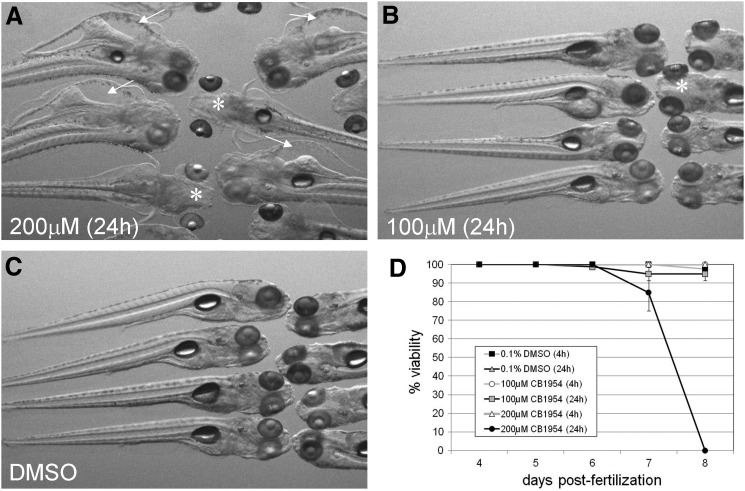
CB1954 treatment induces morphological defects and lethality. (A–C) Images of wild-type larvae treated for 24 h in 200 μM CB1954 (A), 100 μM CB1954 (B), or DMSO control (C). Larvae were treated from 4 to 5 dpf, then imaged at 6 dpf (i.e., after 1 day of recovery). Arrows indicate edema, and asterisks indicate hydrocephalus. (D) CB1954-induced toxicity/lethality: Wild-type larvae at 4 dpf were treated in the indicated concentrations of CB1954 for 4 or 24 h. The number of viable fish was counted each day during and after treatment (for approximately 8 dpf); the percent of viable fish at each time point is plotted. Data are averages from two to three trials; error bars denote SEM.
<b>FIG. 6.</b>
FIG. 6.
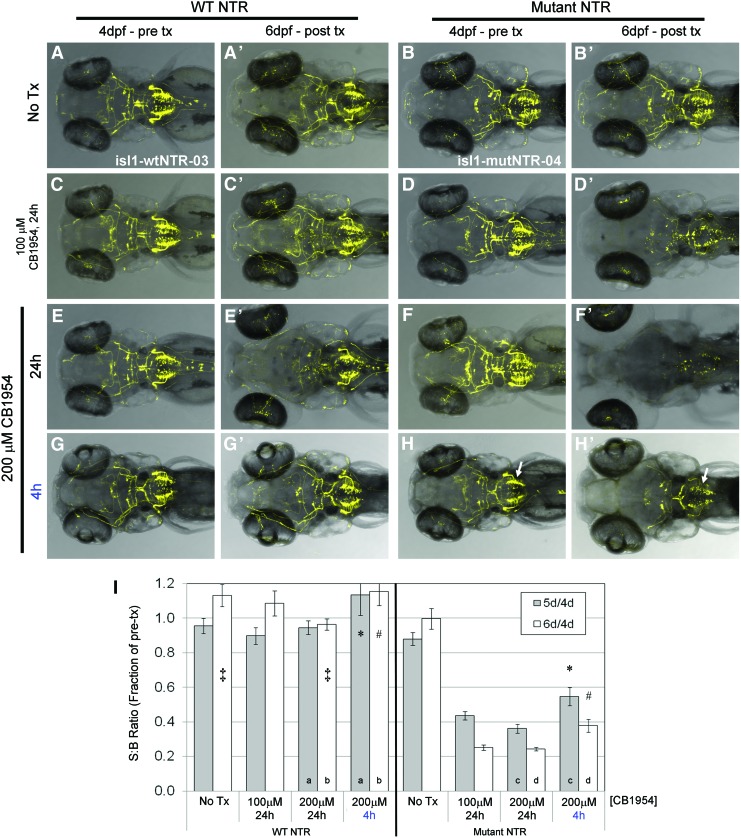
Improved CB1954-induced ablation of cranial motor neurons by mutNTR. (A–H’) Comparison of ablation efficiency between complementary wtNTR (A, C, E, G: isl1-wtNTR-03 line) and mutNTR (B, D, F, H: isl1-mutNTR-04 line) expressing transgenic lines by confocal time series imaging. Pretreatment images of cranial motor neuron subpopulations in individual larvae were captured at 4 dpf (A–H) and at 6 dpf (A’–H’), after indicated CB1954 treatments. (A, A’, B, B’) Control larvae treated in DMSO showed no decrease in YFP expression. (C, C’, D, D’) Larvae exposed to 100 μM MTZ for 24 h (with 1 day of recovery) revealed little effect on wtNTR cells (C, C’), while numbers of mutNTR expressing cells were clearly reduced (D, D’). (E, E’, F, F’) Larvae treated with 200 μM MTZ for 24 h (with 1 day of recovery) showed morphological defects in both lines (hydrocephalus in E’ and F’), while interestingly, wtNTR expressing neurons were largely unaffected (E, E’) and near total ablation of labeled motor neurons expressing mutNTR was evident (F, F’). (G, G’, H, H’) Larvae treated with 200 μM MTZ for 4 h, which does not cause morphological defects in either line (G’, H’), yielded no appreciable loss of wtNTR cells (G, G’) and partial ablation of mutNTR cells (H, H’; arrows indicate “group X” neurons). (I) Quantification of TagYFP fluorescence by plate reader after MTZ treatment of isl1-wtNTR-03 and isl1-mutNTR-04 lines; S:B ratios were calculated from individual larvae at 4 dpf (pretreatment), 5 dpf, and 6 dpf, then plotted as the fraction of individual pretreatment values. Data were analyzed by Student's t-tests: wtNTR, CB1954-treated samples yielded no significant differences (p>0.05) to corresponding untreated controls (No Tx) except where indicated (=0.03); for mutNTR, all CB1954-treated samples were significantly different from corresponding untreated controls; p-values between data pairs: *=1.5×10⁻⁴, #=1.6×10⁻⁸, a>0.05, b,c,d ≤0.05. All error bars denote SEM. Color images available online at www.liebertpub.com/zeb

References

    1. White DT, Mumm JS. The nitroreductase system of inducible targeted ablation facilitates cell-specific regenerative studies in zebrafish. Methods 2013;62:232–240 - PMC - PubMed
    1. Curado S, Stainier DYR, Anderson RM. Nitroreductase-mediated cell/tissue ablation in zebrafish: a spatially and temporally controlled ablation method with applications in developmental and regeneration studies. Nat Protoc 2008;3:948–954 - PMC - PubMed
    1. Mackenzie SM, Raible DW. Proliferative regeneration of zebrafish lateral line hair cells after different ototoxic insults. PLoS One 2012;7:e47257. - PMC - PubMed
    1. Zenno S, Koike H, Tanokura M, Saigo K. Gene cloning, purification, and characterization of NfsB, a minor oxygen-insensitive nitroreductase from Escherichia coli, similar in biochemical properties to FRase I, the major flavin reductase in Vibrio fischeri. J Biochem 1996;120:736–744 - PubMed
    1. Bridgewater JA, Springer CJ, Knox RJ, Minton NP, Michael NP, Collins MK. Expression of the bacterial nitroreductase enzyme in mammalian cells renders them selectively sensitive to killing by the prodrug CB1954. Eur J Cancer 1995;31A:2362–2370 - PubMed

MeSH terms

LinkOut - more resources