


Diabetes-causing gene, kruppel-like factor 11, modulates the antinociceptive response of chronic ethanol intake
- PMID: 24428663
- PMCID: PMC5567722
- DOI: 10.1111/acer.12258
Diabetes-causing gene, kruppel-like factor 11, modulates the antinociceptive response of chronic ethanol intake
Abstract
Background: Alcohol (EtOH [ethanol]) is an antinociceptive agent, working in part, by reducing sensitivity to painful stimuli. The transcription factor Kruppel-like factor 11 (KLF11), a human diabetes-causing gene that also regulates the neurotransmitter metabolic enzymes monoamine oxidase (MAO), has recently been identified as an EtOH-inducible gene. However, its role in antinociception remains unknown. Consequently, we investigated the function of KLF11 in chronic EtOH-induced antinociception using a genetically engineered knockout mouse model.
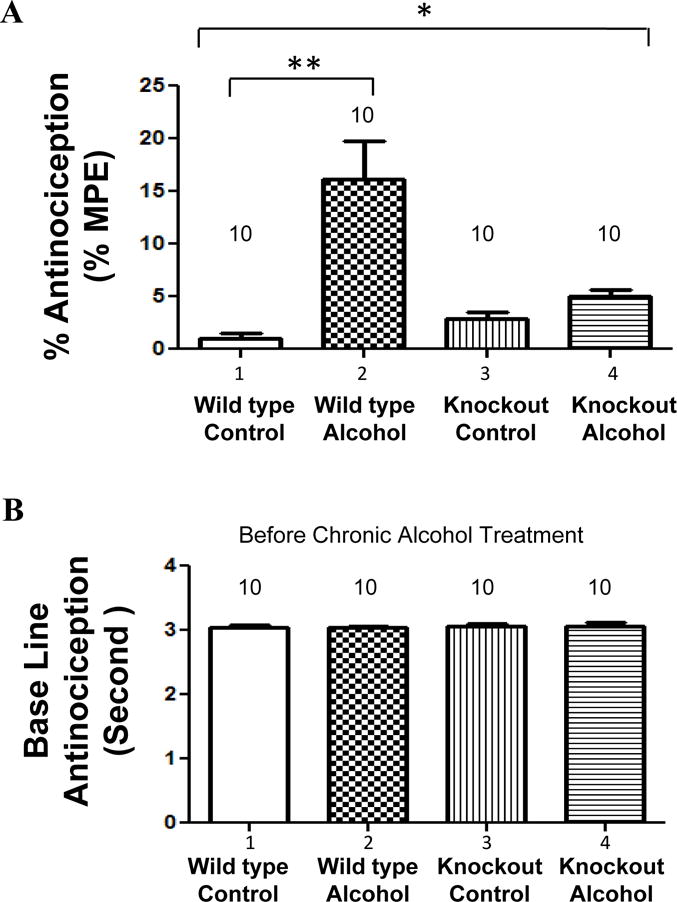
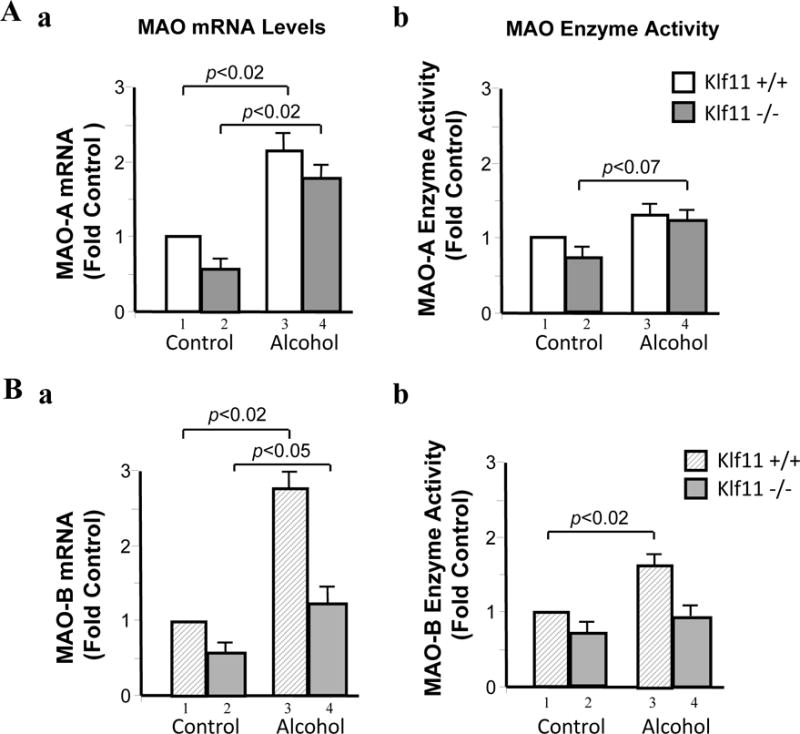
Methods: Wild-type (Klf11(+/+) ) and KLF11 knockout (Klf11(-/-) ) mice were fed a liquid diet containing EtOH for 28 days with increasing amounts of EtOH from 0% up to a final concentration of 6.4%, representing a final diet containing 36% of calories primarily from EtOH. Control mice from both genotypes were fed liquid diet without EtOH for 28 days. The EtOH-induced antinociceptive effect was determined using the tail-flick test before and after EtOH exposure (on day 29). In addition, the enzyme activity and mRNA levels of MAO A and MAO B were measured by real-time RT-PCR and enzyme assays, respectively.
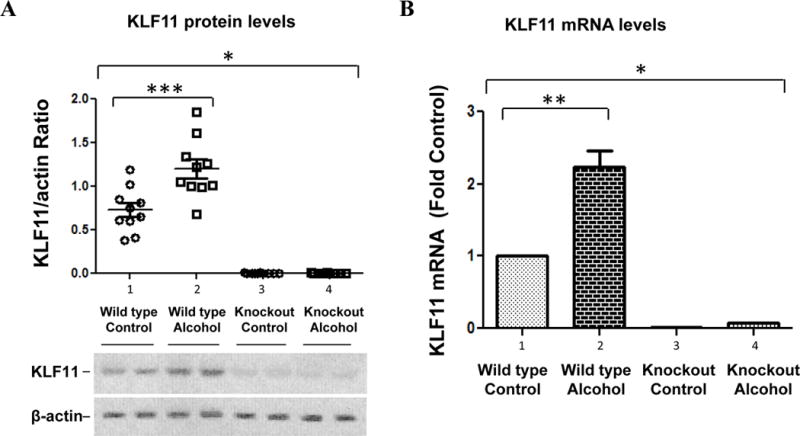
Results: EtOH produced an antinociceptive response to thermal pain in Klf11(+/+) mice, as expected. In contrast, deletion of KLF11 in the Klf11(-/-) mice abolished the EtOH-induced antinociceptive effect. The mRNA and protein levels of KLF11 were significantly increased in the brain prefrontal cortex of Klf11(+/+) mice exposed to EtOH compared with control Klf11(+/+) mice. Furthermore, MAO enzyme activities were affected differently in Klf11 wild-type versus Klf11 knockout mice exposed to chronic EtOH. Chronic EtOH intake significantly increased MAO B activity in Klf11(+/+) mice.
Conclusions: The data show KLF11 modulation of EtOH-induced antinociception. The KLF11-targeted MAO B enzyme may contribute more significantly to EtOH-induced antinociception. Thus, this study revealed a new role for the KLF11 gene in the mechanisms underlying the antinociceptive effects of chronic EtOH exposure.
Keywords: Antinociceptive Response; Chronic Ethanol Intake; Gene Knockout; Kruppel-Like Factor 11 (Transforming Growth Factor-Beta-Inducible Early Gene 2); Mice; Monoamine Oxidase.
Copyright © 2013 by the Research Society on Alcoholism.
Figures
References
-
- Bonnefond A, Lomberk G, Buttar N, Busiah K, Vaillant E, Lobbens S, Yengo L, Dechaume A, Mignot B, Simon A, Scharfmann R, Neve B, Tanyolac S, Hodoglugil U, Pattou F, Cave H, Iovanna J, Stein R, Polak M, Vaxillaire M, Froguel P, Urrutia R. Disruption of a novel Kruppel-like transcription factor p300-regulated pathway for insulin biosynthesis revealed by studies of the c.-331 INS mutation found in neonatal diabetes mellitus. J Biol Chem. 2011;286:28414–24. - PMC - PubMed
-
- Brennan PL, Schutte KK, Moos RH. Pain and use of alcohol to manage pain: prevalence and 3-year outcomes among older problem and non-problem drinkers. Addiction. 2005;100:777–86. - PubMed
-
- Brunner HG, Nelen M, Breakefield XO, Ropers HH, van Oost BA. Abnormal behavior associated with a point mutation in the structural gene for monoamine oxidase A. Science. 1993;262:578–80. - PubMed
-
- Campbell VC, Taylor RE, Tizabi Y. Antinociceptive effects of alcohol and nicotine: involvement of the opioid system. Brain Res. 2006;1097:71–7. - PubMed
Publication types
MeSH terms
Substances
Grants and funding
LinkOut - more resources
Full Text Sources
Other Literature Sources
Medical
Molecular Biology Databases
