. 2014 Nov;16(11):3398-415.
doi: 10.1111/1462-2920.12388. Epub 2014 Feb 26.

Microscale sulfur cycling in the phototrophic pink berry consortia of the Sippewissett Salt Marsh

Affiliations
Free PMC article

Microscale sulfur cycling in the phototrophic pink berry consortia of the Sippewissett Salt Marsh

Elizabeth G Wilbanks et al. Environ Microbiol. 2014 Nov.
Free PMC article

Abstract

Microbial metabolism is the engine that drives global biogeochemical cycles, yet many key transformations are carried out by microbial consortia over short spatiotemporal scales that elude detection by traditional analytical approaches. We investigate syntrophic sulfur cycling in the 'pink berry' consortia of the Sippewissett Salt Marsh through an integrative study at the microbial scale. The pink berries are macroscopic, photosynthetic microbial aggregates composed primarily of two closely associated species: sulfide-oxidizing purple sulfur bacteria (PB-PSB1) and sulfate-reducing bacteria (PB-SRB1). Using metagenomic sequencing and (34) S-enriched sulfate stable isotope probing coupled with nanoSIMS, we demonstrate interspecies transfer of reduced sulfur metabolites from PB-SRB1 to PB-PSB1. The pink berries catalyse net sulfide oxidation and maintain internal sulfide concentrations of 0-500 μm. Sulfide within the berries, captured on silver wires and analysed using secondary ion mass spectrometer, increased in abundance towards the berry interior, while δ(34) S-sulfide decreased from 6‰ to -31‰ from the exterior to interior of the berry. These values correspond to sulfate-sulfide isotopic fractionations (15-53‰) consistent with either sulfate reduction or a mixture of reductive and oxidative metabolisms. Together this combined metagenomic and high-resolution isotopic analysis demonstrates active sulfur cycling at the microscale within well-structured macroscopic consortia consisting of sulfide-oxidizing anoxygenic phototrophs and sulfate-reducing bacteria.


Figures

Fig 1
Fig 1
A. Intertidal pools in Little Sippewissett Salt Marsh form dense stands of pink berry aggregates at the sediment–water interface. B. Large aggregates can reach nearly a centimeter in size. C. Pink berries in sediment (0–5 cm) collected from an intertidal pool in Little Sippewissett. D. Berries can be easily washed free of marsh sediment and manipulated in the lab. E. Cross-section of a berry reveals pink tubules encased in a clear exopolymer matrix, scale bar is 0.5 mm. F. Higher magnification view of pink berry tubules, scale bar is 200 μm.
Fig 2
Fig 2
A. 16S rRNA gene sequences isolated from pink berries which were collected from Penzance Point marsh in 2011 (89 clones), and Little Sippewissett marsh in 2010 (94 clones) and 2007 (90 clones). Two operational taxonomic units (OTUs), a purple sulfur bacteria (PB-PSB1) and sulfate-reducing bacteria (PB-SRB1), account for more than 60% of the sequences observed. B. Maximum-likelihood phylogeny of the full-length PB-SRB1 OTU and related Desulfobulbaceae. Environmental sequences from uncultured organisms are shown in gray. Bootstrap support (500 replicates) greater than 50% are displayed at the nodes. Branch lengths (and scale bar) correspond to the mean number of nucleotide substitutions per site on the respective branch.
Fig 3
Fig 3
Epireflective confocal microscopy of sectioned pink berry tissue. Autofluorescence (excitation 543 nm, emission 550–570 nm) of the purple sulfur bacteria is shown in pink, and reflective signal from the refractile elemental sulfur inclusions is shown in white.
Fig 4
Fig 4
Identification of the berry-associated PB-SRB1 species by catalysed reporter deposition–fluorescence in situ hybridization (CARD-FISH) using a phylotype-specific probe. Scanning confocal micrograph shows a cross section of pink berry biomass from near the periphery of the aggregate. This image is an overlay of three fluorescent signals: autofluorescent purple sulfur bacteria (shown in pink, excitation 543 nm, emission 550–570 nm), CARD-FISH signal from the SRB-PiBe213 probe (shown in green, Alexa 488 tyramide) and DAPI nucleic acid stain (shown in blue).
Fig 5
Fig 5
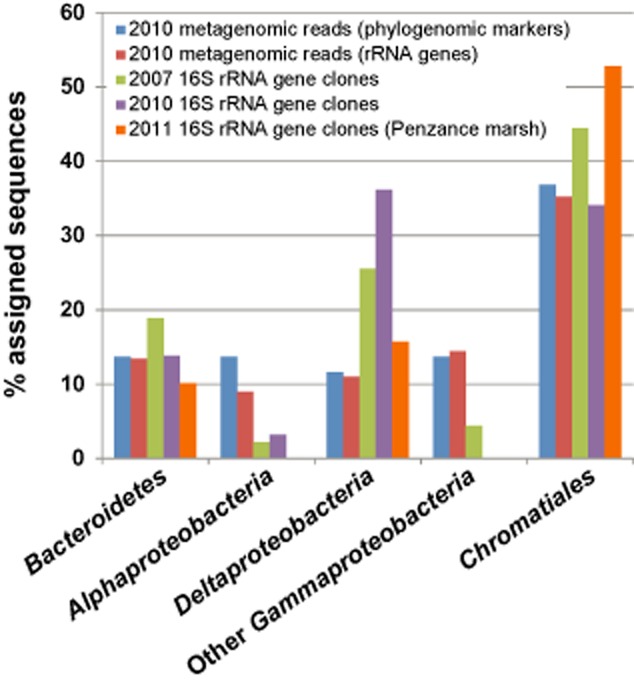
Comparison of bacterial diversity estimates from16S rDNA PCR-amplified clone libraries with unassembled 250 bp paired-end Illumina metagenomic reads. Metagenomic data were analysed using two different methods: maximum-likelihood read placement onto phylogenies conserved protein-coding marker genes (‘phylogenomic markers’) via Phylosift or the read's sequence similarity to ribosomal RNA genes via MG-RAST's M5RNA pipeline. A total of 42 351 metagenomic reads were classified as bacterial ribosomal RNA sequences, and 44 980 reads were assigned to bacterial phylogenetic marker genes.
Fig 6
Fig 6
A. Sulfide concentrations measured by the Cline assay in microcosm incubations with 50 small berries in 50 ml of filter-sterilized marsh water. Incubations were kept on a 14 h light, 10 h dark cycle. Sulfide added to concentration of 1 mM was consumed over the course of the incubation in the presence of the berries (solid line), while the abiotic control showed no change (dashed line). Microcosms without added sulfide had no detectable change from an initial sulfide concentration near 0 mM. Error bars show the standard deviation of three biological replicate incubations. B. Voltammetric scans from a gold amalgam electrode inside a ∼ 0.5 cm diameter pink berry show a distinct peak relating to dissolved sulfide at ∼− 0.8 V (vs. Ag/AgCl) as the electrode tip penetrates the berry. As little control on the exact position of the electrode in the berry was possible, the data do not quantify a gradient of sulfide but rather outline a change in position and relative values across the aggregate. The solid line with no apparent peak was collected when the electrode was in the surrounding water and not penetrating the aggregate.
Fig 7
Fig 7
A. Large pink berries were threaded onto 24 gauge silver wire and incubated in situ overnight. B. Sulfide produced within the berry precipitated onto the wire surface, forming a thin film of AgS visible as the black metallic sheen where the berry had been. SIMS7f ion microprobe analyses were conducted in a transect (25 μm spot sizes) along the wire across the AgS films from two different berries marked by red numbers 1 and 2, shown in panels C and D respectively. C–D. Co-plotted on the y-axes are the sulfur abundance (32S counts, red) and δ34S (blue) for each point along the transect (x-axis). Vertical error bars represent the standard error (n = 20 cycles) for each measurement. The area between berries 1 and 2 where 32S counts approach 0 corresponds to the region on the wire where no dark sulfide film was visible. SIMS data for Fig. 7 have also been provided in the Supporting Information S2.
Fig 8
Fig 8
NanoSIMS analysis of pink berries isotopically labelled with 34S-enriched sulfate and 13C-enriched bicarbonate. A. Hue–saturation–intensity image mapping the 34S : 32S ratio. The color scale ranges from blue, set to the baseline ratio observed in unlabelled control conditions (0.044), to red, where the ratio is enriched ∼ 2 fold relative to baseline (0.08). Image shown is the composite eight consecutive 30 μm frames at 512 × 512 pixel resolution from a cross section of pink berry biomass from near the periphery of the aggregate. B. RGB composite image from overlaid primary ion signals showing the cellular arrangement of morphologically distinctive purple sulfur bacterial cells. Primary ion images overlaid are 12C ion (blue), 12C14N (green) and 32S (red). Underlying ion images for each mass available in Supporting Information S2. C. NanoSIMS-calculated mean incorporation of stable isotopically labelled 13C-bicarbonate (x-axis) and 34S-sulfate (y-axis) incubated in the dark (blue) or 12 h light/dark cycle (red) for 4 days under conditions of active sulfate-respiration (triangles) or SRB-inhibition with sodium molybdate (X), compared with unlabelled control incubations (dots). An isotope-labelled, dark-incubated berry was post-treated with methanol (green triangle). Values plotted are the averages of either 15 × 15 μm (light) or 30 × 30 μm (dark) rasters from different regions in total of seven aggregates (one per condition). D. 14C bicarbonate incorporation into acid-stable products in five berries incubated for either 1 h or 4 h with 1 mM sulfide. Incubations were conducted on heat-killed aggregates, dark equilibrated aggregates, and aggregates in the light with and without 10 mM molybdate additions.
Fig 9
Fig 9
Model of sulfur cycling in the pink berry consortium. PB-SRB1 (green rods) reduce sulfate to sulfide, oxidizing a variety of electron donors from either exogenous sediment sources or from locally supplied photosynthate produced by PB-PSB1. PB-PSB1 (pink cocci) consume syntrophic sulfide, oxidizing sulfide to sulfate and intracellular stores of elemental sulfur (S0, pale yellow circles). Should PB-PSB1 cells lyse, intracellular sulfur might be reduced and/or disproportionated by PB-SRB1 (grey dashed arrows). Some electron donors for PB-PSB1 (HS-) and PB-SRB1 (H2 or fatty acids) are also likely provided exogenously by compounds effluxed from the sediment (squiggly lines). During the day, the phototrophic PB-PSB1 fixes CO2 into biomass, while at night it may derive maintenance energy by respiring elemental sulfur and intracellular carbohydrate reserves and producing sulfide. Though the PB-SRB1 genome suggests the genetic potential to fix CO2, results from our stable and radiocarbon experiments suggest PB-SRB1 does not contribute significantly to carbon fixation in the berries under the conditions of our incubations.

References

    1. Allison S. Martiny J. Resistance, resilience, and redundancy in microbial communities. Proc Natl Acad Sci USA. 2008;105:11512–11519. - PMC - PubMed
    1. Amann RI, Binder BJ, Olson RJ, Chisholm SW, Devereux R. Stahl DA. Combination of 16S rRNA-targeted oligonucleotide probes with flow cytometry for analyzing mixed microbial populations. Appl Environ Microbiol. 1990;56:1919–1925. - PMC - PubMed
    1. Baumgartner LK, Reid RP, Dupraz C, Decho AW, Buckley DH, Spear JR, et al. Sulfate reducing bacteria in microbial mats: changing paradigms, new discoveries. Sediment Geol. 2006;185:131–145.
    1. Baumgartner LK, Dupraz C, Buckley DH, Spear JR, Pace NR. Visscher PT. Microbial species richness and metabolic activities in hypersaline microbial mats: insight into biosignature formation through lithification. Astrobiology. 2009;9:861–874. - PubMed
    1. Boetius A, Ravenschlag K, Schubert CJ, Rickert D, Widdel F, Gieseke A, et al. A marine microbial consortium apparently mediating anaerobic oxidation of methane. Nature. 2000;407:623–626. - PubMed

Publication types