


Classification of adolescent idiopathic scoliosis (AIS)
- PMID: 24432055
- PMCID: PMC3566250
- DOI: 10.1007/s11832-012-0459-2
Classification of adolescent idiopathic scoliosis (AIS)
Abstract
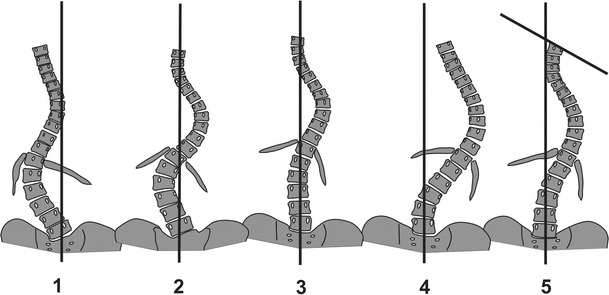
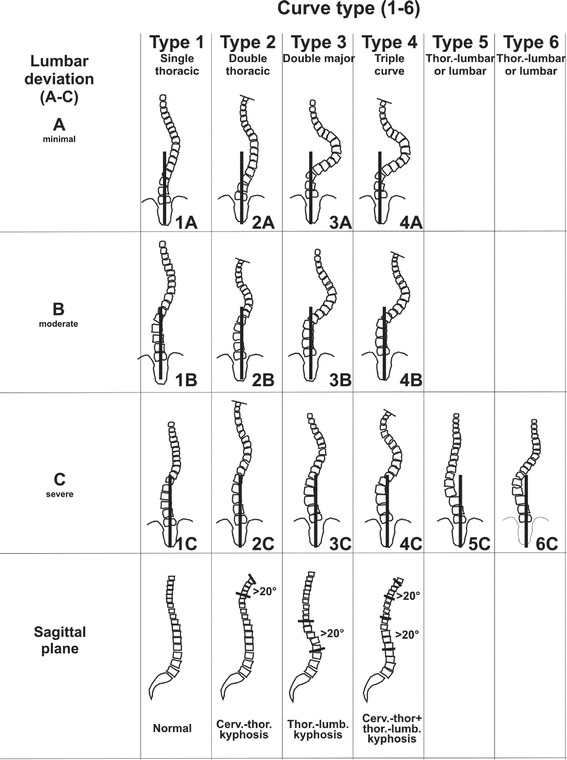
In 1983 Howard King presented his classification system for adolescent idiopathic scoliosis (AIS) based on the experience with Harrington rod instrumentation. Curves were divided into five types and guidelines and recommendations for which levels should be instrumented were given to preserve motion as much as possible. As segmental instrumentation systems began to gain favor over the Harrington rods this system failed and led to the development of a new classification system which was presented by Lawrence Lenke in 2001. In order to define a curve type by the Lenke classification, one must identify the curve type, the lumbar modifier and, for the first time in any classification system for scoliosis, the sagittal profile was also included. The Lenke classification showed higher inter and intra-reliability compared to the King classification. It also provided a better and more reliable tool to assist surgeons in choosing the best method of treatment for each curve pattern. Although the Lenke classification is more comprehensive and reliable than the King classification it is still far from perfect. It does not address the rotational component of the deformity. New technologies which provide three-dimensional (3D) reconstruction of the spine may serve as a basis for a truly 3D classification of scoliosis and for new therapeutic concepts.
Keywords: Adolescent idiopathic scoliosis; Classification; King; Lenke.
Figures
References
-
- King HA, Moe JH, Bradford DS, Winter RB. The selection of fusion levels in thoracic idiopathic scoliosis. J Bone Joint Surg Am. 1983;65:1302–1313. - PubMed
-
- Roye DP Jr, Farcy JP, Rickert JB, Godfried D (1992) Results of spinal instrumentation of adolescent idiopathic scoliosis by King type. Spine 17:S270–S273 - PubMed
-
- Cummings RJ, Loveless EA, Campbell J, Samelson S, Mazur JM. Inter-observer reliability and intra-observer reproducibility of the system of King et al. for the classification of adolescent idiopathic scoliosis. J Bone Joint Surg Am. 1998;80:1107–1111. - PubMed
Publication types
LinkOut - more resources
Full Text Sources
Other Literature Sources
Research Materials
