


doi: 10.1016/j.mmcr.2013.02.004.
Pulmonary cavitation and skin lesions mimicking tuberculosis in a HIV negative patient caused by Sporothrix brasiliensis
Affiliations
- PMID: 24432220
- PMCID: PMC3885933
- DOI: 10.1016/j.mmcr.2013.02.004
Item in Clipboard
Pulmonary cavitation and skin lesions mimicking tuberculosis in a HIV negative patient caused by Sporothrix brasiliensis
Med Mycol Case Rep.
.
Abstract
A 32-year-old HIV negative male presented with multiple pulmonary cavitation and skin abscesses up to 15 cm in diameter mimicking tuberculosis. Sporothrix brasiliensis was isolated and patient responded well to amphotericin B followed by itraconazole, except the skin lesions that had to be surgical drained to obtain cure.
Keywords: Amphotericin B; Genotyping; Pulmonary sporotrichosis; Serology; Sporothrix brasiliensis.
Figures
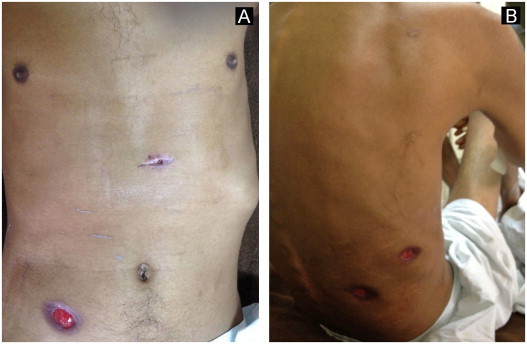
Cutaneous ulcers on the chest, abdomen and back of a patient with pulmonary sporotrichosis (A and B). Cutaneous biopsy scar is visible in Fig. 1A.
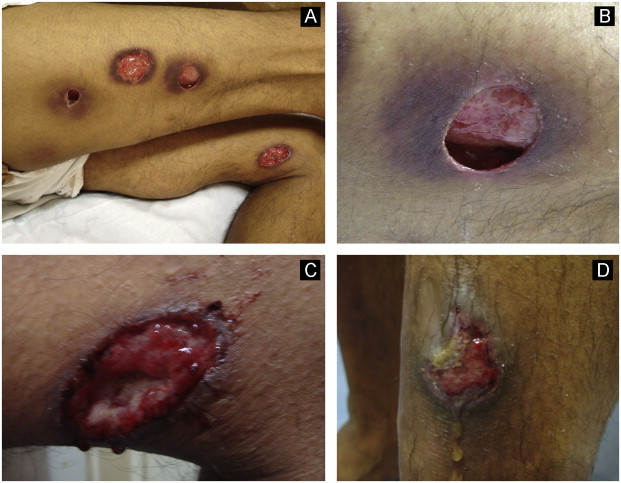
Numerous deep ulcerated nodules on the legs and thighs in the same patient (A, B, C and D).
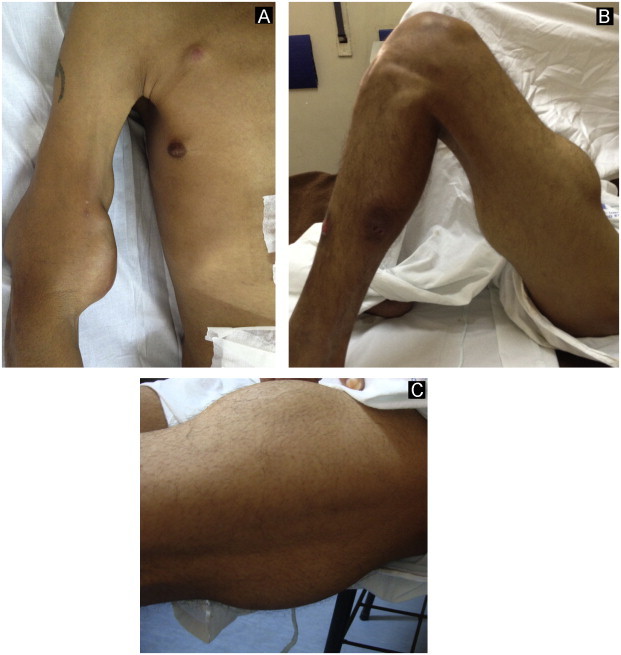
Large cutaneous abscesses on the arms (A) and thighs (B and C) due to S. brasiliensis infection.
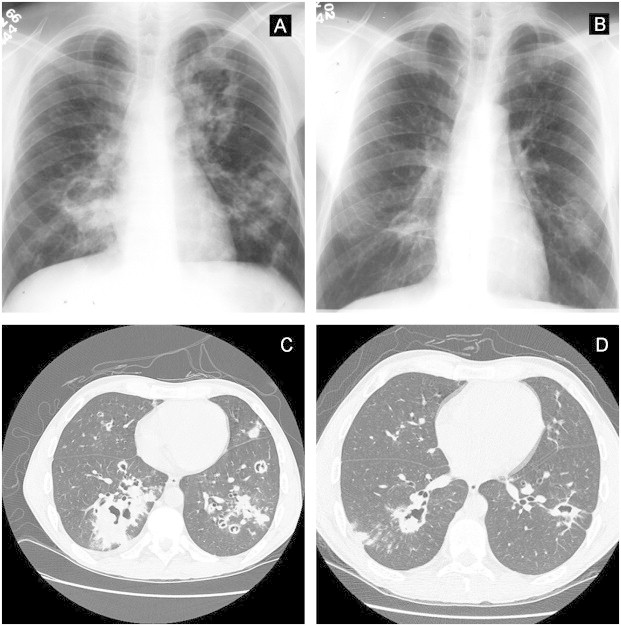
Pretreatment x-ray (A) showing numerous cavitary nodules spread in both lungs due to S. brasiliensis infection; 3 months post-treatment image (B); Pretreatment CT of the same patient (C) and 4 months post-treatment CT (D).
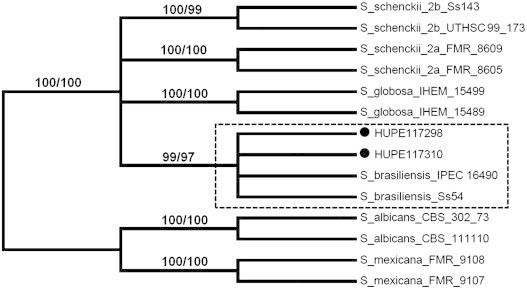
Phylogenetic tree generated by Maximum Likelihood and Neighbour-Joining methods revealing the placement of the isolates HUPE 117310 and HUPE 117298 (●) in the S. brasiliensis clade (dashed clade). The percentage of replicate trees in which isolates clustered together in the bootstrap test (1000 replicates) are shown in the branches in both methods used.
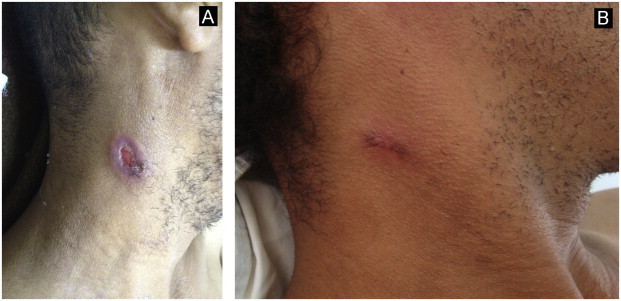
Lymph node fistula on the neck mimicking scrofuloderma: images before (A) and after systemic therapy (B).
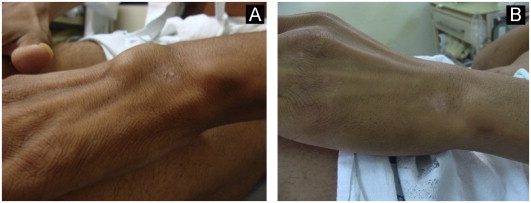
Surgical treatment of an abscess on the left wrist: pretreatment (A) and post-treatment (B) images.
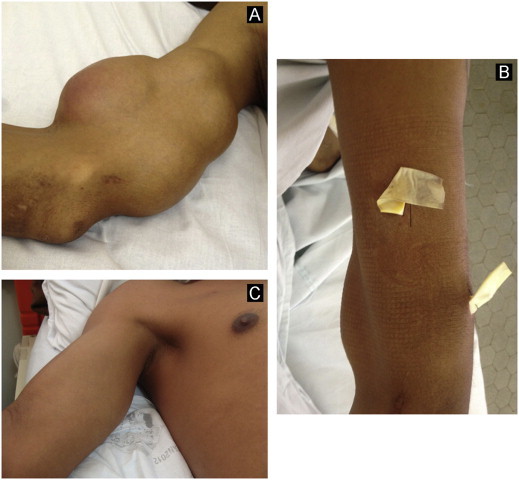
Surgical approach of intercommunicating skin abscesses on the right arm: images before surgery (A); with the drain (B) and post-treatment (C).
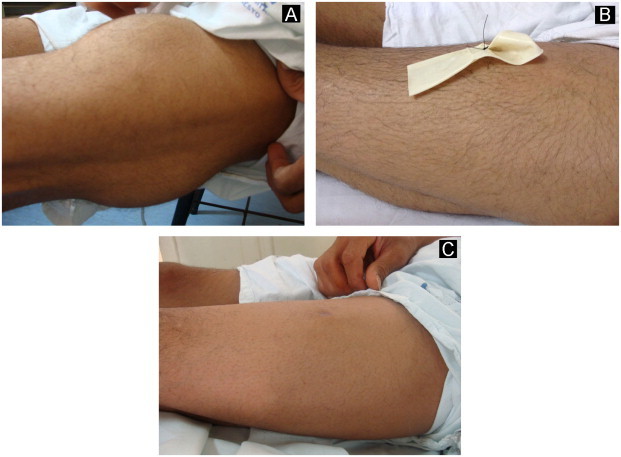
Surgical treatment of a large cutaneous abscess on the left thigh: images before surgery (A); with the drain (B) and post-treatment (C).
References
-
- Lopes-Bezerra LM, Schubach AO, Costa RO. Sporothrix schenckii and sporotrichosis. Anais da Academia Brasileira de Ciências. 2006;78(2):293–308. - PubMed
-
- da Rosa AC, Scrofenerker ML, Vettorato R, Gervini RL, Vettorato G, Weber A. Epidemiology of sporotrichosis: a study of 304 cases in Brazil. Journal of the American Academy of Dermatology. 2005;52(3 Pt 1):451–459. Review. - PubMed
-
- Barros MB, Schubach Ade O, do Valle AC, Gutierrez Galhardo MC, Conceição-Silva F, Schubach TM. Cat-transmitted sporotrichosis epidemic in Rio de Janeiro, Brazil: description of a series of cases. Clinical Infectious Diseases. 2004;38:529–535. - PubMed
-
- Bernardes-Engemann AR, Orofino RC, Miguens BP. Development of an enzyme-linked immunosorbent assay for the serodiagnosis of several clinical forms of sporotrichosis. Medical Mycology. 2005;43:487–493. - PubMed
LinkOut - more resources
Full Text Sources
Other Literature Sources
