


doi: 10.1016/j.mmcr.2013.08.001.
Chromoblastomycosis caused by Rhinocladiella aquaspersa
Affiliations
- PMID: 24432242
- PMCID: PMC3885939
- DOI: 10.1016/j.mmcr.2013.08.001
Item in Clipboard
Chromoblastomycosis caused by Rhinocladiella aquaspersa
Med Mycol Case Rep.
.
Abstract
A case of chromoblastomycosis of the hand caused by Rhinocladiella aquaspersa is described. The case was acquired locally in tropical Venezuela and was successfully treated with oral itraconazole.
Keywords: Chromoblastomycosis; Itraconazole; Rhinocladiella aquaspersa.
Figures
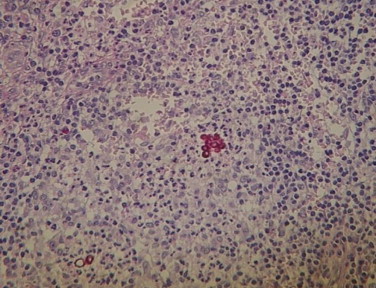
Histopathology examination showing cluster of muriform cells stained with periodic acid Schiff.
References
-
- Rubin H.A., Bruce S., Rosen T., McBride M.E. Evidence for percutaneous inoculation as the mode of transmission for chromoblastomycosis. Journal of the American Academy of Dermatology. 1991;25:951–954. - PubMed
-
- Esterre P., Andriantsimahavandy A., Ramarcel E.R., Pecarrere J.L. Forty years of chromoblastomycosis in Madagascar: a review. American Journal of Tropical Medicine and Hygiene. 1996;55:45–47. - PubMed
-
- Silva J.P., de Souza W., Rozental S. Chromoblastomycosis: a retrospective study of 325 cases on amazonic region (Brazil) Mycopathologia. 1998;143:171–175. - PubMed
-
- Bonifaz A., Carrasco-Gerard E., Saul A. Chromoblastomycosis: clinical and mycologic experience of 51 cases. Mycoses. 2001;44:1–7. - PubMed
LinkOut - more resources
Full Text Sources
Other Literature Sources
