


Exome analysis of HIV patients submitted to dendritic cells therapeutic vaccine reveals an association of CNOT1 gene with response to the treatment
- PMID: 24433985
- PMCID: PMC3889223
- DOI: 10.7448/IAS.17.1.18938
Exome analysis of HIV patients submitted to dendritic cells therapeutic vaccine reveals an association of CNOT1 gene with response to the treatment
Abstract
Introduction: With the aim of searching genetic factors associated with the response to an immune treatment based on autologous monocyte-derived dendritic cells pulsed with autologous inactivated HIV, we performed exome analysis by screening more than 240,000 putative functional exonic variants in 18 HIV-positive Brazilian patients that underwent the immune treatment.
Methods: Exome analysis has been performed using the ILLUMINA Infinium HumanExome BeadChip. zCall algorithm allowed us to recall rare variants. Quality control and SNP-centred analysis were done with GenABEL R package. An in-house implementation of the Wang method permitted gene-centred analysis.
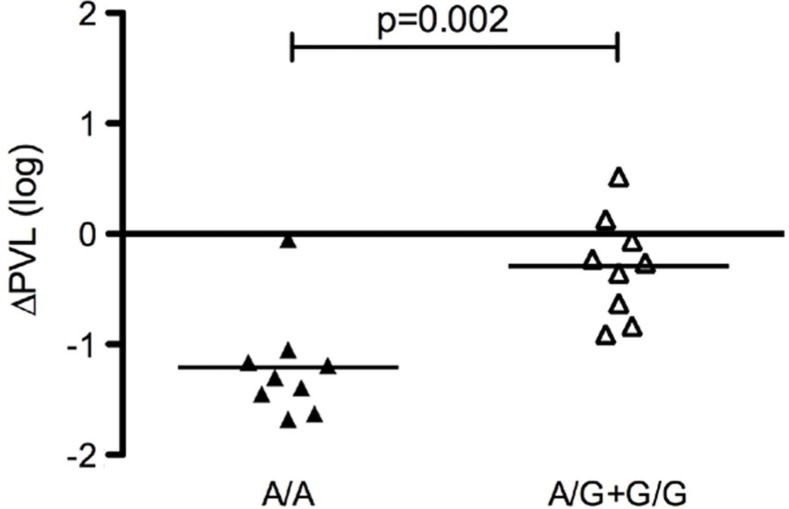
Results: CCR4-NOT transcription complex, subunit 1 (CNOT1) gene (16q21), showed the strongest association with the modification of the response to the therapeutic vaccine (p=0.00075). CNOT1 SNP rs7188697 A/G was significantly associated with DC treatment response. The presence of a G allele indicated poor response to the therapeutic vaccine (p=0.0031; OR=33.00; CI=1.74-624.66), and the SNP behaved in a dominant model (A/A vs. A/G+G/G p=0.0009; OR=107.66; 95% CI=3.85-3013.31), being the A/G genotype present only in weak/transient responders, conferring susceptibility to poor response to the immune treatment.
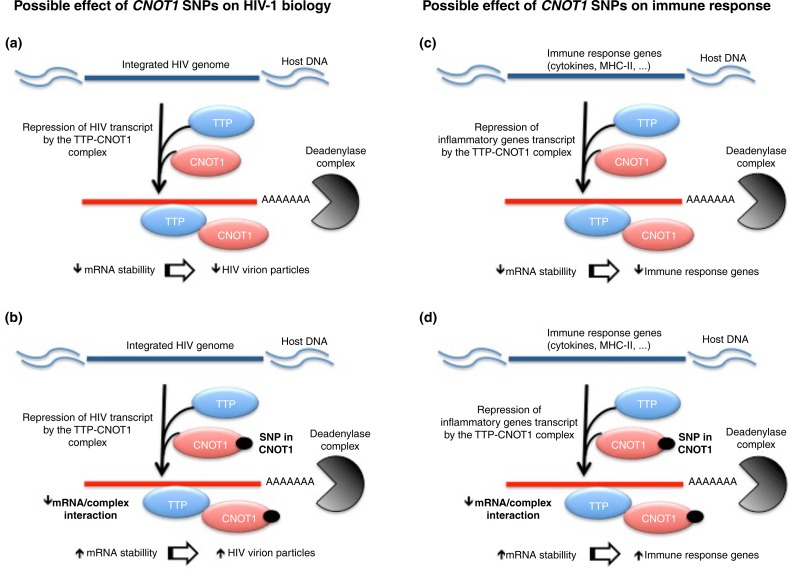
Discussion: CNOT1 is known to be involved in the control of mRNA deadenylation and mRNA decay. Moreover, CNOT1 has been recently described as being involved in the regulation of inflammatory processes mediated by tristetraprolin (TTP). The TTP-CCR4-NOT complex (CNOT1 in the CCR4-NOT complex is the binding site for TTP) has been reported as interfering with HIV replication, through post-transcriptional control. Therefore, we can hypothesize that genetic variation occurring in the CNOT1 gene could impair the TTP-CCR4-NOT complex, thus interfering with HIV replication and/or host immune response.
Conclusions: Being aware that our findings are exclusive to the 18 patients studied with a need for replication, and that the genetic variant of CNOT1 gene, localized at intron 3, has no known functional effect, we propose a novel potential candidate locus for the modulation of the response to the immune treatment, and open a discussion on the necessity to consider the host genome as another potential variant to be evaluated when designing an immune therapy study.
Keywords: CNOT1; DC immunotherapy; HIV; TTP; exome analysis.
Figures
References
-
- García F, Routy JP. Challenges in dendritic cells-based therapeutic vaccination in HIV-1 infection Workshop in dendritic cell-based vaccine clinical trials in HIV-1. Vaccine. 2011;29(38):6454–63. - PubMed
-
- García F, Climent N, Guardo AC, Gil C, León A, Autran B, et al. DCV2/MANON07-ORVACS Study Group. A dendritic cell-based vaccine elicits T cell responses associated with control of HIV-1 replication. Sci Transl Med. 2013;5(166):166ra2. - PubMed
-
- Lu W, Arraes LC, Ferreira WT, Andrieu JM. Therapeutic dendritic-cell vaccine for chronic HIV-1 infection. Nat Med. 2004;12:1359–65. - PubMed
-
- Segat L, Brandão LA, Guimarães RL, Pontillo A, Athanasakis E, de Oliveira RM, et al. Polymorphisms in innate immunity genes and patients response to dendritic cell-based HIV immuno-treatment. Vaccine. 2010;28(10):2201–6. - PubMed
Publication types
MeSH terms
Substances
LinkOut - more resources
Full Text Sources
Other Literature Sources
Medical
