. 2015 Jan;73(1):44-50.
doi: 10.1002/mrm.25094. Epub 2014 Jan 16.

Frequency and phase drift correction of magnetic resonance spectroscopy data by spectral registration in the time domain

Affiliations

Frequency and phase drift correction of magnetic resonance spectroscopy data by spectral registration in the time domain

Jamie Near et al. Magn Reson Med. 2015 Jan.

Abstract

Purpose: Frequency and phase drifts are a common problem in the acquisition of in vivo magnetic resonance spectroscopy (MRS) data. If not accounted for, frequency and phase drifts will result in artifactual broadening of spectral peaks, distortion of spectral lineshapes, and a reduction in signal-to-noise ratio (SNR). We present herein a new method for estimating and correcting frequency and phase drifts in in vivo MRS data.

Methods: We used a simple method of fitting each spectral average to a reference scan (often the first average in the series) in the time domain through adjustment of frequency and phase terms. Due to the similarity with image registration, this method is referred to as "spectral registration." Using simulated data with known frequency and phase drifts, the performance of spectral registration was compared with two existing methods at various SNR levels.

Results: Spectral registration performed well in comparison with the other methods tested in terms of both frequency and phase drift estimation.

Conclusions: Spectral registration provides an effective method for frequency and phase drift correction. It does not involve the collection of navigator echoes, and does not rely on any specific resonances, such as residual water or creatine, making it highly versatile.

Keywords: B0 drift; frequency drift; magnetic resonance spectroscopy; motion correction; phase drift.


Figures

FIG. 1
FIG. 1
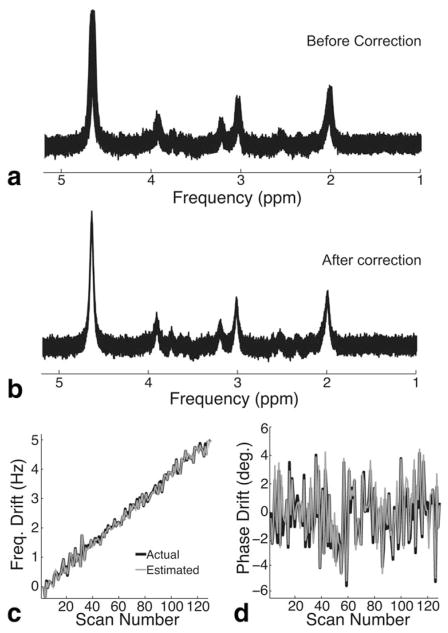
Frequency and phase drift correction using spectral registration. a: Simulated PRESS MRS data (TE = 80 ms) consisting of 128 averages with a total frequency drift of 5 Hz, a random phase error, and a per-average SNR of 20. b: The same spectrum following frequency and phase drift correction using spectral registration. c: Actual (black line) and estimated (gray line) frequency drift as a function of scan number. d: Actual (black line) and estimated (gray line) phase drift as a function of scan number.
FIG. 2
FIG. 2
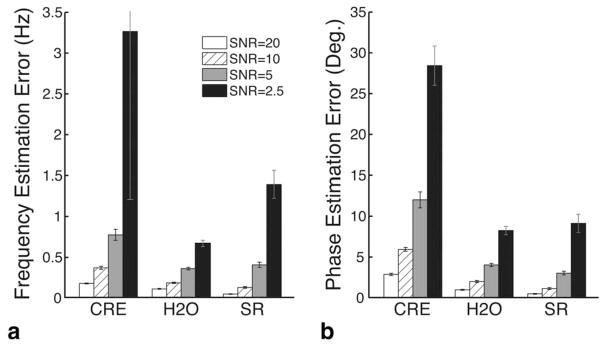
Comparison of spectral registration with existing drift correction methods. a: Bar graph showing the standard deviation of the residual frequency estimation error (in Hz) of the creatine fitting method (CRE), the residual water method (H2O), and the spectral registration method (SR). b: Bar graph showing the standard deviation of the residual phase estimation error (in degrees) of the same three methods. The four bars in each group represent the four different SNR levels tested. Bar heights and error bars represent the average and standard deviation, respectively, across 10 simulated datasets.
FIG. 3
FIG. 3
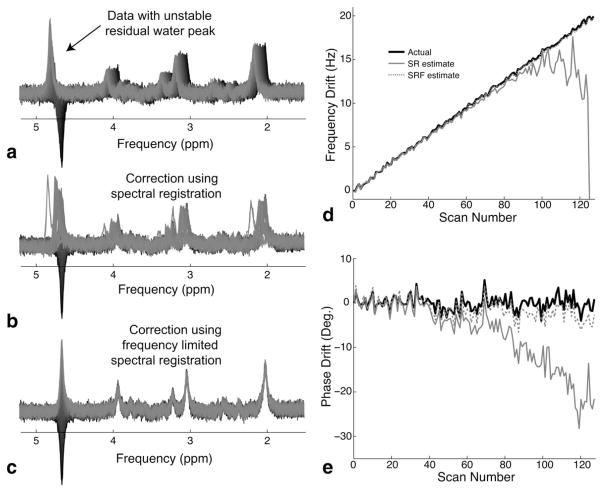
Illustration of spectral registration over a limited frequency range. a: Simulated PRESS MRS data (TE = 80 ms) consisting of 128 averages, with a large unstable residual water peak and a total frequency drift of 20 Hz and random phase error. b: The same spectrum following frequency and phase drift correction using spectral registration. Note the visibly poor alignment of the averages. c: The same spectrum following frequency and phase drift correction using spectral registration over a limited frequency range (0–3.5 ppm). Note the improved alignment of the averages. d: The actual frequency drift (solid black line) is shown with the drift estimates using spectral registration (SR, solid gray line), and spectral registration over a limited frequency range (SRF, dotted gray line). e: The actual phase drift (solid black line) is shown with the drift estimates using SR (solid gray line), and SRF (dotted gray line).
FIG. 4
FIG. 4
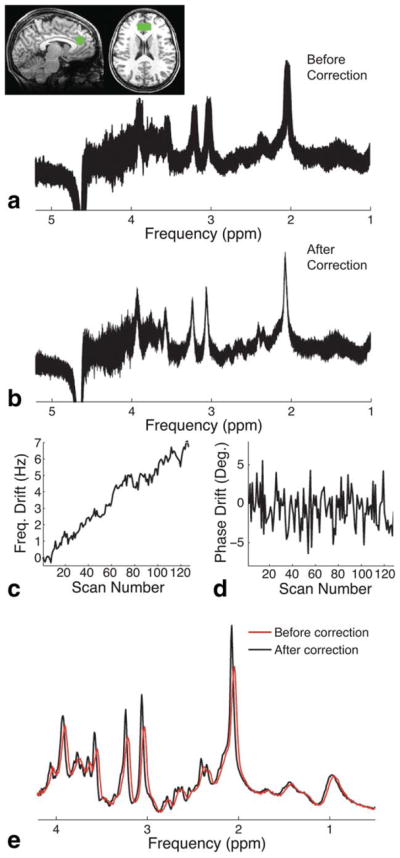
Frequency and phase drift correction on in vivo data. a: In vivo SPECIAL MRS data (TR/TE = 3200/8.5 ms) acquired from the medial prefrontal cortex of a healthy volunteer. Data are shown following subtraction of the partial ISIS inversion-on/inversion-off scans. The voxel position is shown in the top left. b: Same spectrum as above, following frequency and phase drift correction using spectral registration over a limited frequency range (from −2 to 4.2 ppm). Note the improved alignment of the averages. c: The measured frequency drift. d: The measured phase drift. e: The final averaged spectrum before (red line) and after (black line) drift correction. Note that both peak intensity and lineshape are improved following drift correction.

References

    1. Star-Lack JM, Adalsteinsson E, Gold GE, Ikeda DM, Spielman DM. Motion correction and lipid suppression for 1H magnetic resonance spectroscopy. Magn Reson Med. 2000;43:325–330. - PubMed
    1. Helms G, Piringer A. Restoration of motion-related signal loss and line-shape deterioration of proton MR spectra using the residual water as intrinsic reference. Magn Reson Med. 2001;46:395–400. - PubMed
    1. Henry PG, van de Moortele PF, Giacomini E, Nauerth A, Bloch G. Field-frequency locked in vivo proton MRS on a whole-body spectrometer. Magn Reson Med. 1999;42:636–642. - PubMed
    1. Keating B, Deng W, Roddey JC, White N, Dale A, Stenger VA, Ernst T. Prospective motion correction for single-voxel 1H MR spectroscopy. Magn Reson Med. 2010;64:672–679. - PMC - PubMed
    1. Zaitsev M, Speck O, Hennig J, Buchert M. Single-voxel MRS with prospective motion correction and retrospective frequency correction. NMR Biomed. 2010;23:325–332. - PubMed

Publication types