


Working with existing databases
- PMID: 24436641
- PMCID: PMC3699145
- DOI: 10.1055/s-0033-1333627
Working with existing databases
Abstract
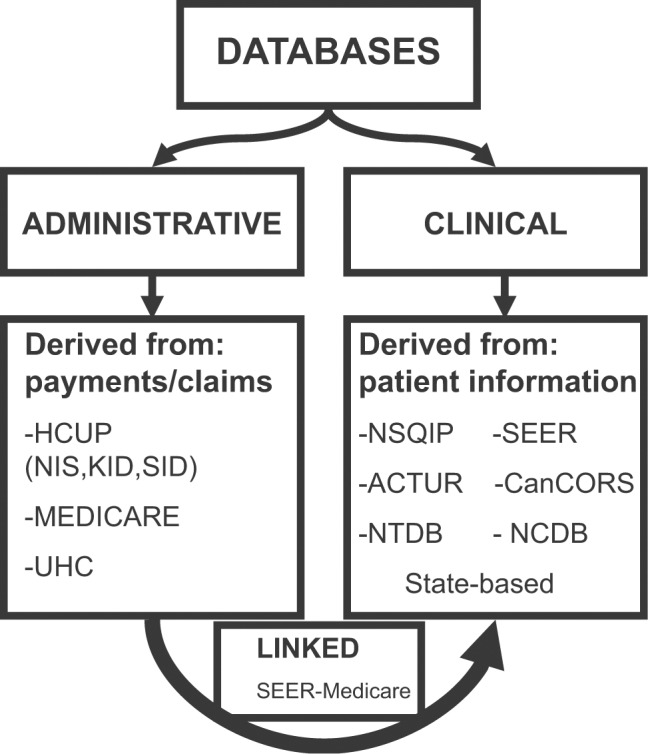
Outcomes research has established itself as an integral part of surgical research as physicians and hospitals are increasingly required to demonstrate attainment of performance markers and surgical safety indicators. Large-volume and clinical and administrative databases are used to study regional practice pattern variations, health care disparities, and resource utilization. Understanding the unique strengths and limitations of these large databases is critical to performing quality surgical outcomes research. In the current work, we review the currently available large-volume databases including selection processes, modes of analyses, data application, and limitations.
Keywords: administrative; databases; outcomes; research.
Figures
References
-
- Rhodes R S Biester T W Certification and maintenance of certification in surgery Surg Clin North Am 2007874825–836., vi - PubMed
-
- Birkmeyer J D, Shahian D M, Dimick J B. et al. Blueprint for a new American College of Surgeons: National Surgical Quality Improvement Program. J Am Coll Surg. 2008;207(5):777–782. - PubMed
-
- Birkmeyer N J, Birkmeyer J D. Strategies for improving surgical quality—should payers reward excellence or effort? N Engl J Med. 2006;354(8):864–870. - PubMed
-
- Morris A M, Wei Y, Birkmeyer N J, Birkmeyer J D. Racial disparities in late survival after rectal cancer surgery. J Am Coll Surg. 2006;203(6):787–794. - PubMed
-
- Purves H Pietrobon R Hervey S Guller U Miller W Ludwig K Relationship between surgeon caseload and sphincter preservation in patients with rectal cancer Dis Colon Rectum 2005482195–202., discussion 202–204 - PubMed
Publication types
LinkOut - more resources
Full Text Sources
Other Literature Sources
