


Review
doi: 10.3109/03008207.2013.867337.
Lens capsule as a model to study type IV collagen
Affiliations
- PMID: 24437599
- PMCID: PMC4138812
- DOI: 10.3109/03008207.2013.867337
Item in Clipboard
Review
Lens capsule as a model to study type IV collagen
Connect Tissue Res.
2014 Jan-Feb.
Abstract
The study of collagen IV has benefited greatly from the seminal work conducted by Arthur Veis and colleagues over three decades ago. Through a series of electron microscopy studies focused on lens basement membrane, an appreciation was gained for the distinct network-forming properties of collagen IV. Veis correctly suggested that network assembly is a phenomenon of the non-collagenous termini of the molecule. This review seeks to document how the field advanced following these seminal conclusions, including recent discoveries regarding the molecular reinforcement of networks that support Veis' conclusions.
Conflict of interest statement
Figures
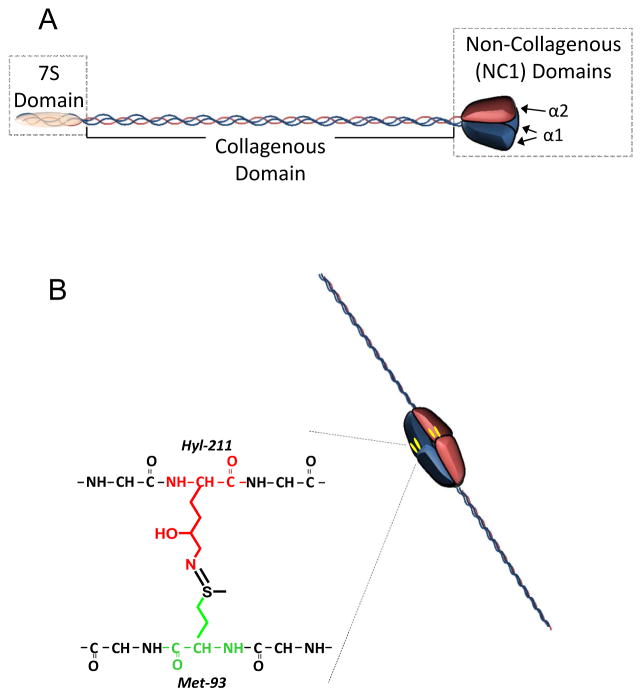
(A) Domain structure of collagen IV protomer showing N-terminal 7S domain, triple helical collagenous domain, and C-terminal NC1 domain. (B) Adjoining protomers form a hexameric complex from constituent NC1 domains, which is covalently reinforced by sulfilimine cross-links.
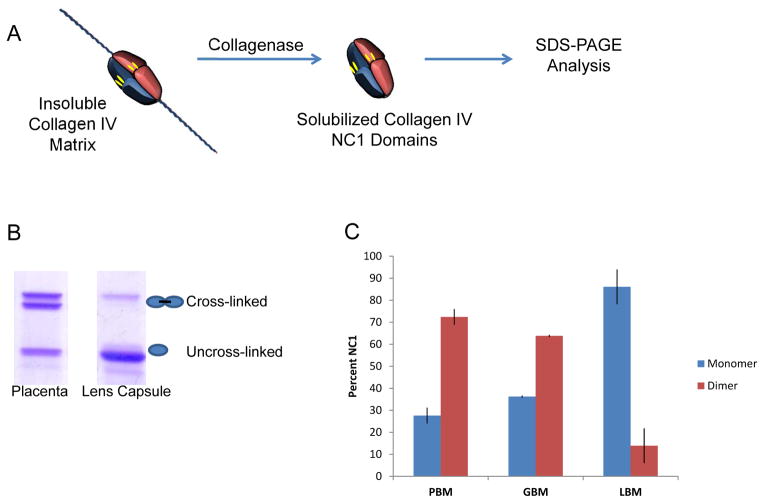
(A) Schematic depicting the solubilization of NC1 domains from collagen IV matrices via collagenase treatment. (B) Non-reducing SDS-PAGE analysis of NC1 isolated from placenta and lens basement membrane. Upper protein bands represent NC1 dimers containing sulfilimine cross-links, while lower protein bands represent uncrosslinked NC1 domains. (C) Densitometic analysis of SDS-PAGE gels reveal LBM as being comprised of mostly monomeric NC1 domains, which contrasts with NC1 isolated from placental and glomerular basement membranes.
References
-
- Poschl E, Schlotzer-Schrehardt U, Brachvogel B, Saito K, Ninomiya Y, Mayer U. Collagen IV is essential for basement membrane stability but dispensable for initiation of its assembly during early development. Development. 2004;131:1619–28. - PubMed
-
- Hudson BG, Tryggvason K, Sundaramoorthy M, Neilson EG. Alport’s Syndrome, Goodpasture’s Syndrome, and Type IV Collagen. N Eng J Med. 2003;348:2534–56. - PubMed
-
- Shah S, Kumar Y, McLean B, Churchill A, Stoodley N, Rankin J, Rizzu P, van der Knaap M, Jardine P. A dominantly inherited mutation in collagen IV A1 (COL4A1) causing childhood onset stroke without porencephaly. Eur J Paediatr Neurology. 2010;14:182–7. - PubMed
-
- Colville DJ, Savige J. Alport Syndrome. A review of the ocular manifestations. Ophthalmic Genet. 1997;18:161–73. - PubMed
Publication types
MeSH terms
Substances
Grants and funding
LinkOut - more resources
Full Text Sources
Other Literature Sources
