


Multiple short bouts of exercise over 12-h period reduce glucose excursions more than an energy-matched single bout of exercise
- PMID: 24439242
- PMCID: PMC3965589
- DOI: 10.1016/j.metabol.2013.12.006
Multiple short bouts of exercise over 12-h period reduce glucose excursions more than an energy-matched single bout of exercise
Abstract
Objective: Long, uninterrupted bouts of sedentary behavior are thought to negatively influence postprandial glucose and insulin concentrations. We examined the effects of a 1-h bout of morning exercise versus intermittent walking bouts of short duration on glucose excursions and insulin secretion over 12-h.
Materials/methods: Eleven young, obese individuals (18-35 years, BMI>30kg/m(2)) with impaired glucose tolerance were studied on three 12-h study days: 1) sedentary behavior (SED); 2) sedentary behavior with 1-h morning exercise (EX) at 60%-65% VO2peak; and 3) sedentary behavior with 12-hourly, 5-min intervals of exercise (INT) at 60%-65% VO2peak. Meals (1046kJ/meal) were provided every 2-h. Blood samples were collected every 10 min and measured for glucose, insulin, and c-peptide concentrations.
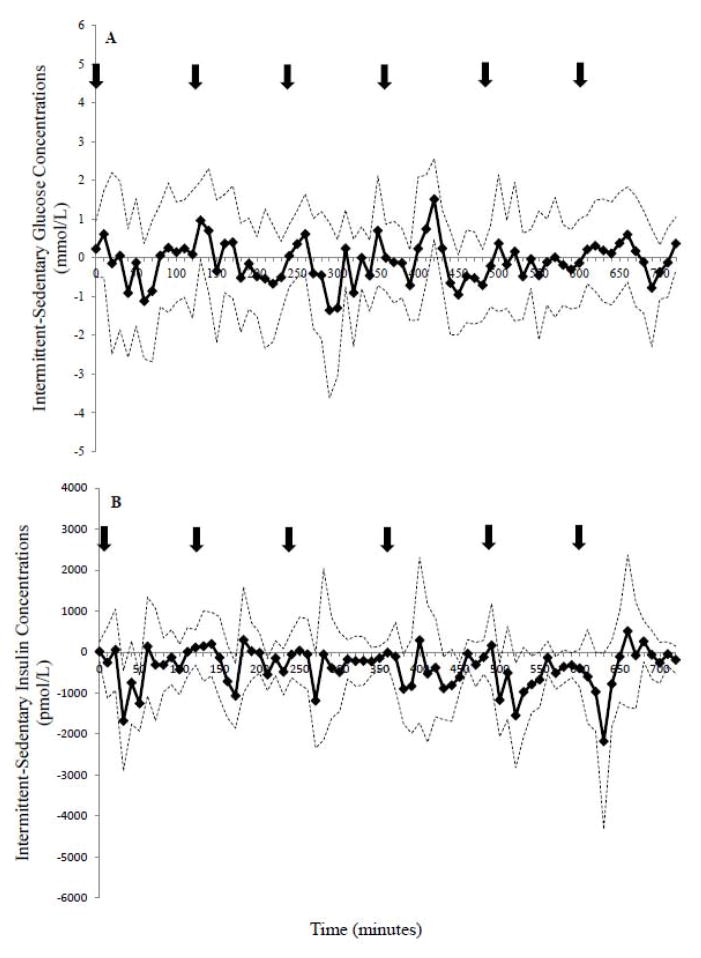
Results: Glucose iAUC (12-h) was attenuated in the INT and SED conditions compared to the EX condition (P<0.05). Glucose concentrations were higher in the EX compared to the SED condition for ~150min (20% of the study day), and comparison of the EX-INT study days revealed that glucose concentrations were greater for~240min (~1/3 of the 12-hday). In the SED condition, the 12-h insulin iAUC was ~15% higher (P<0.05) compared to the INT and EX conditions. Insulin production rate was found to increase ~20% with INT exercise vs. the SED and EX condition (P<0.05).
Conclusions: Short, frequent periods of exercise attenuated glucose excursions and insulin concentrations in obese individuals to a greater degree than an equal amount of exercise performed continuously in the morning.
Keywords: Glucose; Insulin; Obesity; Physical activity; Sedentary.
Copyright © 2014 Elsevier Inc. All rights reserved.
Conflict of interest statement
There were no conflicts of interest for any of the authors of this manuscript.
Figures
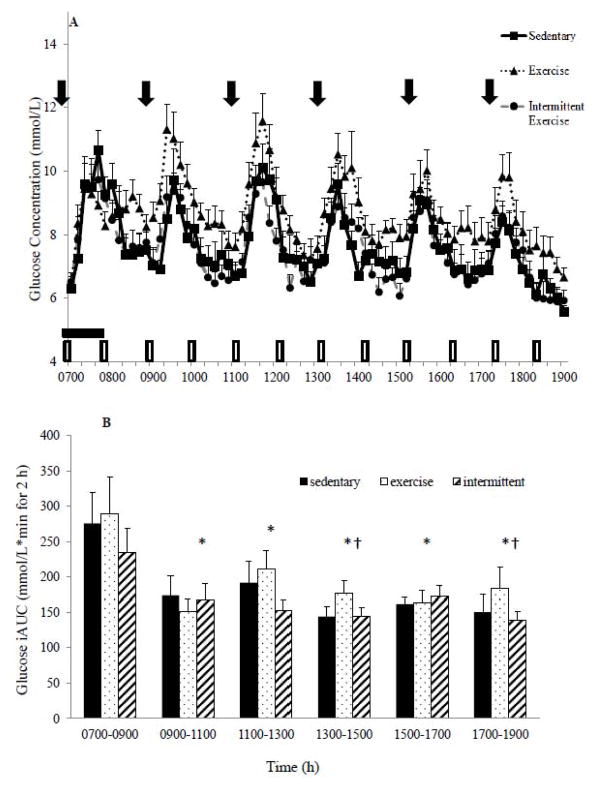
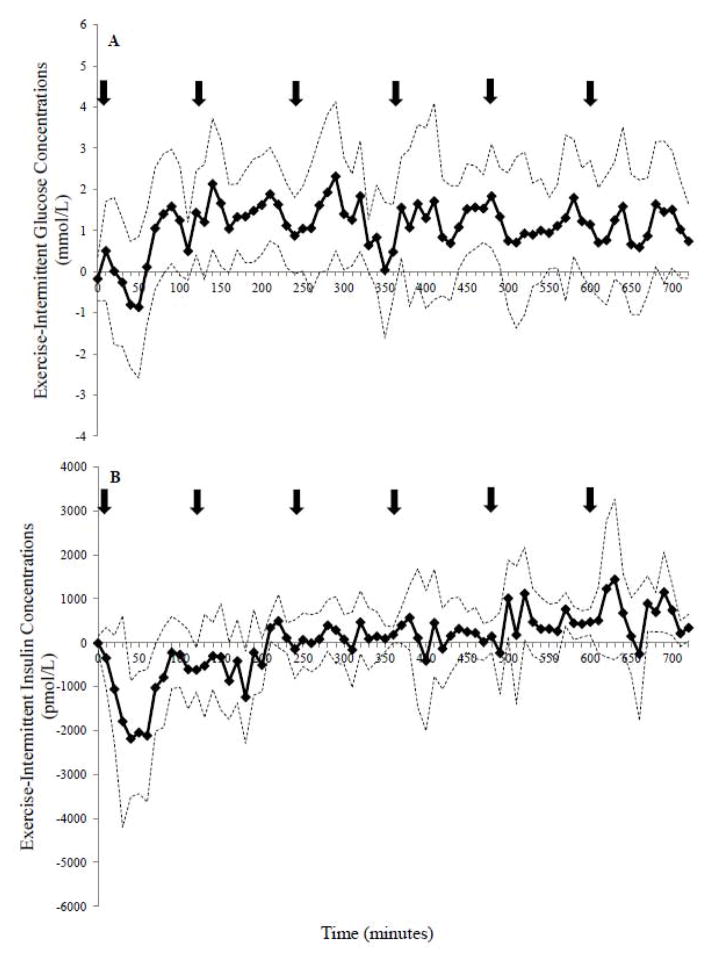
 1-h Exercise.
 Intermittent exercise condition; hourly 5-minute walking bouts. B: Two-hour glucose incremental area under the curve (iAUC) across the 12 h study day. Mean±SEM. *P<0.05 vs. 0700–0900h. †P<0.05 vs. 1100–1300h
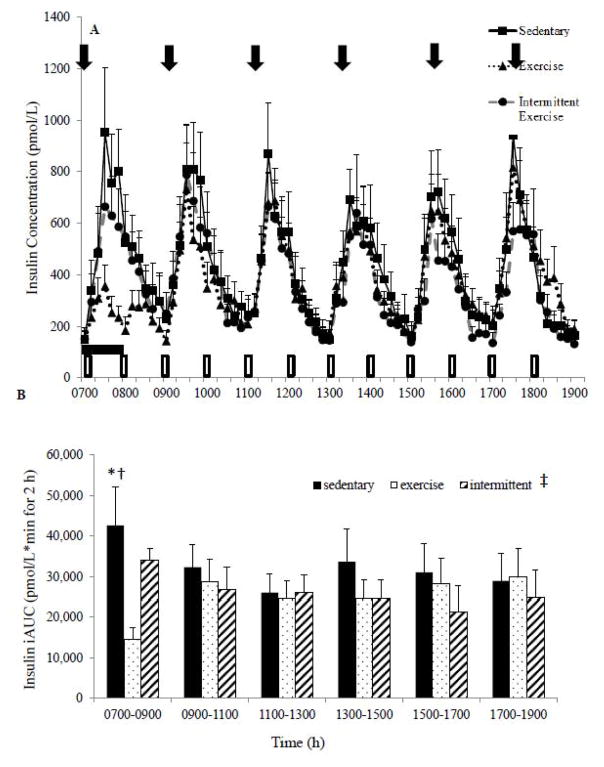 1-h Exercise.
Intermittent exercise condition; hourly 5-minute walking bouts. B: Two-hour serum insulin iAUC across the 12 h study day. Mean±SEM. ‡P<0.05 between conditions (SED vs EX P=0.01, SED vs INT P=0.015); no significant difference between the 2-h time intervals; 0700–0900 *P=.007 SED vs EX, †P=0.06 SED vs INT.
1-h Exercise.
Intermittent exercise condition; hourly 5-minute walking bouts. B: Two-hour serum insulin iAUC across the 12 h study day. Mean±SEM. ‡P<0.05 between conditions (SED vs EX P=0.01, SED vs INT P=0.015); no significant difference between the 2-h time intervals; 0700–0900 *P=.007 SED vs EX, †P=0.06 SED vs INT.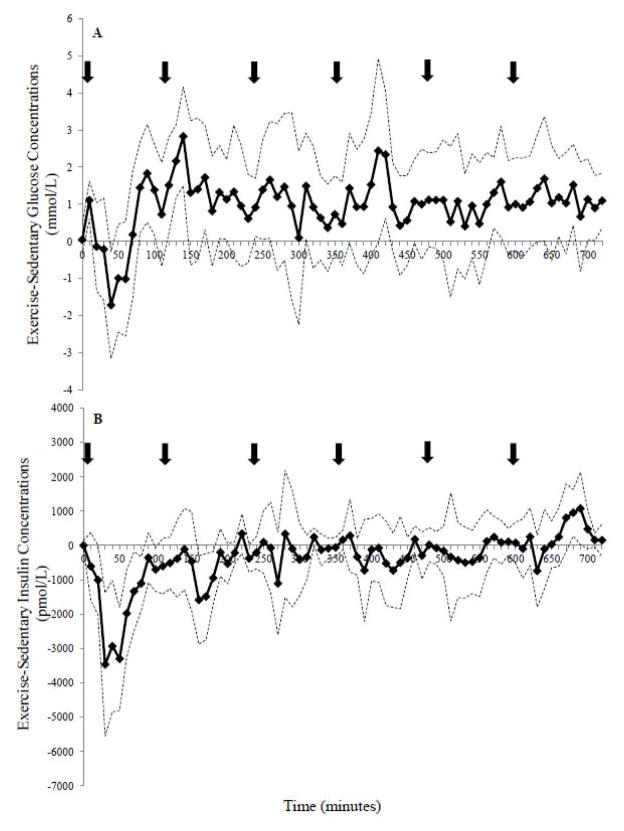
References
-
- Hayashi T, Wojtaszewski JF, Goodyear LJ. Exercise regulation of glucose transport in skeletal muscle. Am J Physiol. 1997;273(6 Pt 1):E1039–51. - PubMed
-
- LeBlanc J, Nadeau A, Richard D, Tramblay A. Studies on the sparing effect of exercise on insulin requirements in human subjects. metabolism. 1981;30:1119–24. - PubMed
-
- Levitt NS, Hirsch L, Rubenstein AH, Polonsky KS. Quantitative evaluation of the effect of low-intensity exercise on insulin secretion in man. Metabolism. 1993;42(7):829–33. - PubMed
-
- Hu F, Stampfer M, Solomon C, Liu S, Colditz G, Speizer F, et al. Physical activity and risk for cardiovascular events in diabetic women. Ann Intern Med. 2001;134(2):96–104. - PubMed
Publication types
MeSH terms
Substances
Grants and funding
LinkOut - more resources
Full Text Sources
Other Literature Sources
Medical
