


Sedentary behavior and mortality in older women: the Women's Health Initiative
- PMID: 24439345
- PMCID: PMC3896923
- DOI: 10.1016/j.amepre.2013.10.021
Sedentary behavior and mortality in older women: the Women's Health Initiative
Abstract
Background: Although epidemiologic studies have shown associations between sedentary behavior and mortality, few have focused on older women with adequate minority representation and few have controlled for both physical activity and functional status.
Purpose: The objective of this study was to determine the relationship between sedentary time and total; cardiovascular disease (CVD); coronary heart disease (CHD); and cancer mortality in a prospective, multiethnic cohort of postmenopausal women.
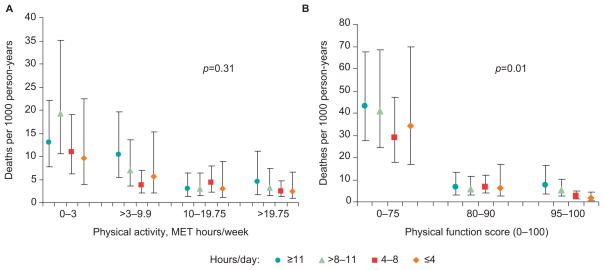
Methods: The study population included 92,234 women aged 50-79 years at baseline (1993-1998) who participated in the Women's Health Initiative Observational Study through September 2010. Self-reported sedentary time was assessed by questionnaire and examined in 4 categories (≤4, >4-8, ≥8-11, >11 hours). Mortality risks were examined using Cox proportional hazard models adjusting for confounders. Models were also stratified by age, race/ethnicity, body mass index, physical activity, physical function, and chronic disease to examine possible effect modification. Analyses were conducted in 2012-2013.
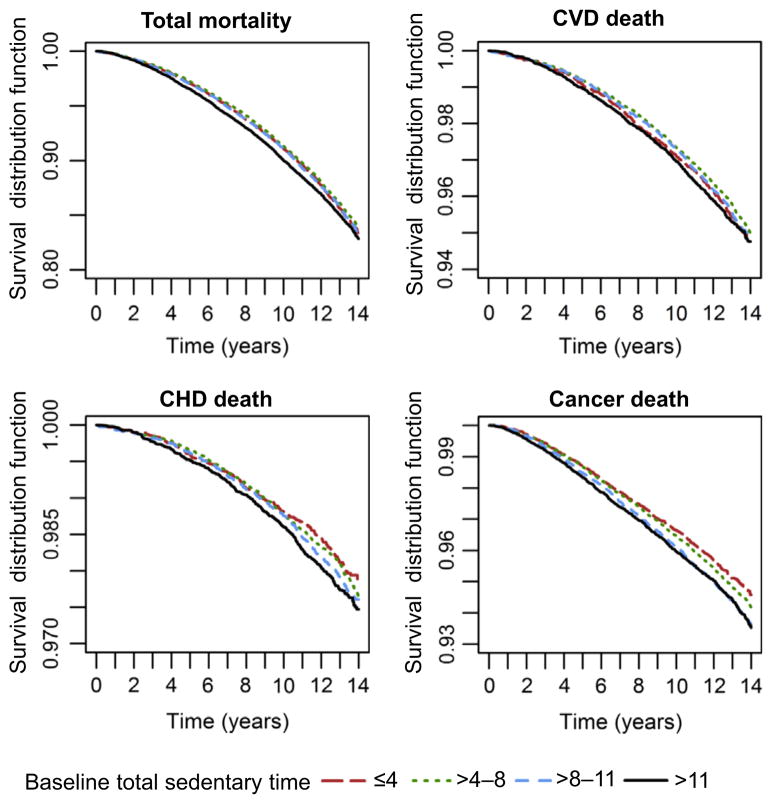
Results: The mean follow-up period was 12 years. Compared with women who reported the least sedentary time, women reporting the highest sedentary time had increased risk of all-cause mortality in the multivariate model (HR=1.12, 95% CI=1.05, 1.21). Results comparing the highest versus lowest categories for CVD, CHD, and cancer mortality were as follows: HR=1.13, 95% CI=0.99, 1.29; HR=1.27, 95% CI=1.04, 1.55; and HR=1.21, 95% CI=1.07, 1.37, respectively. For all mortality outcomes, there were significant linear tests for trend.
Conclusions: There was a linear relationship between greater amounts of sedentary time and mortality risk after controlling for multiple potential confounders.
© 2013 American Journal of Preventive Medicine Published by American Journal of Preventive Medicine All rights reserved.
Conflict of interest statement
No conflicts of interest were reported by the authors of this paper.
Figures
References
-
- USDHHS. Physical Activity Guidelines Advisory Committee Report. Washington DC: USDHHS; 2008.
-
- Katzmarzyk PT, Church TS, Craig CL, Bouchard C. Sitting time and mortality from all causes, cardiovascular disease, and cancer. Med Sci Sports Exerc. 2009;41:998–1005. - PubMed
-
- van der Ploeg HP, Chey T, Korda RJ, Banks E, Bauman A. Sitting time and all-cause mortality risk in 222 497 Australian adults. Arch Intern Med. 2012;172:494–500. - PubMed
Publication types
MeSH terms
Grants and funding
- N01WH32102/WH/WHI NIH HHS/United States
- N01 WH022110/WH/WHI NIH HHS/United States
- N01WH42107-42126/WH/WHI NIH HHS/United States
- N01WH32113/WH/WHI NIH HHS/United States
- R21AG031974/AG/NIA NIH HHS/United States
- P30AG028740/AG/NIA NIH HHS/United States
- N01WH32111/WH/WHI NIH HHS/United States
- N01WH42130/WH/WHI NIH HHS/United States
- 5R01AG025441-03/AG/NIA NIH HHS/United States
- K01 HL108807/HL/NHLBI NIH HHS/United States
- N01WH32100/WH/WHI NIH HHS/United States
- N01WH32115/WH/WHI NIH HHS/United States
- R01 AG025441/AG/NIA NIH HHS/United States
- N01WH24152/WH/WHI NIH HHS/United States
- N01WH32112/WH/WHI NIH HHS/United States
- N01WH32101/WH/WHI NIH HHS/United States
- N01WH32119/WH/WHI NIH HHS/United States
- N01WH32105/WH/WHI NIH HHS/United States
- N01WH42132/WH/WHI NIH HHS/United States
- P01 CA53996/CA/NCI NIH HHS/United States
- P01 CA053996/CA/NCI NIH HHS/United States
- R01AG025441-03/AG/NIA NIH HHS/United States
- N01WH32106/WH/WHI NIH HHS/United States
- N01WH42129/WH/WHI NIH HHS/United States
- N01WH32118/WH/WHI NIH HHS/United States
- P30 AG028740/AG/NIA NIH HHS/United States
- N01WH42131/WH/WHI NIH HHS/United States
- 5 R01 H205065-02/PHS HHS/United States
- T32 AG027677/AG/NIA NIH HHS/United States
- N01WH32122/WH/WHI NIH HHS/United States
- N01WH32109/WH/WHI NIH HHS/United States
- R01 ES017030/ES/NIEHS NIH HHS/United States
- N01WH32108/WH/WHI NIH HHS/United States
- R21 AG031974/AG/NIA NIH HHS/United States
LinkOut - more resources
Full Text Sources
Other Literature Sources
Medical
