


Domain-specific effects of prenatal exposure to PCBs, mercury, and lead on infant cognition: results from the Environmental Contaminants and Child Development Study in Nunavik
- PMID: 24441767
- PMCID: PMC3948023
- DOI: 10.1289/ehp.1206323
Domain-specific effects of prenatal exposure to PCBs, mercury, and lead on infant cognition: results from the Environmental Contaminants and Child Development Study in Nunavik
Abstract
Background: Polychlorinated biphenyls (PCBs), methylmercury (MeHg), and lead (Pb) are environmental contaminants known for their adverse effects on cognitive development.
Objectives: In this study we examined the effects of prenatal exposure to PCBs, MeHg, and Pb on cognitive development in a sample of Inuit infants from Arctic Québec.
Methods: Mothers were recruited at local prenatal clinics. PCBs, mercury (Hg), Pb, and two seafood nutrients-docosahexaenoic acid (DHA) and selenium (Se)-were measured in umbilical cord blood. Infants (n = 94) were assessed at 6.5 and 11 months of age on the Fagan Test of Infant Intelligence (FTII), A-not-B test, and Bayley Scales of Infant Development-2nd Edition (BSID-II).
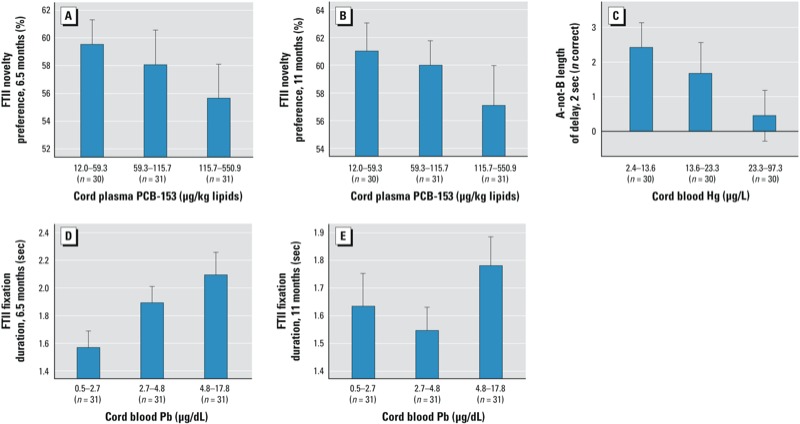
Results: Multiple regression analyses revealed that higher prenatal PCB exposure was associated with decreased FTII novelty preference, indicating impaired visual recognition memory. Prenatal Hg was associated with poorer performance on A-not-B, which depends on working memory and is believed to be a precursor of executive function. Prenatal Pb was related to longer FTII fixation durations, indicating slower speed of information processing.
Conclusions: PCBs, MeHg, and Pb each showed specific and distinct patterns of adverse associations with the outcomes measured during infancy. By contrast, none of these exposures was associated with performance on the BSID-II, a global developmental measure. The more focused, narrow band measures of cognitive function that appeared to be sensitive to these exposures also provide early indications of long-term impairment in specific domains that would otherwise not likely be evident until school age.
Citation: Boucher O, Muckle G, Jacobson JL, Carter RC, Kaplan-Estrin M, Ayotte P, Dewailly É, Jacobson SW. 2014. Domain-specific effects of prenatal exposure to PCBs, mercury, and lead on infant cognition: results from the Environmental Contaminants and Child Development Study in Nunavik. Environ Health Perspect 122:310-316; http://dx.doi.org/10.1289/ehp.1206323.
Conflict of interest statement
The authors declare they have no actual or potential competing financial interests.
Figures
References
-
- American Psychiatric Association. Arlington, VA: American Psychiatric Association; 2000. Diagnostic and Statistical Manual of Mental Disorders, 4th Edition.
-
- Bayley N. San Antonio, TX:Psychological Corporation. 1993. Bayley Scales of Infant Development.
-
- Bellinger D. Interpreting the literature on lead and child development: the neglected role of the experimental system. Neurotoxicol Teratol. 1994;17:201–212. - PubMed
-
- Bellinger D, Leviton A, Waternaux C, Needleman H, Rabinowitz M. Longitudinal analyses of prenatal and postnatal lead exposure and early cognitive development. N Engl J Med. 1987;317:1037–1043. - PubMed
-
- Bellinger DC, Stiles KM, Needleman HL. Low-level lead exposure, intelligence and academic achievement: a long-term follow-up study. Pediatrics. 1992;90:855–861. - PubMed
Publication types
MeSH terms
Substances
Grants and funding
LinkOut - more resources
Full Text Sources
Other Literature Sources
Medical