


The potential economic benefits of improved postfracture care: a cost-effectiveness analysis of a fracture liaison service in the US health-care system
- PMID: 24443384
- PMCID: PMC4176766
- DOI: 10.1002/jbmr.2180
The potential economic benefits of improved postfracture care: a cost-effectiveness analysis of a fracture liaison service in the US health-care system
Abstract
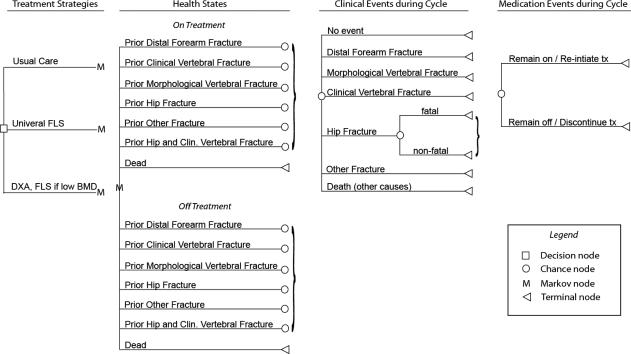
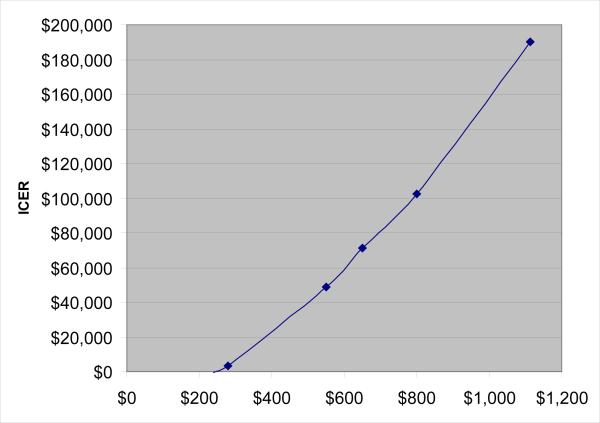
Fractures related to osteoporosis are associated with $20 billion in cost in the United States, with the majority of cost born by federal health-care programs, such as Medicare and Medicaid. Despite the proven fracture reduction benefits of several osteoporosis treatments, less than one-quarter of patients older than 65 years of age who fracture receive such care. A postfracture liaison service (FLS) has been developed in many health systems but has not been widely implemented in the United States. We developed a Markov state-transition computer simulation model to assess the cost-effectiveness of an FLS using a health-care system perspective. Using the model, we projected the lifetime costs and benefits of FLS, with or without a bone mineral density test, in men and women who had experienced a hip fracture. We estimated the costs and benefits of an FLS, the probabilities of refracture while on osteoporosis treatment, as well as the utilities associated with various health states from published literature. We used multi-way sensitivity analyses to examine impact of uncertainty in input parameters on cost-effectiveness of FLS. The model estimates that an FLS would result in 153 fewer fractures (109 hip, 5 wrist, 21 spine, 17 other), 37.43 more quality-adjusted life years (QALYs), and save $66,879 compared with typical postfracture care per every 10,000 postfracture patients. Doubling the cost of the FLS resulted in an incremental cost-effectiveness ratio (ICER) of $22,993 per QALY. The sensitivity analyses showed that results were robust to plausible ranges of input parameters; assuming the least favorable values of each of the major input parameters results in an ICER of $112,877 per QALY. An FLS targeting patients post-hip fracture should result in cost savings and reduced fractures under most scenarios.
Keywords: COST-EFFECTIVENESS; FRACTURE LIAISON SERVICE; HIP FRACTURE; OSTEOPOROSIS.
© 2014 American Society for Bone and Mineral Research.
Figures
References
-
- Board of Trustees FHITF Annual report. Services HaH. 2012:60. <zaq;2>.
-
- National Committee for Quality Assurance . 2010 The state of health care quality. NCQA; Washington, DC: 2010. p. 94.
-
- Recker RR, Lewiecki EM, Miller PD, Reiffel J. Safety of bisphosphonates in the treatment of osteoporosis. Am J Med. 2009;122(2 Suppl):S22–32. - PubMed
-
- Wells GA, Cranney A, Peterson J, et al. Alendronate for the primary and secondary prevention of osteoporotic fractures in postmenopausal women. Cochrane Database Syst Rev. 2008;(1):CD001155. - PubMed
-
- Dell R. Fracture prevention in Kaiser Permanente Southern California. Osteoporos Int. 2011;22(Suppl 3):457–60. - PubMed
Publication types
MeSH terms
Substances
Grants and funding
LinkOut - more resources
Full Text Sources
Other Literature Sources
Medical
