


Ageing and moisture uptake in polymethyl methacrylate (PMMA) bone cements
- PMID: 24445003
- PMCID: PMC3988952
- DOI: 10.1016/j.jmbbm.2013.12.010
Ageing and moisture uptake in polymethyl methacrylate (PMMA) bone cements
Abstract
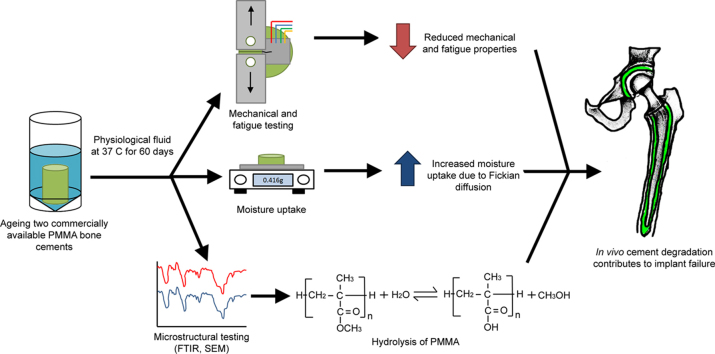
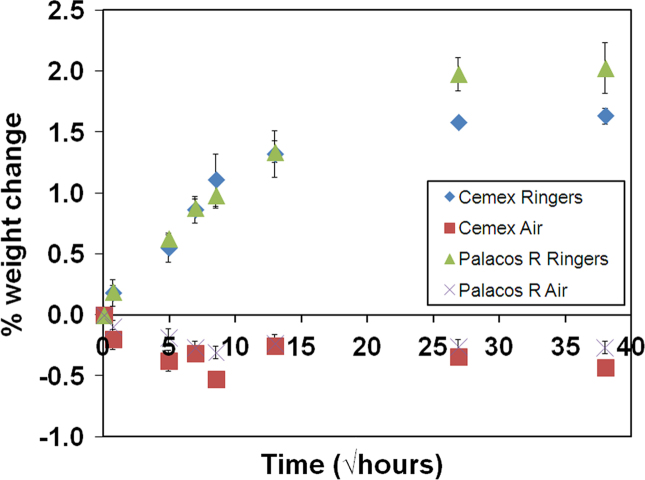
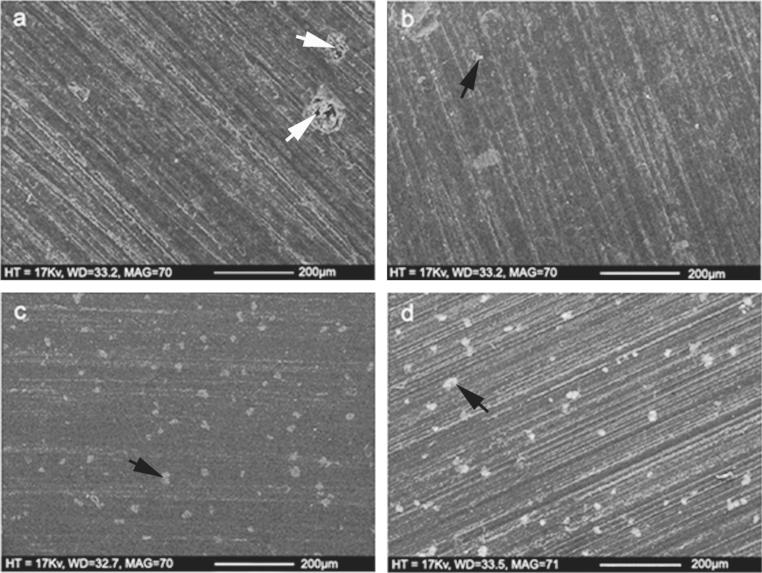
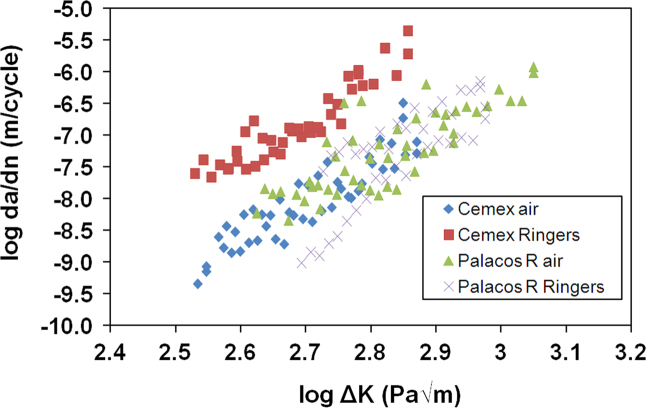
Bone cements are extensively employed in orthopaedics for joint arthroplasty, however implant failure in the form of aseptic loosening is known to occur after long-term use. The exact mechanism causing this is not well understood, however it is thought to arise from a combination of fatigue and chemical degradation resulting from the hostile in vivo environment. In this study, two commercial bone cements were aged in an isotonic fluid at physiological temperatures and changes in moisture uptake, microstructure and mechanical and fatigue properties were studied. Initial penetration of water into the cement followed Fickian diffusion and was thought to be caused by vacancies created by leaching monomer. An increase in weight of approximately 2% was experienced after 30 days ageing and was accompanied by hydrolysis of poly(methyl methacrylate) (PMMA) in the outermost layers of the cement. This molecular change and the plasticising effect of water resulted in reduced mechanical and fatigue properties over time. Cement ageing is therefore thought to be a key contributor in the long-term failure of cemented joint replacements. The results from this study have highlighted the need to develop cements capable of withstanding long-term degradation and for more accurate test methods, which fully account for physiological ageing.
Keywords: Biodegradation; Bone cement; Diffusion; Fatigue; Mechanical properties.
Copyright © 2013 The Authors. Published by Elsevier Ltd.. All rights reserved.
Figures
References
-
- Alfrey T., Gurnee E.F., Lloyd W.G. Diffusion in glassy polymers. J. Polym. Sci., Part C: Polym. Symptoms. 1966;12(1):249–261.
-
- Arnold J.C., Venditti N.P. Effects of environment on the creep properties of a poly(ethylmethacrylate) based bone cement. J. Mater. Sci. Mater. Med. 2001;12(8):707–717. - PubMed
-
- Ashby M.F., Jones D.R.H. Elsevier; Oxford: 2007. Engineering Materials 1: An Introduction to Properties, Applications and Design.
-
- Breusch S.J., Malchau H. Springer; Berlin: 2005. The Well-Cemented Total Hip Arthroplasty: Theory and Practice.
-
- Baker A.S., Greenham L.W. Release of gentamicin from acrylic bone cement. Elution and diffusion studies. J. Bone Jt. Surg. 1988;70(10):1551–1557. - PubMed
Publication types
MeSH terms
Substances
LinkOut - more resources
Full Text Sources
Other Literature Sources
