Review
. 2014 Jan 20;369(1637):20120472.
doi: 10.1098/rstb.2012.0472. Print 2014 Mar 5.

Relative timing: from behaviour to neurons

Affiliations
Review

Relative timing: from behaviour to neurons

S Mehdi Aghdaee et al. Philos Trans R Soc Lond B Biol Sci. .

Abstract

Processing of temporal information is critical to behaviour. Here, we review the phenomenology and mechanism of relative timing, ordinal comparisons between the timing of occurrence of events. Relative timing can be an implicit component of particular brain computations or can be an explicit, conscious judgement. Psychophysical measurements of explicit relative timing have revealed clues about the interaction of sensory signals in the brain as well as in the influence of internal states, such as attention, on those interactions. Evidence from human neurophysiological and functional imaging studies, neuropsychological examination in brain-lesioned patients, and temporary disruptive interventions such as transcranial magnetic stimulation (TMS), point to a role of the parietal cortex in relative timing. Relative timing has traditionally been modelled as a 'race' between competing neural signals. We propose an updated race process based on the integration of sensory evidence towards a decision threshold rather than simple signal propagation. The model suggests a general approach for identifying brain regions involved in relative timing, based on looking for trial-by-trial correlations between neural activity and temporal order judgements (TOJs). Finally, we show how the paradigm can be used to reveal signals related to TOJs in parietal cortex of monkeys trained in a TOJ task.

Keywords: parietal cortex; prior entry theory; race models; relative timing perception; temporal order judgement.


Figures
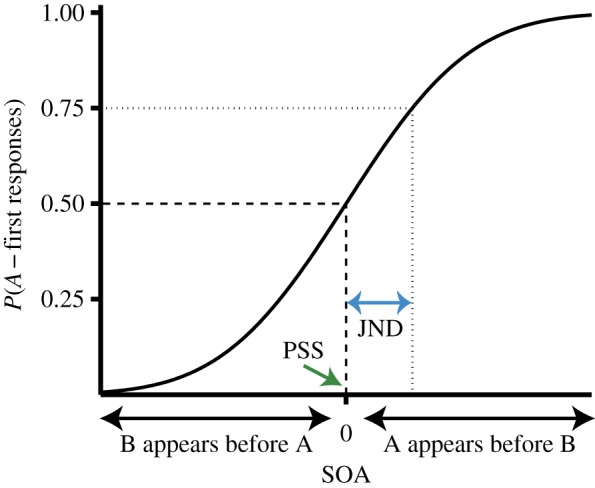
Figure 1.
Figure 1.
Hypothetical psychometric function from a temporal order judgement (TOJ) experiment. Two stimuli (A and B) are presented with a range of stimulus onset asynchronies (SOA). Subject's probability of reporting stimulus A appearing first is plotted as a function of SOA, defined as ‘stimulus A lead time’. SOA is positive when stimulus A is presented first and negative when stimulus B is presented first. The single-headed arrow (green) corresponds to the point of subjective simultaneity (PSS), the SOA that corresponds to 50% on the ordinate. The double-headed arrow (blue) indicates the just notable difference (JND), defined as half of the interquartile range. (Online version in colour.)
Figure 2.
Figure 2.
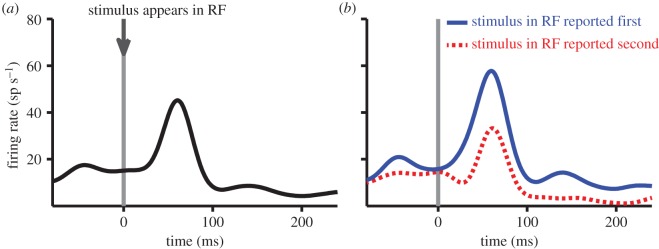
Response of a single LIP neuron for SOA = 0 ms. (a) Shows spike-rate function aligned to the appearance of the stimulus in RF, for all trials. (b) Depicts the same data, but with the trials divided by whether the animal reported the stimulus in the RF appearing first (solid blue) or second (dotted red). Spike-rate functions for individual units were generated by convolving 1-ms-binned histograms with a Gaussian function (SD = 15 ms). (Online version in colour.)

References

    1. Gibbon J, Church RM. 1990. Representation of time. Cognition 37, 23–54. (10.1016/0010-0277(90)90017-E) - DOI - PubMed
    1. Gallistel CR, Gibbon J. 2000. Time, rate, and conditioning. Psychol. Rev. 107, 289–344. (10.1037/0033-295X.107.2.289) - DOI - PubMed
    1. Schneiderman N, Gormezano I. 1964. Conditioning of the nicitating membrane of the rabbit as a function of CS-US interval. J. Comp. Physiol. Psychol. 57, 188–195. (10.1037/h0043419) - DOI - PubMed
    1. Buhusi CV, Meck WH. 2005. What makes us tick? Functional and neural mechanisms of interval timing. Nat. Rev. Neurosci. 6, 755–765. (10.1038/nrn1764) - DOI - PubMed
    1. Alais D, Blake R, Lee SH. 1998. Visual features that vary together over time group together over space. Nat. Neurosci. 1, 160–164. (10.1038/1151) - DOI - PubMed

LinkOut - more resources