Therapeutic alliance in face-to-face and telephone-administered cognitive behavioral therapy
- PMID: 24447003
- PMCID: PMC3966946
- DOI: 10.1037/a0035554
Therapeutic alliance in face-to-face and telephone-administered cognitive behavioral therapy
Abstract
Objective: Telephone-administered therapies have emerged as an alternative method of delivery for the treatment of depression, yet concerns persist that the use of the telephone may have a deleterious effect on therapeutic alliance. The purpose of this study was to compare therapeutic alliance in clients receiving cognitive behavioral therapy (CBT) for depression by telephone (T-CBT) or face-to-face (FtF-CBT).
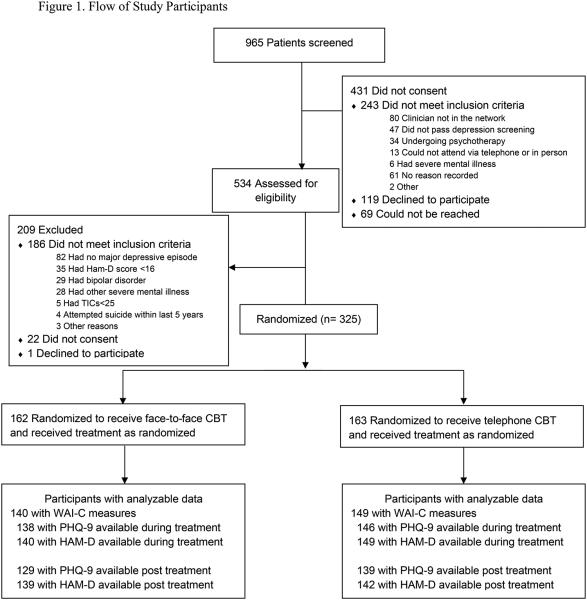
Method: We randomized 325 participants to receive 18 sessions of T-CBT or FtF-CBT. The Working Alliance Inventory (WAI) was administered at Weeks 4 and 14. Depression was measured during treatment and over 1 year posttreatment follow-up using the Hamilton Rating Scale for Depression and Patient Health Questionnaire-9.
Results: There were no significant differences in client or therapist WAI between T-CBT or FtF-CBT (Cohen's f² ranged from 0 to .013, all ps > .05). All WAI scores predicted depression end of treatment outcomes (Cohen's f² ranged from .009 to .06, all ps < .02). The relationship between the WAI and depression outcomes did not vary by treatment group (Cohen's f² ranged from 0 to .004, ps > .07). The WAI did not significantly predict depression during posttreatment follow-up (all ps > .12).
Conclusions: Results from this analysis do not support the hypothesis that the use of the telephone to provide CBT reduces therapeutic alliance relative to FtF-CBT.
Figures
References
-
- Beck JS. Cognitive Therapy: Basics and Beyond. Guilford Press; New York, NY: 1995.
-
- Beckner V, Vella L, Howard I, Mohr DC. Alliance in two telephone-administered treatments: relationship with depression and health outcomes. Journal of Consulting and Clinical Psychology. 2007;75(3):508–512. doi: 10.1037/0022-006X.75.3.508. - PubMed
-
- Bordin ES. The generalizability of the psychoanalytic concept of the working alliance. Psychotherapy: Theory, Research & Practice. 1979;16(3):252–260. doi: 10.1037/h0085885.
-
- Corson K, Gerrity MS, Dobscha SK. Screening for depression and suicidality in a VA primary care setting: 2 items are better than 1. American Journal of Managed Care. 2004;10:839–845. - PubMed
Publication types
MeSH terms
Grants and funding
LinkOut - more resources
Full Text Sources
Other Literature Sources
Miscellaneous