


Body mass index and circulating oestrone sulphate in women treated with adjuvant letrozole
- PMID: 24448359
- PMCID: PMC3950872
- DOI: 10.1038/bjc.2014.2
Body mass index and circulating oestrone sulphate in women treated with adjuvant letrozole
Abstract
Background: Obesity is an independent adverse prognostic factor in early breast cancer patients, but it is still controversial whether obesity may affect adjuvant endocrine therapy efficacy. The aim of our study (ancillary to the two clinical trials Gruppo Italiano Mammella (GIM)4 and GIM5) was to investigate whether the circulating oestrogen levels during treatment with the aromatase inhibitor letrozole are related to body mass index (BMI) in postmenopausal women with breast cancer.
Methods: Plasma concentration of oestrone sulphate (ES) was evaluated by radioimmunoassay in 370 patients. Plasma samples were obtained after at least 6 weeks of letrozole therapy (steady-state time). Patients were divided into four groups according to BMI. Differences among the geometric means (by ANOVA and ANCOVA) and correlation (by Spearman's rho) between the ES levels and BMI were assessed.
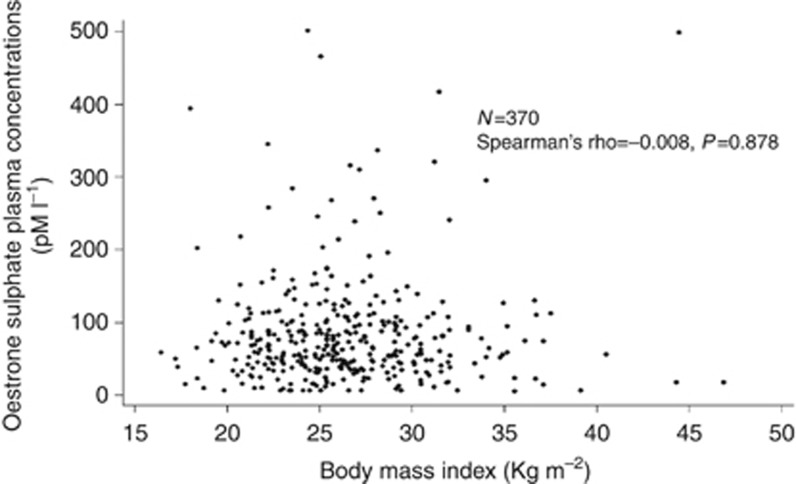
Results: Picomolar geometric mean values (95% confidence interval, n=patients) of circulating ES during letrozole were 58.6 (51.0-67.2, n=150) when BMI was <25.0 kg m(-2); 65.6 (57.8-74.6, n=154) when 25.0-29.9 kg m(-2); 59.3 (47.1-74.6, n=50) when 30.0-34.9 kg m(-2); and 43.3 (23.0-81.7, n=16) when ≥35.0 kg m(-2). No statistically significant difference in terms of ES levels among groups and no correlation with BMI were observed.
Conclusions: Body mass index does not seem to affect circulating oestrogen levels in letrozole-treated patients.
Figures
References
-
- Brind JL, Chervinsky K, Völgelman JH, Orentreich N. Radioimmunoassay of estrone sulfate in the serum of normal men after a non-chromatographic procedure that eliminates interference from dehydroepiandrosterone sulphate. Steroids. 1990;55:32–35. - PubMed
-
- Carpenter CL, Ross RK, Paganini-Hill A, Bernstein L. Effect of family history, obesity and exercise on breast cancer risk among postmenopausal women. Int J Cancer. 2003;106:96–102. - PubMed
-
- Diorio C, Lemieux J, Provencher L, Hogue JC, Vachon E. Aromatase inhibitors in obese breast cancer patients are not associated with increased plasma estradiol levels. Breast Cancer Res Treat. 2012;136:573–579. - PubMed
-
- Dixon JM, Renshaw L, Young O, Murray J, Macaskill EJ, McHugh M, Folkerd E, Cameron DA, A'Hern RP, Dowsett M. Letrozole suppresses plasma estradiol and estrone sulphate more completely than anastrozole in postmenopausal women with breast cancer. J Clin Oncol. 2008;26:1671–1676. - PubMed
Publication types
MeSH terms
Substances
LinkOut - more resources
Full Text Sources
Other Literature Sources
Medical
