. 2014:3:e01488.
doi: 10.7554/eLife.01488. Epub 2014 Jan 21.

Computation identifies structural features that govern neuronal firing properties in slowly adapting touch receptors

Affiliations

Computation identifies structural features that govern neuronal firing properties in slowly adapting touch receptors

Daine R Lesniak et al. Elife. 2014.

Abstract

Touch is encoded by cutaneous sensory neurons with diverse morphologies and physiological outputs. How neuronal architecture influences response properties is unknown. To elucidate the origin of firing patterns in branched mechanoreceptors, we combined neuroanatomy, electrophysiology and computation to analyze mouse slowly adapting type I (SAI) afferents. These vertebrate touch receptors, which innervate Merkel cells, encode shape and texture. SAI afferents displayed a high degree of variability in touch-evoked firing and peripheral anatomy. The functional consequence of differences in anatomical architecture was tested by constructing network models representing sequential steps of mechanosensory encoding: skin displacement at touch receptors, mechanotransduction and action-potential initiation. A systematic survey of arbor configurations predicted that the arrangement of mechanotransduction sites at heminodes is a key structural feature that accounts in part for an afferent's firing properties. These findings identify an anatomical correlate and plausible mechanism to explain the driver effect first described by Adrian and Zotterman. DOI: http://dx.doi.org/10.7554/eLife.01488.001.

Keywords: Merkel cell; NaV1.6; computational modeling; skin; somatosensory; tactile.


Conflict of interest statement

The authors declare that no competing interests exist.

Figures

Figure 1.
Figure 1.. Morphometry of touch-dome afferents reveals diverse end-organ architectures.
(A) Schematic of the SAI afferent’s end organ. (B and C) SAI afferents, labeled with antibodies against Neurofilament-H (NFH; cyan) and Myelin Basic Protein (MBP; magenta), were identified by their connection to Keratin 8-positive Merkel cells (K8; blue) in touch-dome cryosections. The voltage-gated sodium channel NaV1.6 (yellow) localized to heminodes (B) and nodes of Ranvier (C). Scale bar in C (10 µm) applies to B. (DF) Projections of touch domes labeled in whole mount. (D) NFH (red), MBP (green) and K8 (blue) labeled Merkel cells contacted by a single myelinated afferent (see also Video 1) or (E) two afferent branches whose point of convergence was not identified (see also Video 2). Arrows: examples of heminodes; arrowheads: examples of nodes of Ranvier. (F) NaV1.6 (green) identified heminodes and nodes in an NFH-positive afferent (red) innervating K8-positive Merkel cells (blue). Inset shows an expanded view of an NaV1.6-positive node. Scale bar in F (50 µm) applies to DF’. (D’F’) Projections of 3D reconstructions of end organs shown above: afferent (black), Merkel cells (green), heminodes (red half-circles) and nodes (red circles). (E’) A non-converging branch is marked in gray. Note that this branch is thinner than other myelinated branches. (G) The highest branching order found in each SAI afferent arbor was independent of the number of Merkel cells contacted. (H) Morphometric quantification of reconstructed touch domes innervated by single afferents. (I) More than 80% of Merkel cells were contacted by neurites and a similar proportion of terminal neurites contacted Merkel cells (N = 15 touch domes from five mice in GI). Red lines represent median values in H and I. DOI: http://dx.doi.org/10.7554/eLife.01488.003
Figure 2.
Figure 2.. Merkel cell–neurite complexes are asymmetrically distributed between heminodes.
(A) Distribution of terminal neurites per heminode (N = 219 neurites). (B) Histogram of the number of Merkel cells contacted by each terminal neurite (N = 226 Merkel cells). Red: Gaussian fit (R2 = 0.99). (C) Confocal projection of six terminal neurites contacting individual Merkel cells (asterisks). (D) A projection of a single terminal neurite contacting a chain of four Merkel cells (asterisks). Arrowheads denote heminodes and scale bar (25 µm) applies to C and D. (E and F) The distribution of Merkel cell–neurite complexes per heminode from pooled touch-dome afferents (E; N = 51 heminodes from 15 touch domes) and within individual tactile arbors (F). In F, number of Merkel cells at each heminode from three touch domes is plotted from the largest, or primary (1°), cluster to the smallest, quaternary (4°), clusters. Representative touch domes across the skew range are shown and linear regressions are plotted (slopes = −0.6, −2.3 and −4.5, R2 = 0.6, 0.99, 1.0). See also Figure 2—figure supplement 1. DOI: http://dx.doi.org/10.7554/eLife.01488.006
Figure 2—figure supplement 1.
Figure 2—figure supplement 1.. Skew values for each touch dome plotted vs the number of Merkel cell-neurite complexes in the arbor.
Orange symbols denote the skew values for modeled arbors in Figure 5B, which were chosen to encompass the skew range observed for most SAI arbors. DOI: http://dx.doi.org/10.7554/eLife.01488.007
Figure 3.
Figure 3.. Physiological response properties vary between mouse SAI afferents.
(A) Extracellular recordings from an SAI afferent stimulated at two displacement magnitudes demonstrates the biphasic SAI response, which is characterized by high-frequency firing during the ramp phase, as well as slow adaptation and variable spike timing during the static phase. (B) Displacement–response relations from individual SAI afferents. Legend indicates the number of Merkel cells in each touch dome quantified based on GFP fluorescence. Responses from receptive fields with large end organs (blue) and small end organs (orange) are shown. Firing rates during the static phase are plotted (mean ± SD, N = 3–12 stimuli per displacement magnitude). Data were fitted with single exponentials to estimate mechanical sensitivity (κ) and threshold firing rate (Y0; R2 = 0.63–0.99). (C) Merkel cells (green) from Atoh1/nGFP transgenic mice selectively express GFP. The receptive field of the SAI afferent in A is shown (dotted line). (D) Force-displacement relations measured during the recordings shown in B. Skin mechanics were indistinguishable between these recordings. DOI: http://dx.doi.org/10.7554/eLife.01488.008
Figure 4.
Figure 4.. Computational modeling recapitulates characteristic features of the SAI response.
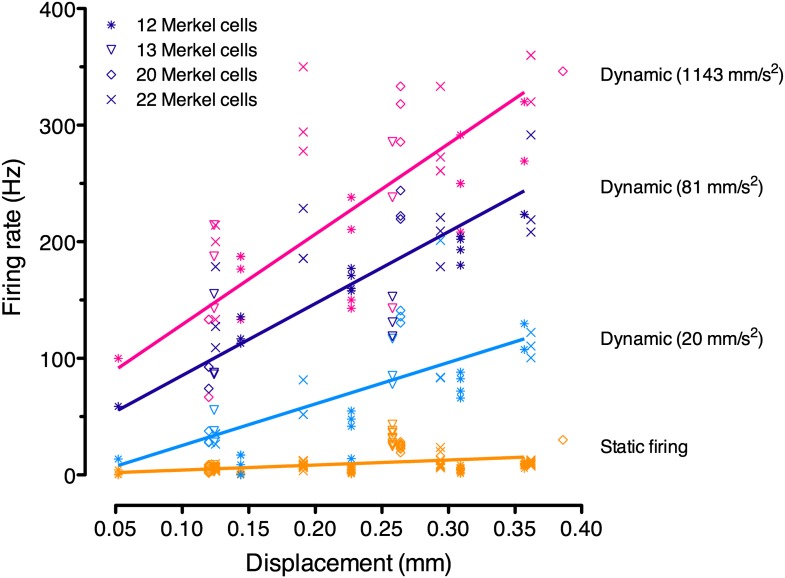
(A) The network model configuration for the reconstructed SAI afferent in Figure 1D’. (B) Data flow through computational models and example outputs from each module: a finite element model (FEM) produces strain energy density (SED) at transduction units, transduction functions (Trans <# merkel cell–neurite complexes>) predict transduction currents (I(t)) and a leaky integrate-and-fire (LIF) array produces spike times. (C) The model’s predicted spike-timing variability, assessed by the distribution of normalized ISIs during static-phase responses (black bars: N = 1,591 intervals), corresponded to the skewed Gaussian distribution previously reported for mouse SAI afferents (orange bars: N = 3,348 intervals from 11 afferents; Wellnitz et al., 2010). To compare ISIs across a range of displacement magnitudes, each ISI was normalized to the mean interval for its stimulus. (D) Simulated firing rates (black symbols) from the model configuration in A were fitted to linear regressions of ramp-phase (blue dotted line: ramp acceleration = 20 mm·s−2, pink dotted line: ramp acceleration = 1143 mm·s−2) and static (orange dotted line) responses pooled from the SAI afferents shown in Figure 3B. Goodness of fit = 0.96 (fractional sum of squares). (E) Displacement–response relations from models configured with different primary cluster sizes. All configurations had 17 total transduction units and four spike initiation zones. Mean firing rates during the static phase of displacement are plotted (mean ± SD, N = 15 simulations per displacement). Displacement-response curves were compared by fitting with exponential regressions (R2 ≥ 0.99). Increasing or decreasing primary cluster size by two transduction units significantly changed the best fits (8 vs 10: p=0.004; 6 vs 8: p=0.017, extra sum-of-squares F test). Legend indicates the distribution of transduction units at spike initiation zones. DOI: http://dx.doi.org/10.7554/eLife.01488.009
Figure 4—figure supplement 1.
Figure 4—figure supplement 1.. Linear regression analysis of pooled responses from the four SAI afferents in Figure 3B (denoted by symbols; N = 3–12 stimuli per displacement magnitude).
Displacements were ramped into the skin at three accelerations, which were analyzed separately (purple: 1143 mm·s−2; black: 81 mm·s−2; cyan: 20 mm·s−2). Static firing rates (orange) were pooled for regression analysis as they did not differ significantly between ramp accelerations. These regressions were used for model fitting. DOI: http://dx.doi.org/10.7554/eLife.01488.010
Figure 5.
Figure 5.. A survey of computational parameter space predicts that the number and arrangement of mechanosensory transduction units modulates SAI-afferent firing properties.
(A) Two strategies for adding transduction units to an SAI-afferent arbor were tested in four independent model end organs (Arbors 1–4). Arbor configurations differed in number of spike initiation zones (3–5) and initial end-organ sizes (13–20). Transduction units were added progressively to either secondary (solid lines) or smallest clusters (dashed lines). Orange symbols highlight examples from the two strategies after adding multiple transduction units. Example cluster arrangements are indicated in brackets. Clusters changed from the initial configuration are indicated in orange font. The percent change in firing rate from baseline configuration is plotted. (B) Comparison of displacement–response relations (mean ± SD, N = 15 stimuli per displacement magnitude) for two model configurations indicated in brackets: a skewed distribution of 12 transduction units among three spike initiation zones (gray) and an equal distribution of 20 transduction units among five spike initiation zones (black). Simulation results were fitted with single exponential equations (R2 ≥ 0.99). The mechanical sensitivity of the small end organ was predicted to be significantly greater than that of the large end organ (κ = 7.7 and 5.0, respectively, p=0.005, extra sum-of-squares F test). DOI: http://dx.doi.org/10.7554/eLife.01488.012

References

    1. Adrian ED, Zotterman Y. 1926a. The impulses produced by sensory nerve endings: part 3. Impulses set up by touch and pressure. The Journal of Physiology 61:465–483 - PMC - PubMed
    1. Adrian ED, Zotterman Y. 1926b. The impulses produced by sensory nerve-endings: part II. The response of a Single End-Organ. The Journal of Physiology 61:151–171 - PMC - PubMed
    1. Banks RW, Hulliger M, Scheepstra KA, Otten E. 1997. Pacemaker activity in a sensory ending with multiple encoding sites: the cat muscle spindle primary ending. The Journal of Physiology 498:177–199 - PMC - PubMed
    1. Baranauskas G, David Y, Fleidervish IA. 2013. Spatial mismatch between the Na+ flux and spike initiation in axon initial segment. Proceedings of the National Academy of Sciences of the United States of America 110:4051–4056. 10.1073/pnas.1215125110 - DOI - PMC - PubMed
    1. Black JA, Renganathan M, Waxman SG. 2002. Sodium channel Na(v)1.6 is expressed along nonmyelinated axons and it contributes to conduction. Brain Research Molecular Brain Research 105:19–28. 10.1016/S0169-328X(02)00385-6 - DOI - PubMed

Publication types

MeSH terms

LinkOut - more resources