Review
. 2014 Feb;15(2):118-27.
doi: 10.1038/ni.2787.

Unifying immunology with informatics and multiscale biology

Affiliations
Review

Unifying immunology with informatics and multiscale biology

Brian A Kidd et al. Nat Immunol. 2014 Feb.

Erratum in

  • Nat Immunol. 2014 Sep;15(9):894

Abstract

The immune system is a highly complex and dynamic system. Historically, the most common scientific and clinical practice has been to evaluate its individual components. This kind of approach cannot always expose the interconnecting pathways that control immune-system responses and does not reveal how the immune system works across multiple biological systems and scales. High-throughput technologies can be used to measure thousands of parameters of the immune system at a genome-wide scale. These system-wide surveys yield massive amounts of quantitative data that provide a means to monitor and probe immune-system function. New integrative analyses can help synthesize and transform these data into valuable biological insight. Here we review some of the computational analysis tools for high-dimensional data and how they can be applied to immunology.


Figures

Figure 1
Figure 1
Integrating biological data from multiple sources to construct regulatory network models. State-of-the-art computational techniques combine information from large-scale public data sets with omics measurements collected from the samples under study to generate multiscale causal models. Whenever possible, samples should be collected from multiple tissues or states in an individual (for example, diseased and healthy) at several time points. Measurements from single tissues miss important context-specific regulatory interactions that are responsible for disease. Single time points (cross-sectional studies) fail to capture the system dynamics and often require larger sample sizes to detect intersample variability. WGS, whole-genome sequencing. Ab, antibody.
Figure 2
Figure 2
Identifying drugs to treat diseases by using networks. (a) A drug can target the product of a gene within the network and influence disease if the drug acts directly on the gene product from the disease-associated gene (left) or by modulating a gene product that then influences the gene associated with disease (right). (b) Schematic network of drug–immune system–disease interactions. Individual genes from a Bayesian causal regulatory network (macrophage-enriched) have been aggregated into modules using Gene Ontology (GO) terms and are shown schematically as light blue circles. Diseases associated with genes through GWAS are shown as triangles and connected to a gene module if the SNP resides on one of the genes inside it. Drugs from DrugBank have been organized into anatomical therapeutic chemical classes, and are displayed as colored squares. Categories are connected to gene modules if at least one gene product is the known target for one of the drugs in the class. Size of each shape is proportional to the number of elements (genes or drugs) it contains.
Figure 3
Figure 3
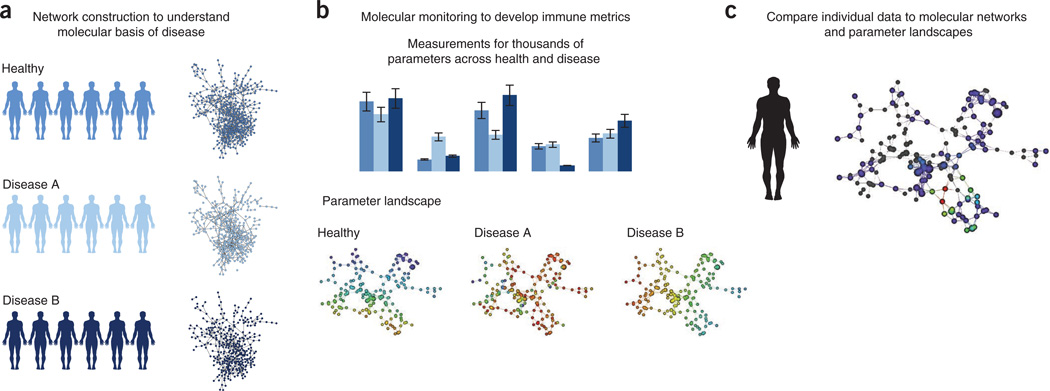
Constructing causal regulatory networks to understand the immunological basis of disease and advance precision medicine. (a) Cohorts of patients provide data that lead to tissue-specific and cell type–specific networks for health and various diseases. These regulatory networks allow for cross-condition comparisons to understand the molecular basis of immunological diseases. (b) Measurements collected from omics networks can be used to estimate the dynamic range for each molecular measurement and to develop the parameter landscape for various healthy and diseased conditions. (c) Data collected from individual patients can be projected onto molecular networks and parameter landscapes to construct a personal profile for informing medical decisions.

References

    1. Pascual V, Chaussabel D, Banchereau J. A genomic approach to human autoimmune diseases. Annu. Rev. Immunol. 2010;28:535–571. - PMC - PubMed
    1. Boisson B, et al. Immunodeficiency, autoinflammation and amylopectinosis in humans with inherited HOIL-1 and LUBAC deficiency. Nat. Immunol. 2012;13:1178–1186. - PMC - PubMed
    1. Chaussabel D, et al. A modular analysis framework for blood genomics studies: application to systemic lupus erythematosus. Immunity. 2008;29:150–164. - PMC - PubMed
    1. Querec TD, et al. Systems biology approach predicts immunogenicity of the yellow fever vaccine in humans. Nat. Immunol. 2009;10:116–125. - PMC - PubMed
    1. Nakaya HI, et al. Systems biology of vaccination for seasonal influenza in humans. Nat. Immunol. 2011;12:786–795. - PMC - PubMed

Publication types