Review
. 2014 Mar;44(3):617-26.
doi: 10.1002/eji.201344301. Epub 2014 Feb 16.

Diabetes and immunity to tuberculosis

Affiliations
Review

Diabetes and immunity to tuberculosis

Nuria Martinez et al. Eur J Immunol. 2014 Mar.

Abstract

The dual burden of tuberculosis (TB) and diabetes has attracted much attention in the past decade as diabetes prevalence has increased dramatically in countries already afflicted with a high burden of TB. The confluence of these two major diseases presents a serious threat to global public health; at the same time it also presents an opportunity to learn more about the key elements of human immunity to TB that may be relevant to the general population. Some effects of diabetes on innate and adaptive immunity that are potentially relevant to TB defense have been identified, but have yet to be verified in humans and are unlikely to fully explain the interaction of these two disease states. This review provides an update on the clinical and epidemiological features of TB in the diabetic population and relates them to recent advances in understanding the mechanistic basis of TB susceptibility and other complications of diabetes. Issues that merit further investigation - such as geographic host and pathogen differences in the diabetes/TB interaction, the role of hyperglycemia-induced epigenetic reprogramming in immune dysfunction, and the impact of diabetes on lung injury and fibrosis caused by TB - are highlighted in this review.

Keywords: Bacterial infections; Diabetes; Host/pathogen interaction; Infectious disease; Tuberculosis.


Conflict of interest statement

Conflict of interest: The authors declare no financial or commercial conflict of interest.

Figures

Figure 1
Figure 1
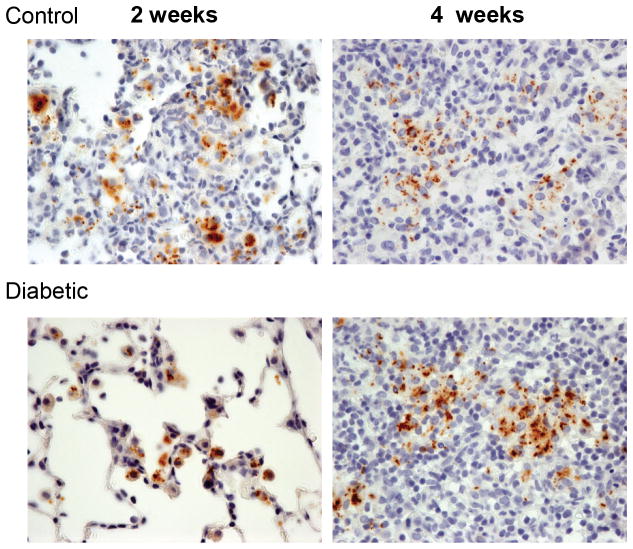
Diabetes affects early events in the host-pathogen interaction of TB. Control C57BL/6 mice (top) and mice with 12 weeks of STZ-induced diabetes (bottom) were challenged with ~100 CFU of Mtb Erdman by aerosol [28]. Lung sections prepared from mice after 2 weeks (left) or 4 weeks (right) of TB disease were stained with anti-PPD Ab to detect infecting bacilli (brown). At the 2-week time point, sites of Mtb infection in control mice were characterized by aggregates of recruited myeloid cells. In contrast, the lungs of diabetic mice contained Mtb-infected alveolar macrophages with few or no recruited myeloid cells in their vicinity. After 4 weeks of TB disease, the lesions of control and diabetic mice were indistinguishable. This is interpreted as reflecting a delay in initiating an innate response by alveolar macrophages initially infected with inhaled Mtb [28]. Original magnification ×400.
Figure 2
Figure 2
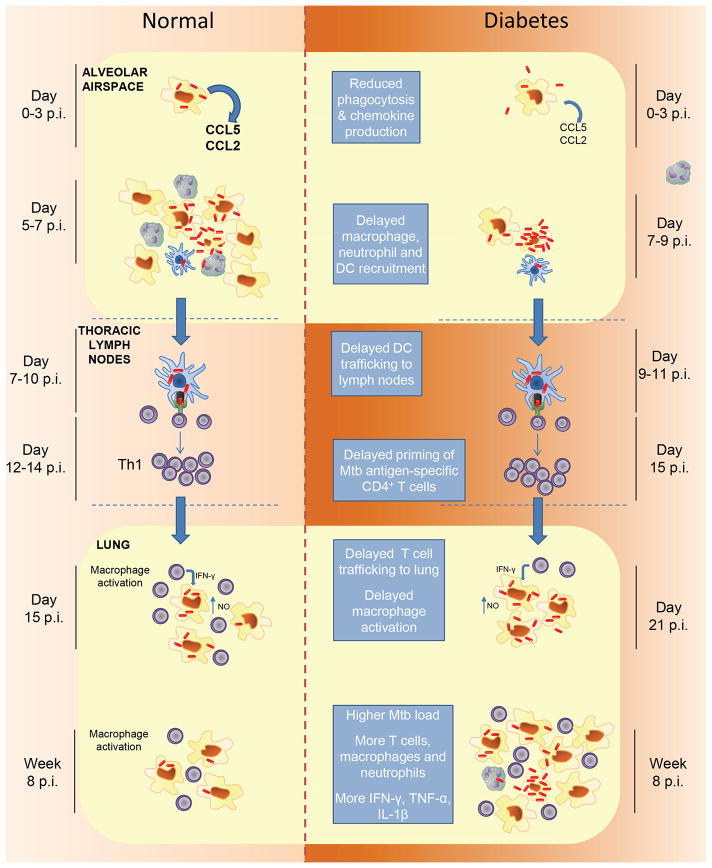
A proposed model for TB susceptibility in DM. A defective innate response to inhaled Mtb by diabetic hosts results in a critical delay in priming adaptive immunity. Resident alveolar macrophages are the first cells to become infected with inhaled Mtb. They fail to restrict Mtb replication but in non-diabetic hosts (left) produce signals that recruit na macrophages, neutrophils and mDCs to the alveolus. Infection spreads to recruited cells, including mDCs [18], which then transport bacilli to lung-draining lymph nodes where the adaptive response is primed (Day 7–10 p.i.). Antigen-specific T cells traffic to the lungs and mediate an effector response capable of restricting Mtb replication (Day 15 p.i.). Diabetic hosts (right) are slow to mount an innate response to the alveolar macrophages initially infected with Mtb. The delay in recruiting mDCs to the alveolar airspace to acquire bacilli leads to downstream delays in their delivery of antigen to thoracic lymph nodes and the subsequent expression of adaptive immunity in the lung during the period of logarithmic Mtb replication. This results in a higher plateau lung bacterial load once effective control is exerted, associated with increased severity of immune pathology and worse outcomes in TB/DM. Additional factors contributing to excessive inflammation may be a relative deficiency of Treg cells [57], accelerated death of Mtb-infected macrophages due to elevated intracellular methylglyoxal [73], and intrinsic proinflammatory effects of DM resulting from increased mitochondrial generation of superoxide [65]. The timeline of events following inhalation of Mtb are based on data published by Vallerskog et al. [28].

References

    1. Gauld WR, Lyall A. Tuberculosis as a complication of diabetes mellitus. Brit Med J. 1947;1:677–679. - PMC - PubMed
    1. Chen L, Magliano DJ, Zimmet PZL. The worldwide epidemiology of type 2 diabetes mellitus – present and future perspectives. Nat Rev Endocrinol. 2011;8:228–236. - PubMed
    1. Webb EA, Hesseling AC, Schaaf HS, Gie RP, Lombard CJ, Spitaels A, Delport S, et al. High prevalence of Mycobacterium tuberculosis infection and disease in children and adolescents with type 1 diabetes mellitus. Int J Tuberc Lung Dis. 2009;13:868–874. - PubMed
    1. Brownlee M. Biochemistry and molecular cell biology of diabetic complications. Nature. 2001;414:813–820. - PubMed
    1. Jeon CY, Murray MB. Diabetes mellitus increases the risk of active tuberculosis: a systematic review of 13 observational studies. PLoS Med. 2008;5:e152. - PMC - PubMed

Publication types

LinkOut - more resources