. 2014 Mar;172(6):2849-65.
doi: 10.1007/s12010-013-0712-2. Epub 2014 Jan 22.

In vitro studies on the relationship between the antioxidant activities of some berry extracts and their binding properties to serum albumin

Affiliations

In vitro studies on the relationship between the antioxidant activities of some berry extracts and their binding properties to serum albumin

Jacek Namiesnik et al. Appl Biochem Biotechnol. 2014 Mar.

Abstract

The aim of this study was to investigate the possibility to use the bioactive components from cape gooseberry (Physalis peruviana), blueberry (Vaccinium corymbosum), and cranberry (Vaccinium macrocarpon) extracts as a novel source against oxidation in food supplementation. The quantitative analysis of bioactive compounds (polyphenols, flavonoids, flavanols, carotenoids, and chlorophyll) was based on radical scavenging spectrophometric assays and mass spectrometry. The total phenolic content was the highest (P < 0.05) in water extract of blueberries (46.6 ± 4.2 mg GAE/g DW). The highest antioxidant activities by 2,2-diphenyl-1-picrylhydrazyl radical scavenging assay and Cupric reducing antioxidant capacity were in water extracts of blueberries, showing 108.1 ± 7.2 and 131.1 ± 9.6 μMTE/g DW with correlation coefficients of 0.9918 and 0.9925, and by β-carotene linoleate assay at 80.1 ± 6.6 % with correlation coefficient of 0.9909, respectively. The water extracts of berries exhibited high binding properties with human serum albumin in comparison with quercetin. In conclusion, the bioactive compounds from a relatively new source of gooseberries in comparison with blueberries and cranberries have the potential as food supplementation for human health. The antioxidant and binding activities of berries depend on their bioactive compounds.


Conflict of interest statement

The authors declare that there is no conflict of interest.

Figures
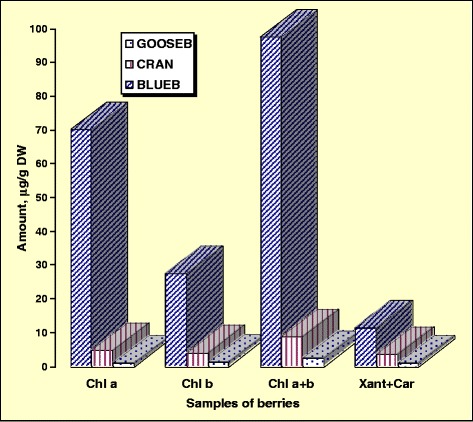
Fig. 1
Fig. 1
Chlorophyll and carotenoid levels in berries. Values are means ± SD: ±7.15, ±0.48, and ±0.01 for Chl a in BLUEB, CRAN, and GOOSEB, respectively; ±2.45, ±0.43, and ±0.01 for Chl b in BLUEB, CRAN, and GOOSEB, respectively; ±10.08, ±0. 86, and ±0.12 for Chl a + b in BLUEB, CRAN, and GOOSEB, respectively; ±1.25, ±0. 34, and ±0.08 for Xant + Car in BLUEB, CRAN, and GOOSEB, respectively. Chl chlorophyll, Xant xanthophylls, car carotenes, GOOSEB gooseberries, CRAN cranberries, BLUEB blueberries
Fig. 2
Fig. 2
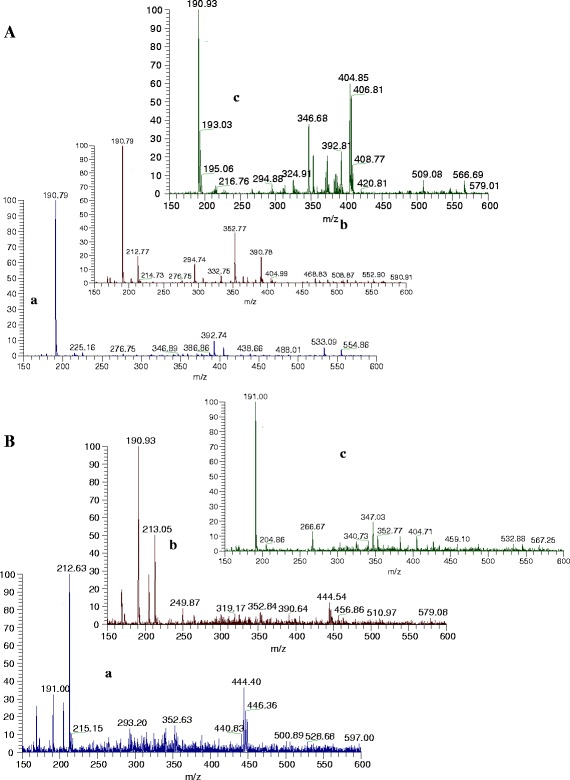
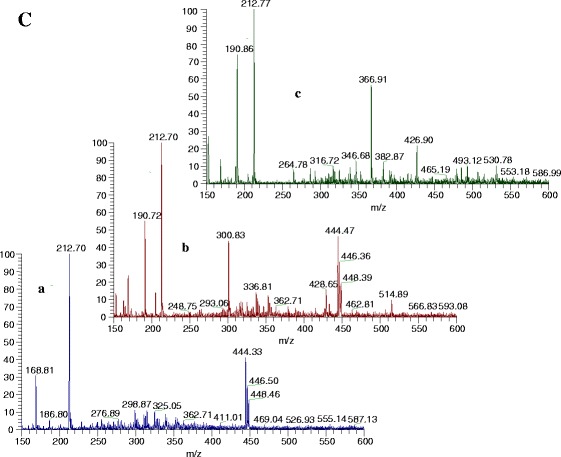
ESI-MS spectra of extracted fractions from three studied berries. a Aqueous, b ethyl acetate, and c diethyl ether of a gooseberries, b cranberries, and c blueberries in negative ion mode. Phenolic compounds were identified at m/z based on the mass spectra data
Fig. 2
Fig. 2
ESI-MS spectra of extracted fractions from three studied berries. a Aqueous, b ethyl acetate, and c diethyl ether of a gooseberries, b cranberries, and c blueberries in negative ion mode. Phenolic compounds were identified at m/z based on the mass spectra data
Fig. 3
Fig. 3
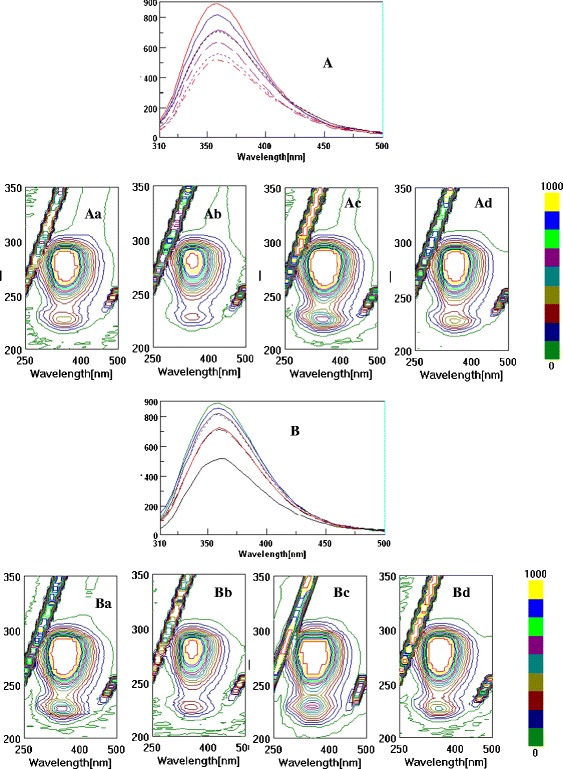
Two-dimensional fluorescence (2D-FL) and three (3D-FL) spectra illustrate the interaction between HSA, quercetin, aqueous (positions Aa, Ab, Ac, and Ad), and ethyl acetate (positions Ba, Bb, Bc, and Bd) extracts of studied berries. a Change in the fluorescence intensity as a result of binding affinity with water extracts: HSA [first line from the top with FI of 890.21], HSA + WGOOSEB (second line from the top with FI = 817.50), HSA + WCRAN (third line, FI = 717.39), HSA + WBLUEB (fourth line, FI = 709.75), HSA + WGOOSEB + QUE (fifth line, FI = 635.24), HSA + WCRAN + QUE (sixth line, FI = 560.83), and HSA + WBLUEB + QUE (seventh line, FI = 518.96). AaAd cross maps from the 3D-FL spectrum of HSA + WBLUEB, HSA + WBLUEB + QUE, HSA + WGOOSEB, and HSA + WGOOSEB + QUE. b Change in the fluorescence intensity as a result of binding affinity of HSA with ethyl acetate extracts: HSA [first line from the top with FI of 890.21], HSA + EtOAcGOOSEB (second line, FI = 834.70), HSA + EtOAcCRAN (third line, FI = 821.65), HSA + EtOAcBLUEB (fourth line, FI = 811.70), HSA + EtOAcGOOSEB + QUE (fifth line, FI = 724.76), HSA + EtOAcCRAN + QUE (sixth line, FI = 713.41), and HSA + EtOAcBLUEB + QUE (seventh line, FI = 618.96). BaBd cross maps from the 3D-FL spectrum of HSA + EtOAcBLUEB, HSA + EtOAcBLUEB + QUE, HSA + EtOAcGOOSEB, and HSA + EtOAcGOOSEB + QUE. In all reactions, the following conditions were used: HSA (2.0 × 10−6 mol/L), quercetin (1.7 × 10−6 mol/L), and water and EtOAc extracts in concentration of 25 and 50 μg/ml, respectively. Binding was during 1 h at 25 °C. Fluorescence intensities are on y-axis and emission wavelengths are on x-axis. HSA human serum albumin, QUE quercetin, EtOAc ethyl acetate, WGOOSEB water extracts of gooseberry, WCRAN water extracts of cranberry, WBLUEB water extracts of blueberry, EtOAcGOOSEB ethyl acetate extracts of gooseberry, EtOAcCRAN ethyl acetate extracts of cranberry, EtOAcBLUEB ethyl acetate extracts of blueberry
Fig. 4
Fig. 4
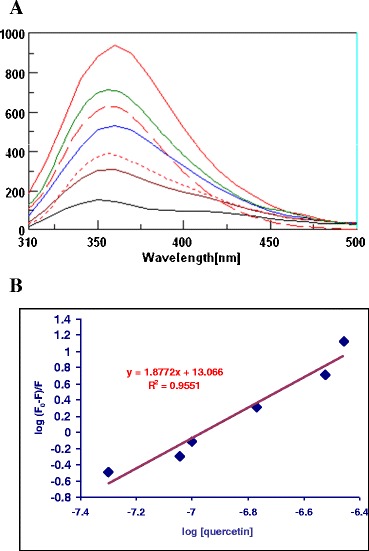
a Fluorescence spectra of aqueous solutions of HSA (2.0 × 10−6 mol/L) in the presence of different concentrations of quercetin: 0, 0.17, 0.30, 1.0, and 1.7 × 10−6) mol/L at pH 7.4 at excitation wavelength of 290 nm. b Linear plot for log (F 0 − F)/F vs log [quercetin], where F 0 and F represent the fluorescence intensity of HSA in the absence and in the presence of polyphenols, respectively

References

    1. Battino M, Beekwilder J, Denoyes-Rothan B, Laimer M, McDougall GJ, Mezzetti B. Nutrition Review. 2009;67(Suppl. 1):S145–S150. doi: 10.1111/j.1753-4887.2009.00178.x. - DOI - PubMed
    1. Bean H, Schuler C, Leggett RE, Levin RM. International Urology and Nephrology. 2010;42:409–415. doi: 10.1007/s11255-009-9639-5. - DOI - PubMed
    1. Macedo LFL, Rogero MM, Guimarães JP, Granato D, Lobato LP, Castro IA. Food Chemistry. 2013;137:122–129. doi: 10.1016/j.foodchem.2012.10.017. - DOI - PubMed
    1. Cote J, Caillet S, Doyon G, Sylvain JF, Lacroix M. Critical Reviews in Food Science and Nutrition. 2010;50:872–888. doi: 10.1080/10408390903042069. - DOI - PubMed
    1. Lin B, Johnson BJ, Rubin RA, Malanoski AP, Ligler FS. Biofactors. 2011;37:121–130. doi: 10.1002/biof.110. - DOI - PubMed

MeSH terms

LinkOut - more resources