Severe bereavement stress during the prenatal and childhood periods and risk of psychosis in later life: population based cohort study
- PMID: 24449616
- PMCID: PMC3898661
- DOI: 10.1136/bmj.f7679
Severe bereavement stress during the prenatal and childhood periods and risk of psychosis in later life: population based cohort study
Abstract
Objective: To examine the risk of psychosis associated with severe bereavement stress during the antenatal and postnatal period, between conception to adolescence, and with different causes of death.
Design: Population based cohort study.
Setting: Swedish national registers including births between 1973 and 1985 and followed-up to 2006.
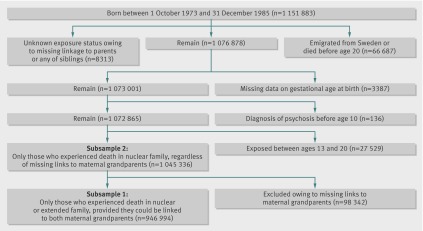
Participants: In a cohort of 1,045,336 Swedish births (1973-85), offspring born to mothers exposed to severe maternal bereavement stress six months before conception or during pregnancy, or exposed to loss of a close family member subsequently from birth to 13 years of age were followed until 2006. Admissions were identified by linkage to national patient registers.
Main outcome measures: Crude and adjusted odds ratios for all psychosis, non-affective psychosis, and affective psychosis.
Results: Maternal bereavement stress occurring preconception or during the prenatal period was not associated with a significant excess risk of psychosis in offspring (adjusted odds ratio, preconception 1.24, 95% confidence interval 0.96 to 1.62; first trimester 0.95, 0.58 to 1.56; second trimester 0.79, 0.46 to 1.33; third trimester 1.14, 0.78 to 1.66). Risks increased modestly after exposure to the loss of a close family member from birth to adolescence for all psychoses (adjusted odds ratio 1.17, 1.04 to 1.32). The pattern of risk was generally similar for non-affective and affective psychosis. Thus estimates were higher after death in the nuclear compared with extended family but remained non-significant for prenatal exposure; the earlier the exposure to death in the nuclear family occurred in childhood (all psychoses: adjusted odds ratio, birth to 2.9 years 1.84, 1.41 to 2.41; 3-6.9 years 1.47, 1.16 to 1.85; 7-12.9 years 1.32, 1.10 to 1.58) and after suicide. Following suicide, risks were especially higher for affective psychosis (birth to 2.9 years 3.33, 2.00 to 5.56; 6.9 years 1.84, 1.04 to 3.25; 7-12.9 years 2.68, 1.84 to 3.92). Adjustment for key confounders attenuated but did not explain associations with risk.
Conclusions: Postnatal but not prenatal bereavement stress in mothers is associated with an increased risk of psychosis in offspring. Risks are especially high for affective psychosis after suicide in the nuclear family, an effect that is not explained by family psychiatric history. Future studies are needed to understand possible sources of risk and resilience so that structures can be put in place to support vulnerable children and their families.
Conflict of interest statement
Competing interests: All authors have completed the ICMJE form at
References
-
- Barker DJP. Mothers, babies and health in later life. Churchill Livingstone, 1998.
-
- Mousseau TA, Fox CW. The adaptive significance of maternal effects. Trends Ecol Evol 1998;13:403-7. - PubMed
-
- Garcia-Moreno C. Intimate partner violence and fetal loss. Lancet 2009;373:278-9. - PubMed
-
- Beydoun H, Saftlas AF. Physical and mental health outcomes of prenatal maternal stress in human and animal studies: a review of recent evidence. Paediatr Perinat Epidemiol 2008;22:438-66. - PubMed
-
- Khashan AS, Mcnamee R, Abel KM, Mortensen PB, Kenny LC, Pedersen MG, et al. Rates of preterm birth following antenatal maternal exposure to severe life events: a population-based cohort study. Hum Reprod 2009;24:429-37. - PubMed
Publication types
MeSH terms
LinkOut - more resources
Full Text Sources
Other Literature Sources
Medical