


Prdm9 polymorphism unveils mouse evolutionary tracks
- PMID: 24449848
- PMCID: PMC4060951
- DOI: 10.1093/dnares/dst059
Prdm9 polymorphism unveils mouse evolutionary tracks
Abstract
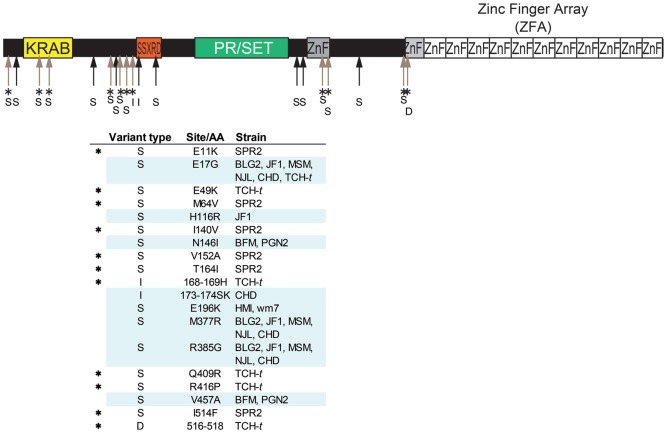
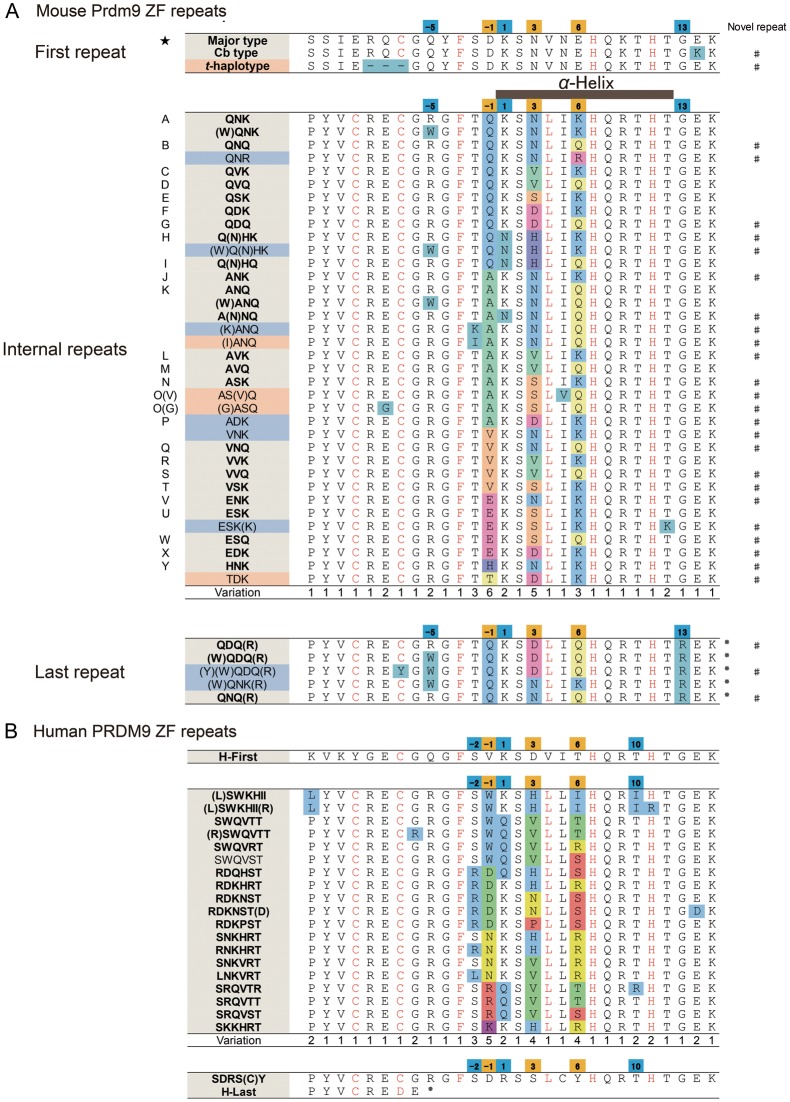
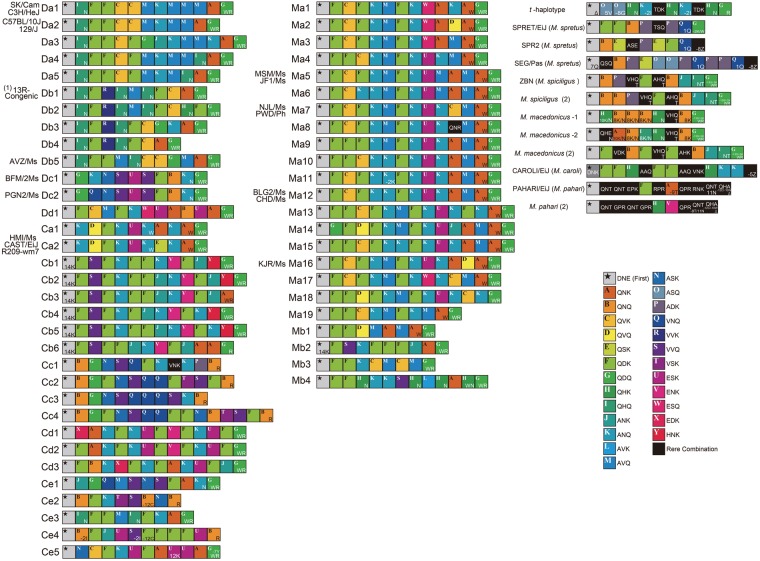
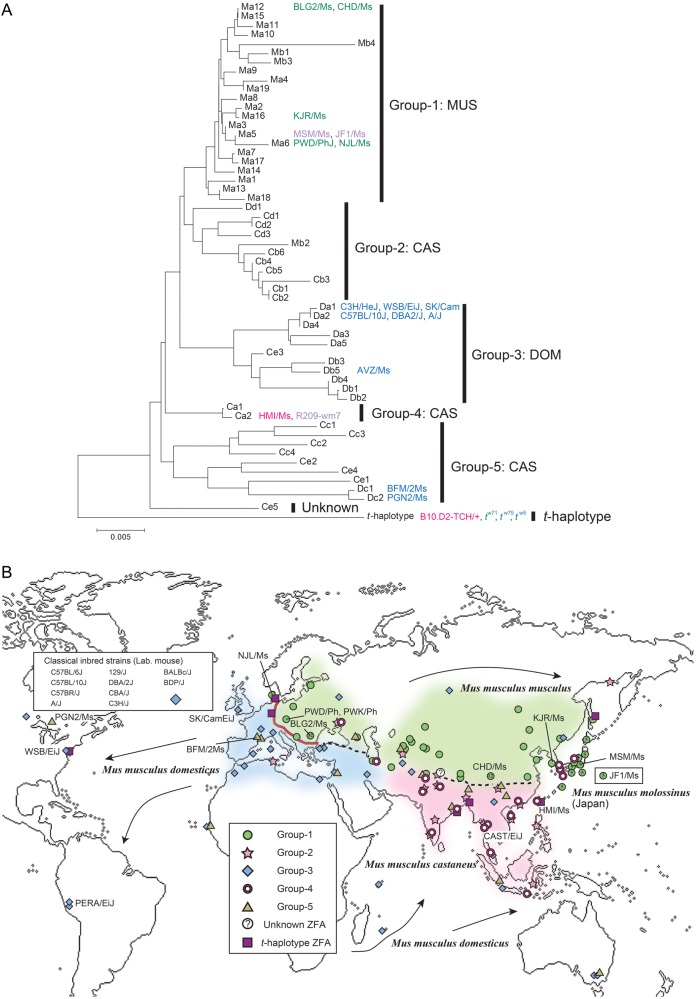
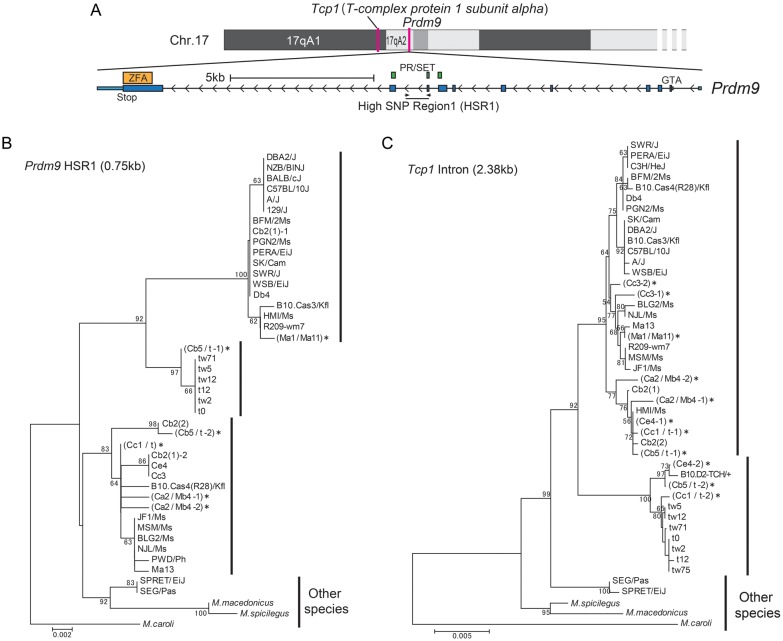
PR/SET domain containing 9 (Prdm9) mediates histone modifications such as H3K4me3 and marks hotspots of meiotic recombination. In many mammalian species, the Prdm9 gene is highly polymorphic. Prdm9 polymorphism is assumed to play two critical roles in evolution: to diversify the spectrum of meiotic recombination hotspots and to cause male hybrid sterility, leading to reproductive isolation and speciation. Nevertheless, information about Prdm9 sequences in natural populations is very limited. In this study, we conducted a comprehensive population survey on Prdm9 polymorphism in the house mouse, Mus musculus. Overall M. musculus Prdm9 displays an extraordinarily high level of polymorphism, particularly in regions encoding zinc finger repeats, which recognize recombination hotspots. Prdm9 alleles specific to various M. musculus subspecies dominate in subspecies territories. Moreover, introgression into other subspecies territories was found for highly divergent Prdm9 alleles associated with t-haplotype. The results of our phylogeographical analysis suggest that the requirement for hotspot diversity depends on geographical range and time span in mouse evolution, and that Prdm9 polymorphism has not been maintained by a simple balanced selection in the population of each subspecies.
Keywords: Prdm9; evolution; mouse; polymorphism.
© The Author 2014. Published by Oxford University Press on behalf of Kazusa DNA Research Institute.
Figures
References
-
- Petes T.D. Meiotic recombination hot spots and cold spots. Nat. Rev. Genet. 2001;2:360–9. - PubMed
-
- Kauppi L., Jeffreys A.J., Keeney S. Where the crossovers are: recombination distributions in mammals. Nat. Rev. Genet. 2004;5:413–24. - PubMed
-
- Shiroishi T., Sagai T., Moriwaki K. A new wild-derived H-2 haplotype enhancing K-IA recombination. Nature. 1982;300:370–2. - PubMed
Publication types
MeSH terms
Substances
Associated data
- Actions
- Actions
- Actions
- Actions
- Actions
- Actions
- Actions
- Actions
- Actions
- Actions
- Actions
- Actions
- Actions
- Actions
- Actions
- Actions
- Actions
- Actions
- Actions
- Actions
- Actions
- Actions
- Actions
- Actions
- Actions
- Actions
- Actions
- Actions
- Actions
- Actions
- Actions
- Actions
- Actions
- Actions
- Actions
- Actions
- Actions
- Actions
- Actions
- Actions
- Actions
- Actions
- Actions
- Actions
- Actions
- Actions
- Actions
- Actions
- Actions
- Actions
- Actions
- Actions
- Actions
- Actions
- Actions
- Actions
- Actions
- Actions
- Actions
- Actions
- Actions
- Actions
- Actions
- Actions
- Actions
- Actions
- Actions
- Actions
- Actions
- Actions
- Actions
- Actions
- Actions
- Actions
- Actions
- Actions
- Actions
- Actions
- Actions
- Actions
- Actions
- Actions
- Actions
- Actions
- Actions
- Actions
- Actions
- Actions
- Actions
- Actions
- Actions
- Actions
- Actions
- Actions
- Actions
- Actions
- Actions
- Actions
- Actions
- Actions
- Actions
- Actions
- Actions
- Actions
- Actions
- Actions
- Actions
- Actions
- Actions
- Actions
- Actions
- Actions
- Actions
- Actions
- Actions
- Actions
- Actions
- Actions
- Actions
- Actions
- Actions
- Actions
- Actions
- Actions
- Actions
- Actions
- Actions
- Actions
- Actions
- Actions
- Actions
- Actions
- Actions
- Actions
- Actions
- Actions
- Actions
- Actions
- Actions
- Actions
- Actions
- Actions
- Actions
- Actions
- Actions
- Actions
- Actions
- Actions
- Actions
- Actions
- Actions
- Actions
- Actions
- Actions
- Actions
- Actions
- Actions
- Actions
- Actions
- Actions
- Actions
- Actions
- Actions
- Actions
- Actions
- Actions
- Actions
- Actions
- Actions
- Actions
- Actions
- Actions
- Actions
- Actions
- Actions
- Actions
- Actions
- Actions
- Actions
- Actions
- Actions
- Actions
- Actions
- Actions
- Actions
- Actions
- Actions
- Actions
- Actions
- Actions
- Actions
- Actions
- Actions
- Actions
- Actions
- Actions
- Actions
- Actions
- Actions
- Actions
- Actions
- Actions
- Actions
- Actions
- Actions
- Actions
- Actions
- Actions
- Actions
- Actions
- Actions
- Actions
- Actions
- Actions
- Actions
- Actions
- Actions
- Actions
- Actions
- Actions
- Actions
- Actions
- Actions
- Actions
- Actions
- Actions
- Actions
- Actions
- Actions
- Actions
- Actions
- Actions
- Actions
- Actions
- Actions
- Actions
- Actions
- Actions
- Actions
- Actions
- Actions
- Actions
- Actions
- Actions
- Actions
- Actions
- Actions
- Actions
- Actions
- Actions
- Actions
- Actions
- Actions
- Actions
- Actions
- Actions
- Actions
- Actions
- Actions
- Actions
LinkOut - more resources
Full Text Sources
Other Literature Sources
Molecular Biology Databases
Research Materials
