


Succession of cable bacteria and electric currents in marine sediment
- PMID: 24451206
- PMCID: PMC4030233
- DOI: 10.1038/ismej.2013.239
Succession of cable bacteria and electric currents in marine sediment
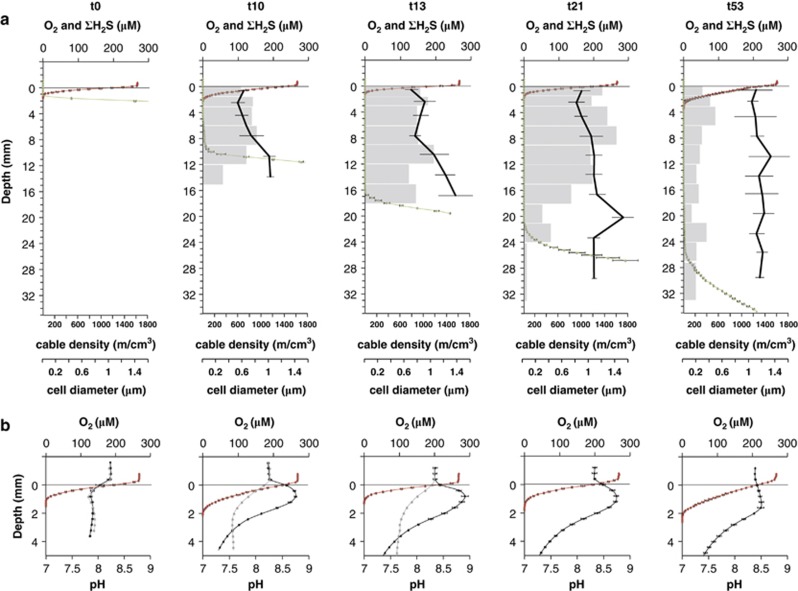
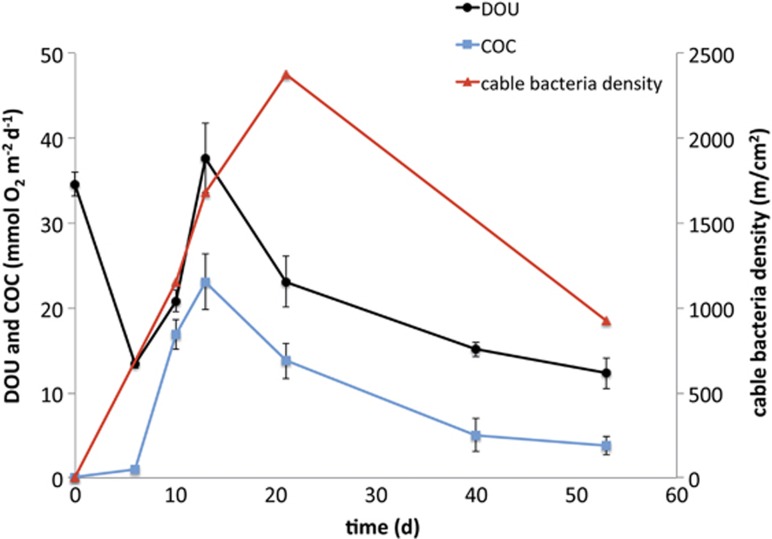
Abstract
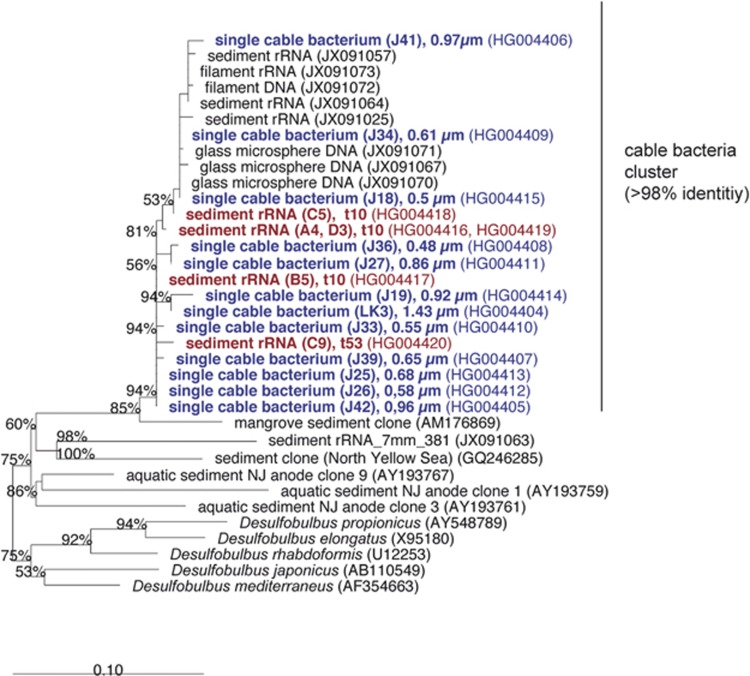
Filamentous Desulfobulbaceae have been reported to conduct electrons over centimetre-long distances, thereby coupling oxygen reduction at the surface of marine sediment to sulphide oxidation in sub-surface layers. To understand how these 'cable bacteria' establish and sustain electric conductivity, we followed a population for 53 days after exposing sulphidic sediment with initially no detectable filaments to oxygen. After 10 days, cable bacteria and electric currents were established throughout the top 15 mm of the sediment, and after 21 days the filament density peaked with a total length of 2 km cm(-2). Cells elongated and divided at all depths with doubling times over the first 10 days of <20 h. Active, oriented movement must have occurred to explain the separation of O2 and H2S by 15 mm. Filament diameters varied from 0.4-1.7 μm, with a general increase over time and depth, and yet they shared 16S rRNA sequence identity of >98%. Comparison of the increase in biovolume and electric current density suggested high cellular growth efficiency. While the vertical expansion of filaments continued over time and reached 30 mm, the electric current density and biomass declined after 13 and 21 days, respectively. This might reflect a breakdown of short filaments as their solid sulphide sources became depleted in the top layers of the anoxic zone. In conclusion, cable bacteria combine rapid and efficient growth with oriented movement to establish and exploit the spatially separated half-reactions of sulphide oxidation and oxygen consumption.
Figures
References
-
- Berg P, Risgaard-Petersen N, Rysgaard S. Interpretation of measured concentration profiles in sediment pore water. Limnol Oceanogr. 1998;43:1500–1510.
-
- Boudreau BP. Diagenetic models and their implementation: modelling transport and reactions in aquatic sediments. Springer: New York; 1996.
-
- Flardh K, Buttner MJ. Streptomyces morphogenetics: dissecting differentiation in a filamentous bacterium. Nat Rev Microbiol. 2009;7:36–49. - PubMed
-
- Geelhoed JS, Kleerebezem R, Sorokin DY, Stams AJM, van Loosdrecht MCM. Reduced inorganic sulfur oxidation supports autotrophic and mixotrophic growth of Magnetospirillum strain J10 and Magnetospirillum gryphiswaldense. Environ Microbiol. 2010;12:1031–1040. - PubMed
Publication types
MeSH terms
Substances
Grants and funding
LinkOut - more resources
Full Text Sources
Other Literature Sources
