


The Novel Secreted Adipokine WNT1-inducible Signaling Pathway Protein 2 (WISP2) Is a Mesenchymal Cell Activator of Canonical WNT
- PMID: 24451367
- PMCID: PMC3945351
- DOI: 10.1074/jbc.M113.511964
The Novel Secreted Adipokine WNT1-inducible Signaling Pathway Protein 2 (WISP2) Is a Mesenchymal Cell Activator of Canonical WNT
Abstract
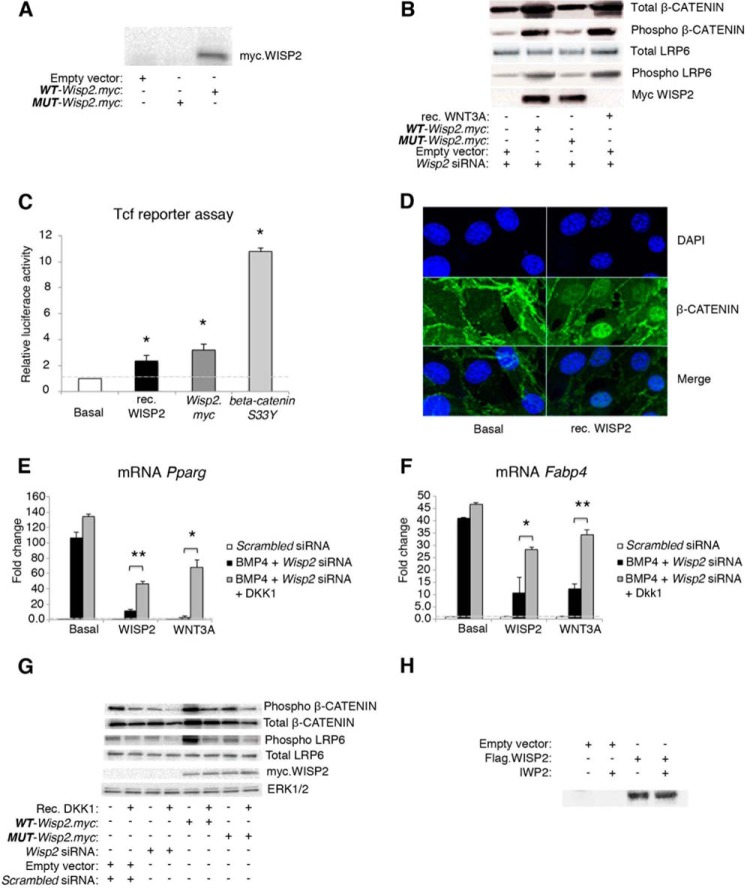
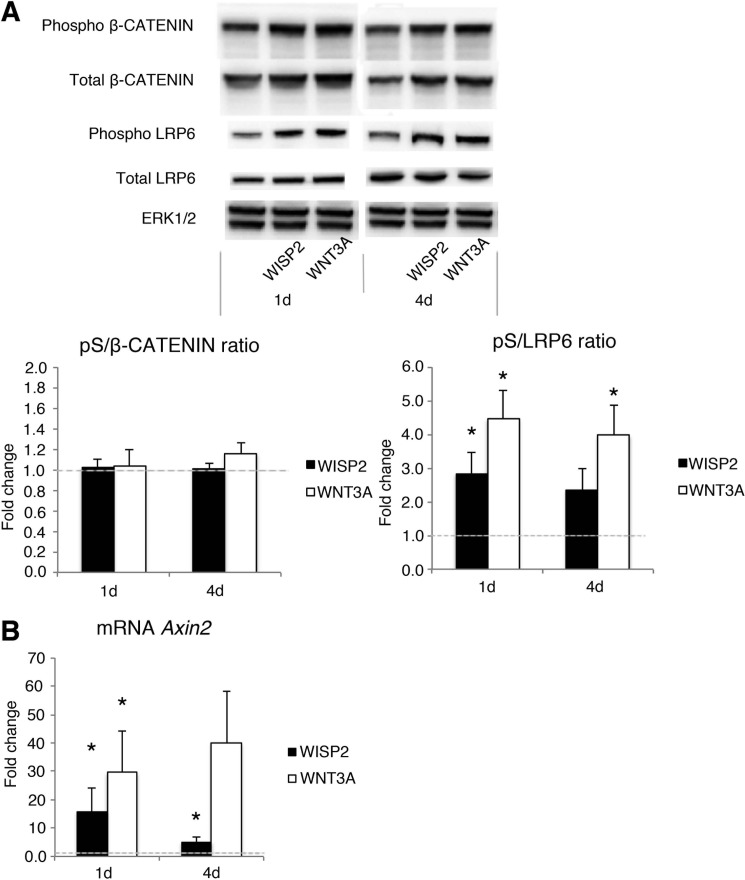
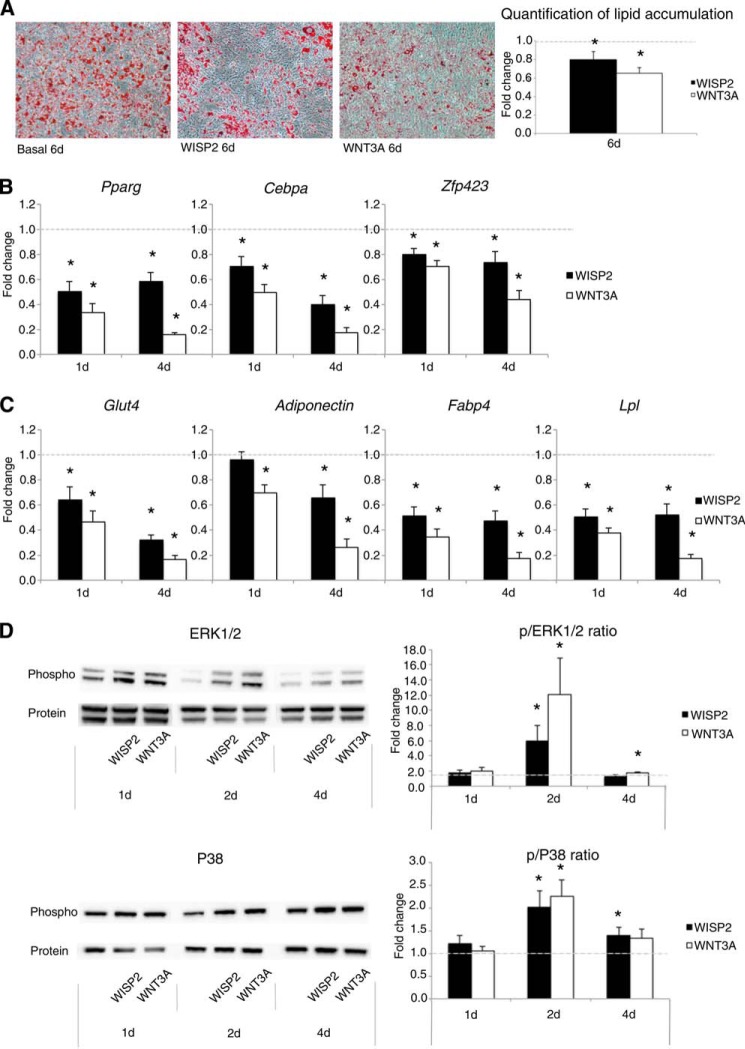
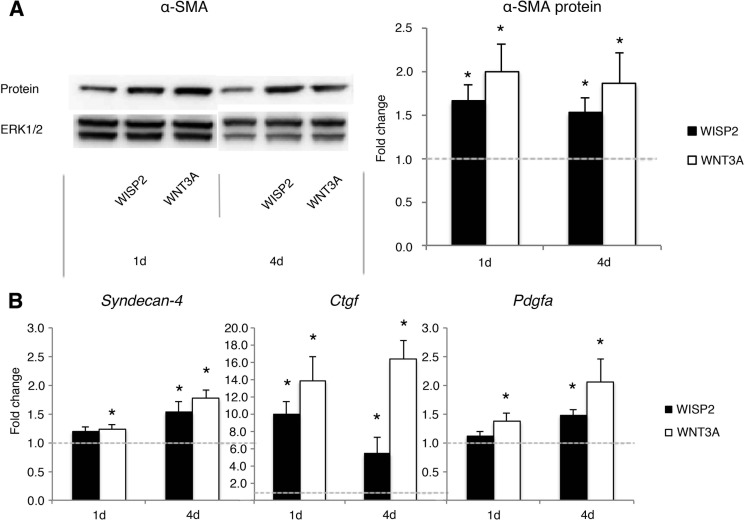
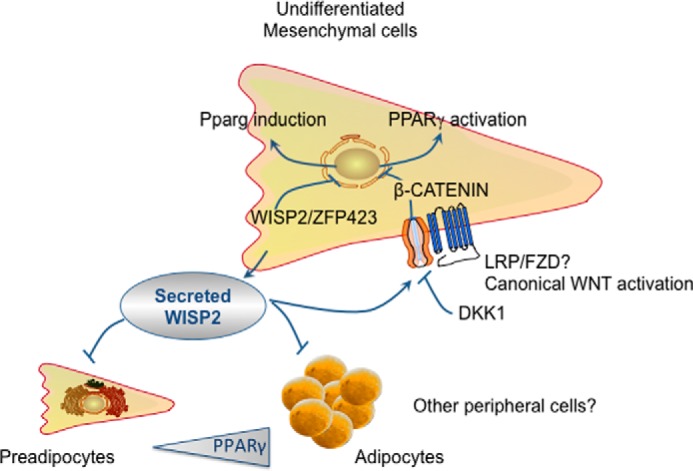
WNT1-inducible-signaling pathway protein 2 (WISP2) is primarily expressed in mesenchymal stem cells, fibroblasts, and adipogenic precursor cells. It is both a secreted and cytosolic protein, the latter regulating precursor cell adipogenic commitment and PPARγ induction by BMP4. To examine the effect of the secreted protein, we expressed a full-length and a truncated, non-secreted WISP2 in NIH3T3 fibroblasts. Secreted, but not truncated WISP2 activated the canonical WNT pathway with increased β-catenin levels, its nuclear targeting phosphorylation, and LRP5/6 phosphorylation. It also inhibited Pparg activation and the effect of secreted WISP2 was reversed by the WNT antagonist DICKKOPF-1. Differentiated 3T3-L1 adipose cells were also target cells where extracellular WISP2 activated the canonical WNT pathway, inhibited Pparg and associated adipose genes and, similar to WNT3a, promoted partial dedifferentiation of the cells and the induction of a myofibroblast phenotype with activation of markers of fibrosis. Thus, WISP2 exerts dual actions in mesenchymal precursor cells; secreted WISP2 activates canonical WNT and maintains the cells in an undifferentiated state, whereas cytosolic WISP2 regulates adipogenic commitment.
Keywords: Adipose Tissue; Beta-catenin; Bone Morphogenetic Protein (BMP); Cell Biology; Obesity; Peroxisome Proliferator-activated receptor (PPAR); Wnt Pathway.
Figures
Similar articles
-
WISP2 regulates preadipocyte commitment and PPARγ activation by BMP4.Proc Natl Acad Sci U S A. 2013 Feb 12;110(7):2563-8. doi: 10.1073/pnas.1211255110. Epub 2013 Jan 28. Proc Natl Acad Sci U S A. 2013. PMID: 23359679 Free PMC article.
-
Dickkopf (Dkk)-2 is a beige fat-enriched adipokine to regulate adipogenesis.Biochem Biophys Res Commun. 2021 Apr 9;548:211-216. doi: 10.1016/j.bbrc.2021.02.068. Epub 2021 Feb 26. Biochem Biophys Res Commun. 2021. PMID: 33647798
-
Dickkopf-1 promotes the differentiation and adipocytokines secretion via canonical Wnt signaling pathway in primary cultured human preadipocytes.Obes Res Clin Pract. 2016 Jul-Aug;10(4):454-64. doi: 10.1016/j.orcp.2015.08.016. Epub 2015 Sep 14. Obes Res Clin Pract. 2016. PMID: 26383960
-
PPARγ and Wnt Signaling in Adipogenic and Osteogenic Differentiation of Mesenchymal Stem Cells.Curr Stem Cell Res Ther. 2016;11(3):216-25. doi: 10.2174/1574888x10666150519093429. Curr Stem Cell Res Ther. 2016. PMID: 25986621 Review.
-
Role of CCN5 (WNT1 inducible signaling pathway protein 2) in pancreatic islets.J Diabetes. 2017 May;9(5):462-474. doi: 10.1111/1753-0407.12507. Epub 2016 Dec 26. J Diabetes. 2017. PMID: 27863006 Review.
Cited by
-
An Approach towards a GMP Compliant In-Vitro Expansion of Human Adipose Stem Cells for Autologous Therapies.Bioengineering (Basel). 2020 Jul 20;7(3):77. doi: 10.3390/bioengineering7030077. Bioengineering (Basel). 2020. PMID: 32698363 Free PMC article.
-
WISP1/CCN4 inhibits adipocyte differentiation through repression of PPARγ activity.Sci Rep. 2017 May 11;7(1):1749. doi: 10.1038/s41598-017-01866-2. Sci Rep. 2017. PMID: 28496206 Free PMC article.
-
Osteoblast-Derived Vesicle Protein Content Is Temporally Regulated During Osteogenesis: Implications for Regenerative Therapies.Front Bioeng Biotechnol. 2019 May 1;7:92. doi: 10.3389/fbioe.2019.00092. eCollection 2019. Front Bioeng Biotechnol. 2019. PMID: 31119130 Free PMC article.
-
Optimization of seeding cell density for differentiation of adipose-derived stem cells into epithelial-like cells on bioengineered composite scaffolds.Differentiation. 2025 May-Jun;143:100870. doi: 10.1016/j.diff.2025.100870. Epub 2025 May 20. Differentiation. 2025. PMID: 40414118
-
Dual roles of WISP2 in the progression of hepatocellular carcinoma: implications of the fibroblast infiltration into the tumor microenvironment.Aging (Albany NY). 2021 Sep 8;13(17):21216-21231. doi: 10.18632/aging.203424. Epub 2021 Sep 8. Aging (Albany NY). 2021. PMID: 34497155 Free PMC article.
References
-
- Després J. P., Lemieux I., Bergeron J., Pibarot P., Mathieu P., Larose E., Rodés-Cabau J., Bertrand O. F., Poirier P. (2008) Abdominal obesity and the metabolic syndrome: contribution to global cardiometabolic risk. Arterioscler. Thromb. Vasc. Biol. 28, 1039–1049 - PubMed
-
- Virtue S., Vidal-Puig A. (2010) Adipose tissue expandability, lipotoxicity and the metabolic syndrome–an allostatic perspective. Biochim. Biophys. Acta 1801, 338–349 - PubMed
Publication types
MeSH terms
Substances
LinkOut - more resources
Full Text Sources
Other Literature Sources
Molecular Biology Databases
