Governance and health in the Arab world
- PMID: 24452043
- PMCID: PMC4176927
- DOI: 10.1016/S0140-6736(13)62185-6
Governance and health in the Arab world
Abstract
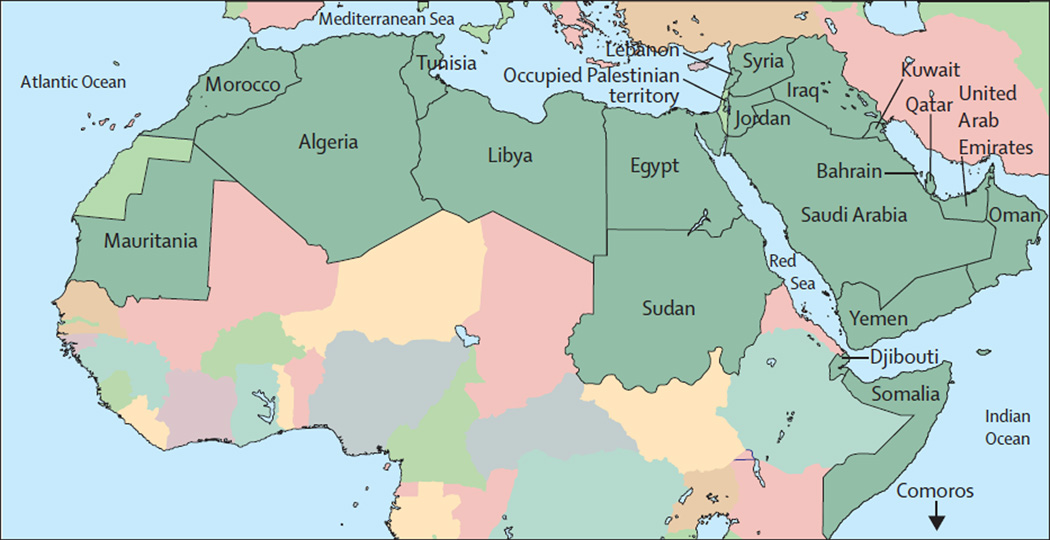
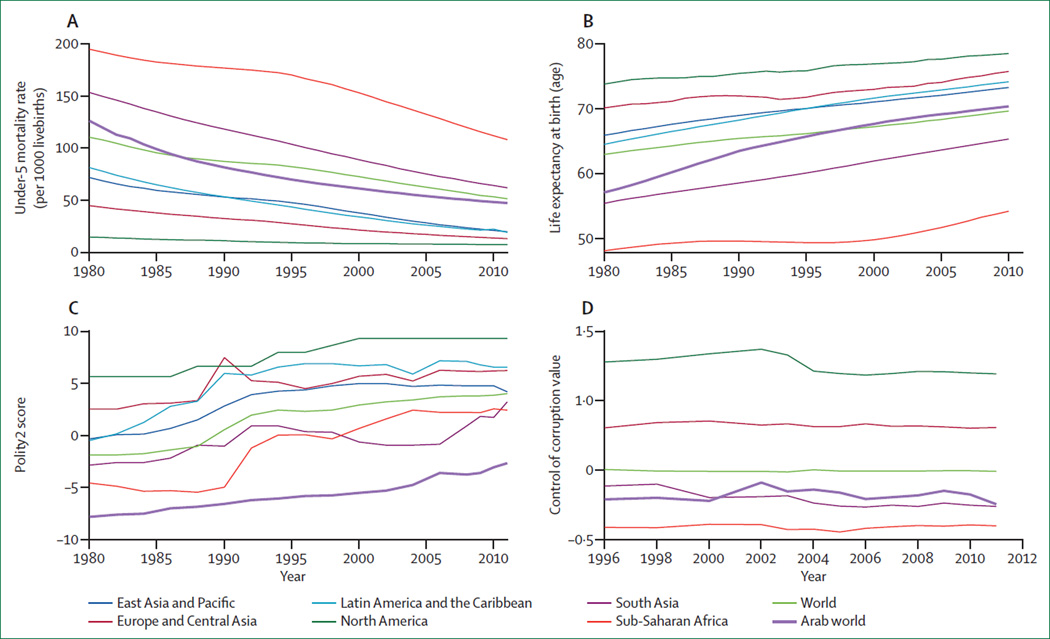
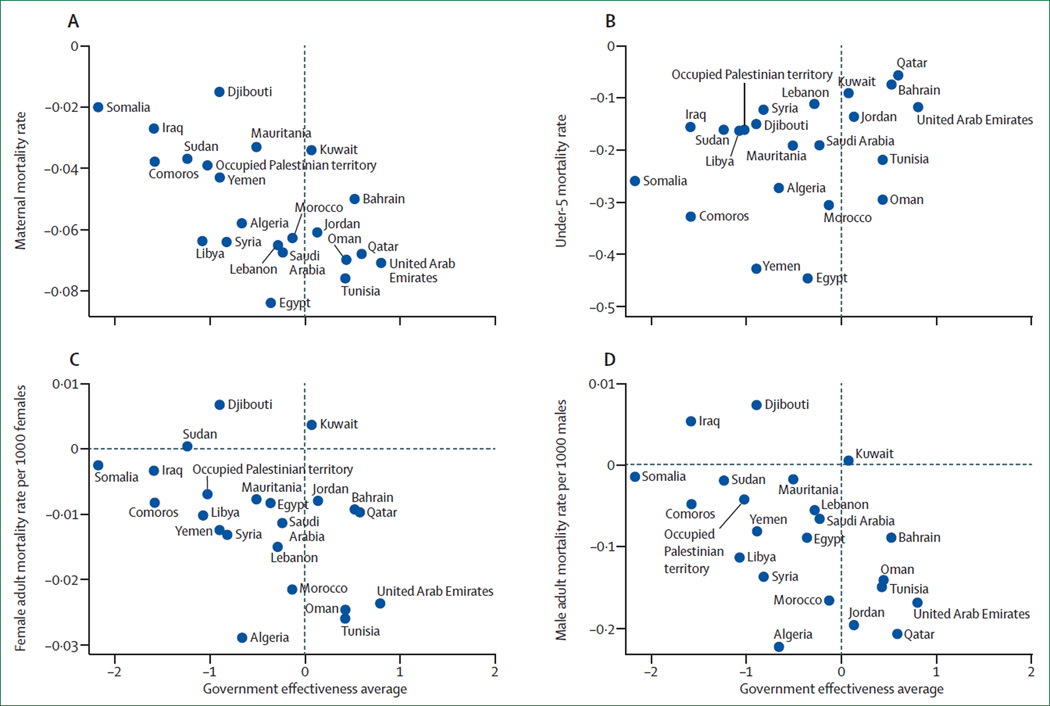
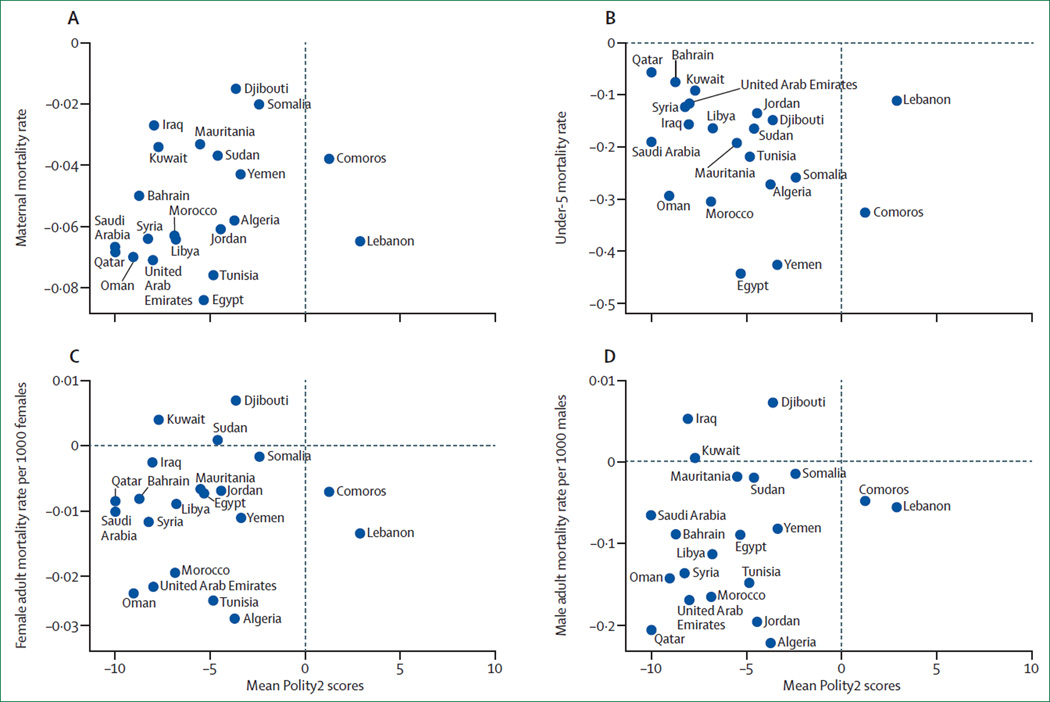
Since late 2010, the Arab world has entered a tumultuous period of change, with populations demanding more inclusive and accountable government. The region is characterised by weak political institutions, which exclude large proportions of their populations from political representation and government services. Building on work in political science and economics, we assess the extent to which the quality of governance, or the extent of electoral democracy, relates to adult, infant, and maternal mortality, and to the perceived accessibility and improvement of health services. We compiled a dataset from the World Bank, WHO, Institute for Health Metrics and Evaluation, Arab Barometer Survey, and other sources to measure changes in demographics, health status, and governance in the Arab World from 1980 to 2010. We suggest an association between more effective government and average reductions in mortality in this period; however, there does not seem to be any relation between the extent of democracy and mortality reductions. The movements for changing governance in the region threaten access to services in the short term, forcing migration and increasing the vulnerability of some populations. In view of the patterns observed in the available data, and the published literature, we suggest that efforts to improve government effectiveness and to reduce corruption are more plausibly linked to population health improvements than are efforts to democratise. However, these patterns are based on restricted mortality data, leaving out subjective health metrics, quality of life, and disease-specific data. To better guide efforts to transform political and economic institutions, more data are needed for health-care access, health-care quality, health status, and access to services of marginalised groups.
Copyright © 2014 Elsevier Ltd. All rights reserved.
Figures
References
-
- Saleh SS, Alameddine MS, Natafgi NM, et al. The path towards universal health coverage in the Arab uprising countries Tunisia, Egypt, Libya, and Yemen. Lancet. 2014 published online Jan 20. http://dx.doi.org/10.1016/S0140-6736(13)62339-9. - DOI - PubMed
-
- El-Zein A, Jabbour S, Tekce B, et al. Health and ecological sustainability in the Arab world: a matter of survival. Lancet. 2014 published online Jan 20. http://dx.doi.org/10.1016/S0140-6736(13)62338-7. - DOI - PMC - PubMed
-
- Abdul Rahim HF, Sibai A, Khader Y, et al. Non-communicable diseases in the Arab world. Lancet. 2014 published online Jan 20. http://dx.doi.org/10.1016/S0140-6736(13)62383-1. - DOI - PubMed
-
- Nakkash R, Afifi R, Maziak W. Research and activism for tobacco control in the Arab world. Lancet. 2014 published online Jan 20. http://dx.doi.org/10.1016/S0140-6736(13)62381-8. - DOI - PubMed
-
- Dewachi O, Skelton M, Nguyen V-K, et al. Changing therapeutic geographies of the Iraqi and Syrian wars. Lancet. 2014 published online Jan 20. http://dx.doi.org/10.1016/S0140-6736(13)62299-0. - DOI - PubMed
MeSH terms
Grants and funding
LinkOut - more resources
Full Text Sources
Other Literature Sources