


Health in the new scenarios for climate change research
- PMID: 24452253
- PMCID: PMC3924435
- DOI: 10.3390/ijerph110100030
Health in the new scenarios for climate change research
Abstract
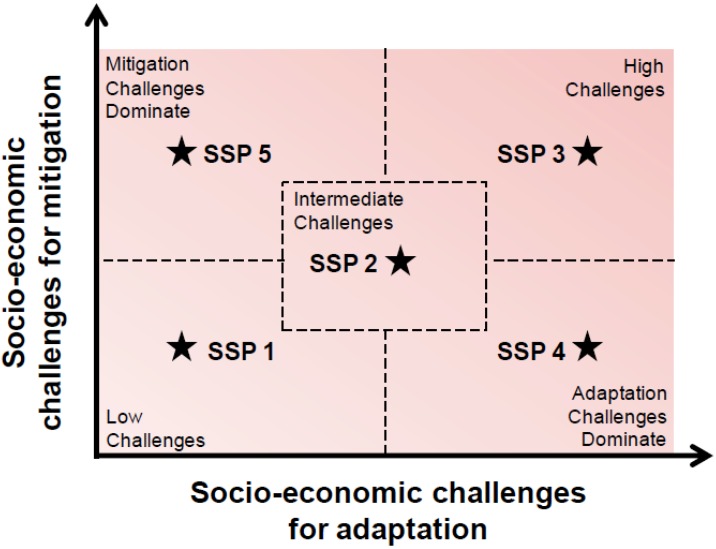
The climate change research community is developing a toolkit for creating new scenarios to explore and evaluate the extensive uncertainties associated with future climate change and development pathways. Components of the toolkit include pathways for greenhouse gas emissions over this century and their associated magnitude and pattern of climate change; descriptions of a range of possible socioeconomic development pathways, including qualitative narratives and quantitative elements; and climate change policies to achieve specific levels of radiative forcing and levels of adaptive capacity. These components are combined within a matrix architecture to create a scenario. Five reference socioeconomic development pathways have been described along axes describing increasing socioeconomic and environmental challenges to adaptation and to mitigation. This paper extends these global pathways to describe their possible consequences for public health and health care, and considers the additional elements that could be added to increase the relevance of the new scenarios to address a wider range of policy relevant questions than previously possible.
Figures
References
-
- Nakicenovic N., Alcamo J., Davis G., de Vries B., Fenhann G., Gaffin S., Gregory K., Grübler A., Jung T.Y., Kram T., et al. Special Report on Emissions Scenarios: A Special Report of Working Group III of the Intergovernmental Panel on Climate Change. Cambridge University Press; Cambridge, UK: 2000.
-
- Ebi K.L., Hallegatte S., Kram T., Arnell N.W., Carter T.R., Edmonds J., Kriegler E., Mathur R., O’Neill B.C., Kewyan R., et al. A new scenario framework for climate change research: Background, process, and future directions. Clim. Chang. 2013 doi: 10.1007/s10584-013-0912-3. - DOI
-
- Meehl G.A., Hibbard K., Aspen Global Change Institute (AGCI) Summary Report: A Strategy for Climate Change Stabilization Experiments with AOGCMs and ESMs. Aspen Global Change Institute 2006 Session: Earth System Models: The Next Generation. 2007. [(accessed on 9 December 2007)]. Report from Aspen Global Change Institute Session, July 30–August 5 2006 and joint WGCM/AIMES Steering Committee Meeting 27 September 2006 (Aspen, Colorado, July 30–August 5 2006) Available online: http://www.agci.org/dB/PDFs/Publications/06S1_WhitePaper.pdf.
-
- Moss R.H., Babiker M., Brinkman S., Calvo E., Carter T., Edmonds J., Elgizouli I., Emori S., Erda L., Hibbard K., et al. Towards New Scenarios for Analysis of Emissions, Climate Change, Impacts, and Response Strategies. Intergovernmental Panel on Climate Change; Geneva, Switzerland: 2008.
MeSH terms
LinkOut - more resources
Full Text Sources
Other Literature Sources
Medical
