


Insulin treatment attenuates renal ADAM17 and ACE2 shedding in diabetic Akita mice
- PMID: 24452639
- PMCID: PMC3949038
- DOI: 10.1152/ajprenal.00516.2013
Insulin treatment attenuates renal ADAM17 and ACE2 shedding in diabetic Akita mice
Abstract
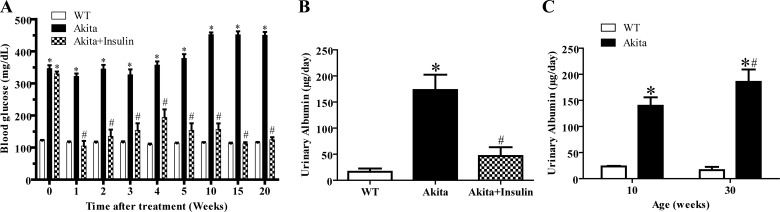
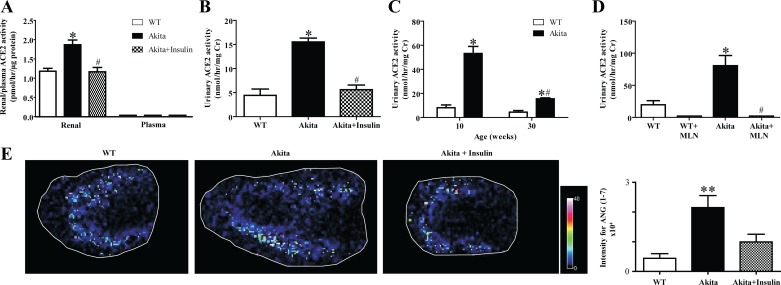
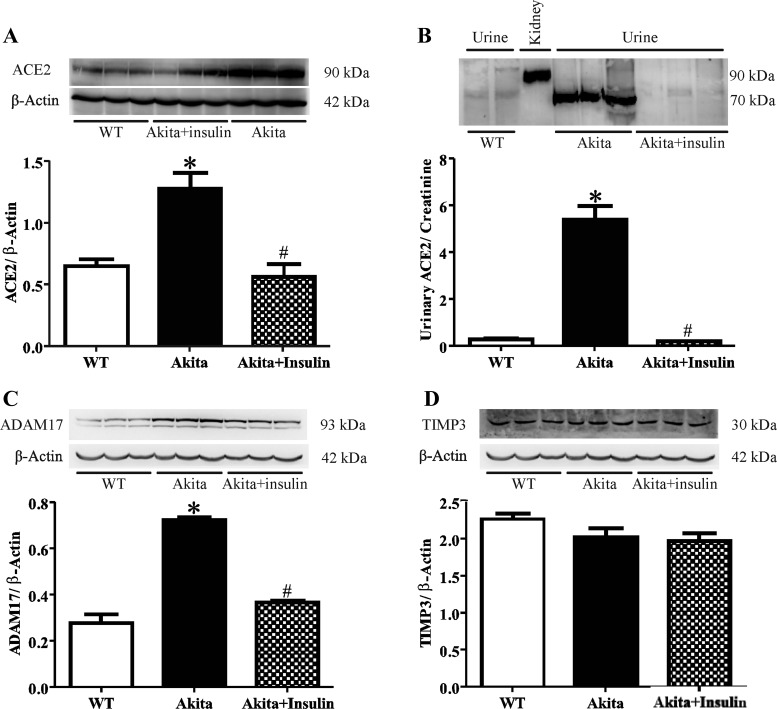
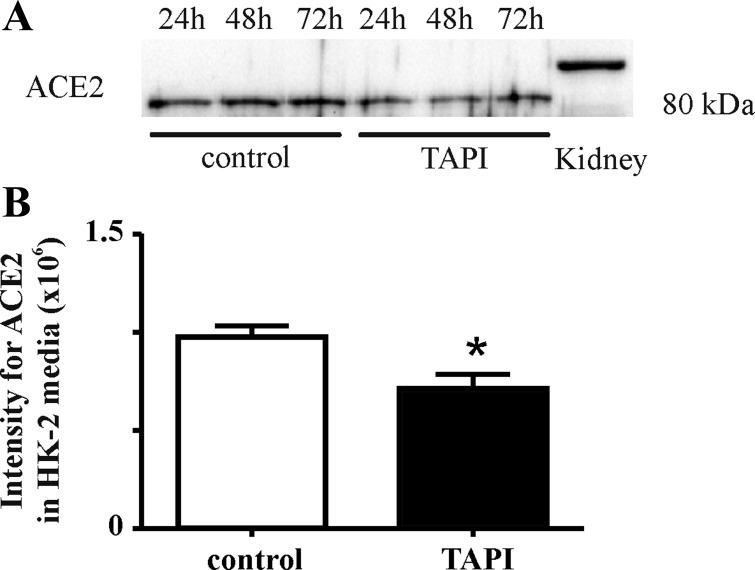
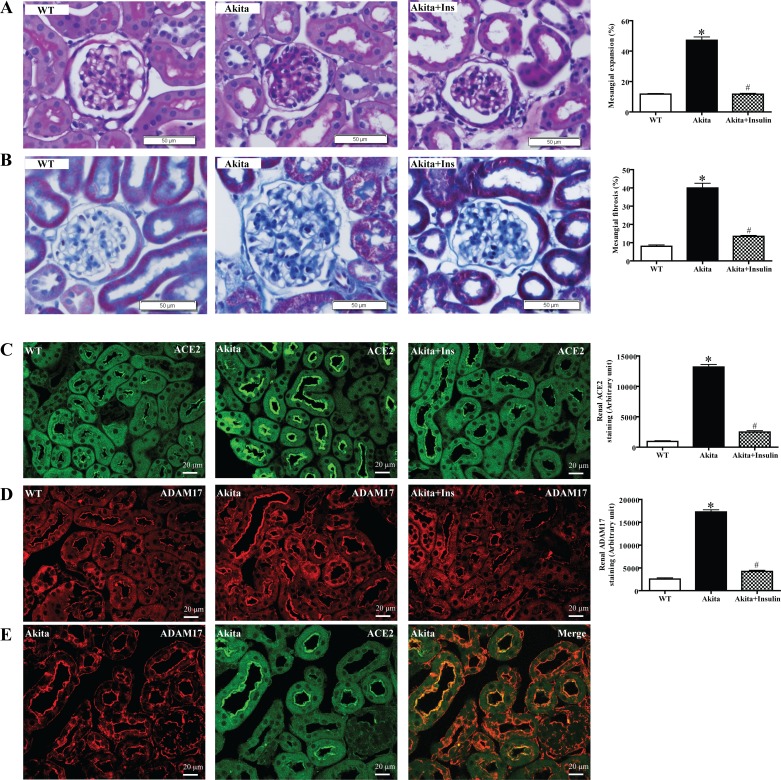
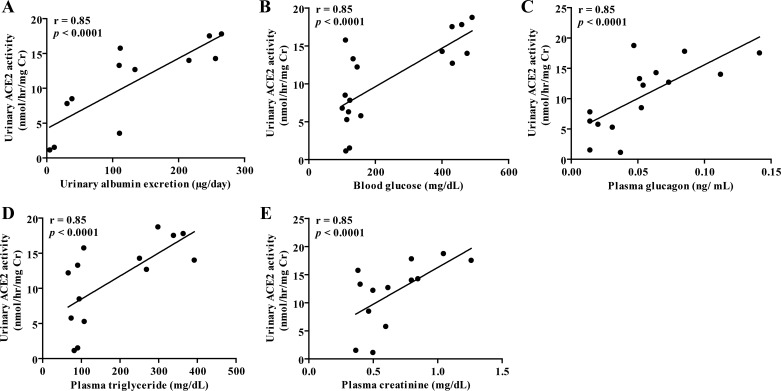
Angiotensin-converting enzyme 2 (ACE2) is located in several tissues and is highly expressed in renal proximal tubules, where it degrades the vasoconstrictor angiotensin II (ANG II) to ANG-(1-7). Accumulating evidence supports protective roles of ACE2 in several disease states, including diabetic nephropathy. A disintegrin and metalloprotease (ADAM) 17 is involved in the shedding of several transmembrane proteins, including ACE2. Our previous studies showed increased renal ACE2, ADAM17 expression, and urinary ACE2 in type 2 diabetic mice (Chodavarapu H, Grobe N, Somineni HK, Salem ES, Madhu M, Elased KM. PLoS One 8: e62833, 2013). The aim of the present study was to determine the effect of insulin on ACE2 shedding and ADAM17 in type 1 diabetic Akita mice. Results demonstrate increased renal ACE2 and ADAM17 expression and increased urinary ACE2 fragments (≈70 kDa) and albumin excretion in diabetic Akita mice. Immunostaining revealed colocalization of ACE2 with ADAM17 in renal tubules. Renal proximal tubular cells treated with ADAM17 inhibitor showed reduced ACE2 shedding into the media, confirming ADAM17-mediated shedding of ACE2. Treatment of Akita mice with insulin implants for 20 wk normalized hyperglycemia and decreased urinary ACE2 and albumin excretion. Insulin also normalized renal ACE2 and ADAM17 but had no effect on tissue inhibitor of metalloproteinase 3 (TIMP3) protein expression. There was a positive linear correlation between urinary ACE2 and albuminuria, blood glucose, plasma creatinine, glucagon, and triglycerides. This is the first report showing an association between hyperglycemia, cardiovascular risk factors, and increased shedding of urinary ACE2 in diabetic Akita mice. Urinary ACE2 could be used as a biomarker for diabetic nephropathy and as an index of intrarenal ACE2 status.
Keywords: ADAM17; TIMP3; albuminuria; diabetic Akita mice; renal and urinary ACE2.
Figures
References
-
- Anonymous The effect of intensive treatment of diabetes on the development, and progression of long-term complications in insulin-dependent diabetes mellitus. The Diabetes Control and Complications Trial Research Group. N Engl J Med 329: 977–986, 1993 - PubMed
-
- Arita DY, Cunha TS, Perez JD, Colucci JA, Ronchi FA, Nogueira MD, Arita LS, Aragao DS, Teixeira VP, Casarini DE. Overexpression of urinary N-domain ACE in chronic kidney dysfunction in Wistar rats. Clin Exp Hypertens 34: 389–396, 2012 - PubMed
-
- Brezar V, Culina S, Gagnerault MC, Mallone R. Short-term subcutaneous insulin treatment delays but does not prevent diabetes in NOD mice. Eur J Immunol 42: 1553–1561, 2012 - PubMed
-
- Cardellini M, Menghini R, Luzi A, Davato F, Cardolini I, D'Alfonso R, Gentileschi P, Rizza S, Marini MA, Porzio O, Lauro D, Sbraccia P, Lauro R, Federici M. Decreased IRS2 and TIMP3 expression in monocytes from offspring of type 2 diabetic patients is correlated with insulin resistance and increased intima-media thickness. Diabetes 60: 3265–3270, 2011 - PMC - PubMed
Publication types
MeSH terms
Substances
Grants and funding
LinkOut - more resources
Full Text Sources
Other Literature Sources
Medical
Molecular Biology Databases
Miscellaneous
