


Effects of cardiac rehabilitation in diabetic patients: both cardiac and noncardiac factors determine improvement in exercise capacity
- PMID: 24452805
- PMCID: PMC6649620
- DOI: 10.1002/clc.22245
Effects of cardiac rehabilitation in diabetic patients: both cardiac and noncardiac factors determine improvement in exercise capacity
Abstract
Background: Diabetic patients have a worse prognosis than nondiabetic patients after myocardial infarction. Although exercise improves risk factors, exercise capacity, and mortality, it is still unclear if these benefits are the same as in nondiabetics. Furthermore, although exercise tolerance is predicted by systolic and diastolic dysfunction in nondiabetics, its role as a predictor of exercise capacity in diabetics remains unclear.
Hypothesis: Diabetics and nondiabetics see a similar improvement in their cardiac risk factors and exercise parameters from exercise-based cardiac rehabilitation (CR).
Methods: A series of 370 diabetics and 942 nondiabetics entered a 36-session outpatient CR program after interventions for coronary heart disease or after bypass or cardiac valve surgery. The program consisted of physical exercise, lifestyle modification, and pharmacotherapy.
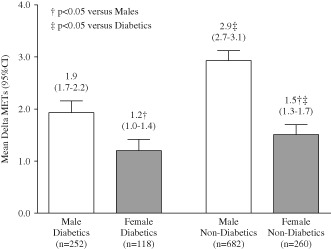
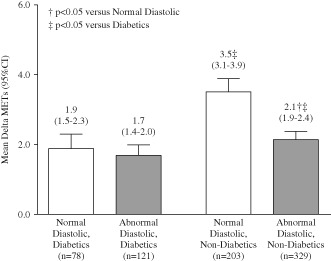
Results: Quality of life, weight, blood pressure, and lipid profiles improved significantly in both groups during the 12-week program. Baseline metabolic equivalents (METs) were lower in diabetics vs nondiabetics at the start of CR (2.4 vs 2.7, P < 0.001). Although both groups increased their exercise capacity, diabetics had less improvement (change in METs 1.7 vs 2.6, P < 0.001). Significant predictors for improvement after CR included age, sex, and weight, as well as both systolic and diastolic function. After adjustment for these, diabetes remained a significant predictor of reduced improvement in exercise capacity.
Conclusions: Diabetics saw a significant benefit in quality of life, weight, exercise tolerance, and cardiac risk factors, but to a lesser extent when compared with nondiabetics. The mechanisms for poorer improvement in diabetics following CR also include noncardiac factors and require further study.
© 2014 Wiley Periodicals, Inc.
Figures

References
-
- Wild S, Roglic G, Green A, et al. Global prevalence of diabetes: estimates for the year 2000 and projections for 2030. Diabetes Care. 2004;27:1047–1053. - PubMed
-
- Audelin MC, Savage PD, Ades PA. Changing clinical profile of patients entering cardiac rehabilitation/secondary prevention programs: 1996 to 2006. J Cardiopulm Rehabil Prev. 2008;28:299–306. - PubMed
-
- Banzer JA, Maguire TE, Kennedy CM, et al. Results of cardiac rehabilitation in patients with diabetes mellitus. Am J Cardiol. 2004;93:81–84. - PubMed
-
- Haffner SM, Lehto S, Ronnemaa T, et al. Mortality from coronary heart disease in subjects with type 2 diabetes and in nondiabetic subjects with and without prior myocardial infarction. N Engl J Med. 1998;339:229–234. - PubMed
-
- Yu CM, Lau CP, Cheung BM, et al. Clinical predictors of morbidity and mortality in patients with myocardial infarction or revascularization who underwent cardiac rehabilitation, and importance of diabetes mellitus and exercise capacity. Am J Cardiol. 2000;85:344–349. - PubMed
MeSH terms
LinkOut - more resources
Full Text Sources
Other Literature Sources
Medical
