Clinical Trial
. 2014 May;32(5):1278-88.
doi: 10.1002/stem.1638.

Bone marrow mesenchymal stromal cells to treat tissue damage in allogeneic stem cell transplant recipients: correlation of biological markers with clinical responses

Affiliations
Clinical Trial

Bone marrow mesenchymal stromal cells to treat tissue damage in allogeneic stem cell transplant recipients: correlation of biological markers with clinical responses

Fang Yin et al. Stem Cells. 2014 May.

Abstract

Bone marrow mesenchymal stromal cells (BMSCs) have been used to treat acute graft-versus-host disease (GVHD) and other complications following allogeneic hematopoietic stem cell transplantation (SCT). We conducted a phase I trial using third party, early passage BMSCs for patients with steroid-refractory GVHD, tissue injury, or marrow failure following SCT to investigate safety and efficacy. To identify mechanisms of BMSC immunomodulation and tissue repair, patients were serially monitored for plasma GVHD biomarkers, cytokines, and lymphocyte phenotype. Ten subjects were infused a fixed dose of 2 × 10(6) BMSCs/kg intravenously weekly for three doses. There was no treatment-related toxicity (primary endpoint). Eight subjects were evaluable for response at 4 weeks after the last infusion. Five of the seven patients with steroid-refractory acute GVHD achieved a complete response, two of two patients with tissue injury (pneumomediastinum/pneumothorax) achieved resolution but there was no response in two subjects with delayed marrow failure. Rapid reductions in inflammatory cytokines were observed. Clinical responses correlated with a fall in biomarkers (Reg 3α, CK18, and Elafin) relevant for the site of GVHD or tissue injury. The GVHD complete responders survived significantly longer and had higher baseline absolute lymphocyte and central memory CD4 and CD8 counts. Cytokine changes also segregated with survival. These results confirm that BMSCs are associated with rapid clinical and biomarker responses in GVHD and tissue injury. However, BMSCs were ineffective in patients with prolonged GVHD with lower lymphocyte counts, which suggest that effective GVHD control by BMSCs requires a relatively intact immune system.

Keywords: Allogeneic stem cell transplantation; Biomarkers; Graft-versus-host disease; Mesenchymal stromal cell.


Conflict of interest statement

Conflict-of-interest disclosure: The authors declare no financial conflicts of interests.

Figures

Figure 1
Figure 1
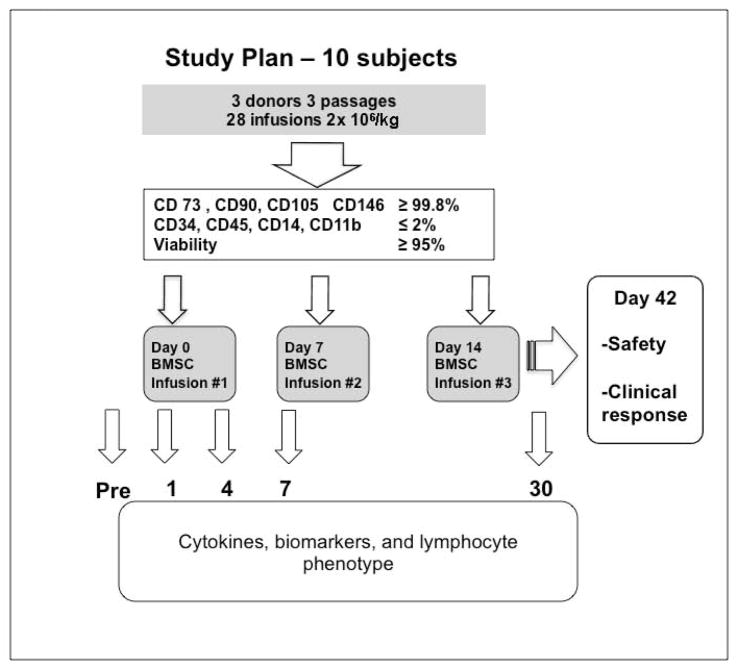
Bone marrow mesenchymal stromal cells (BMSC) treatment plan.
Figure 2
Figure 2
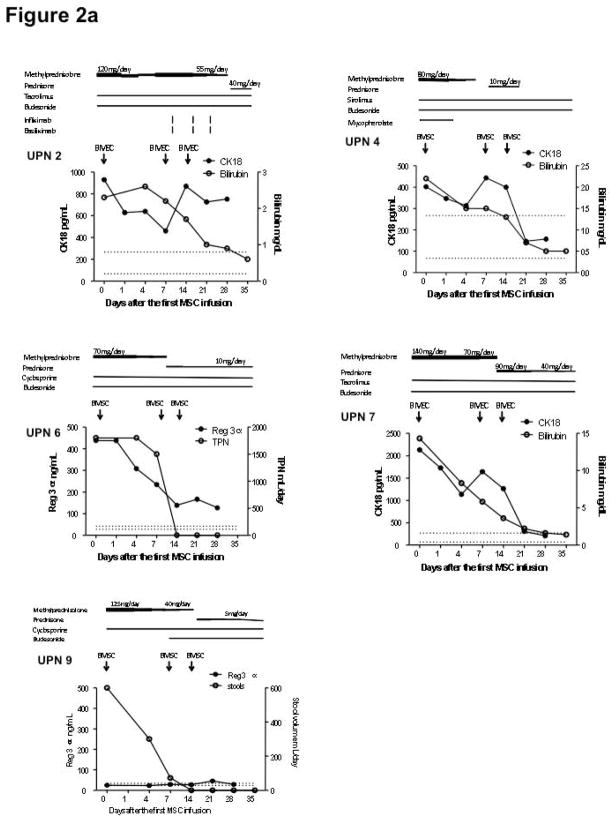
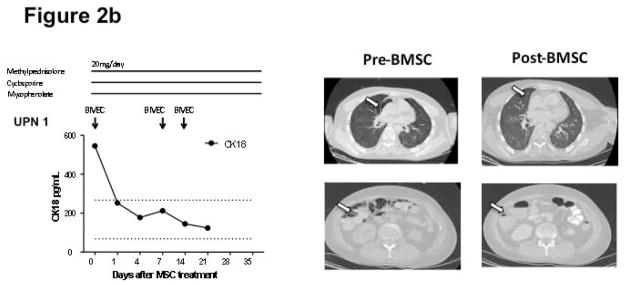
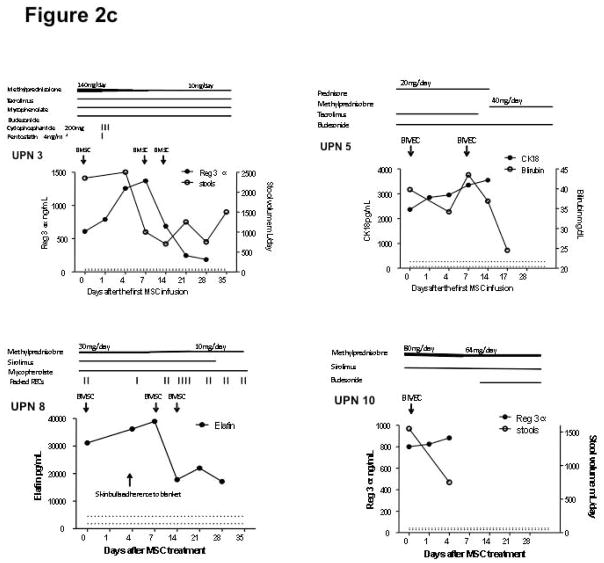
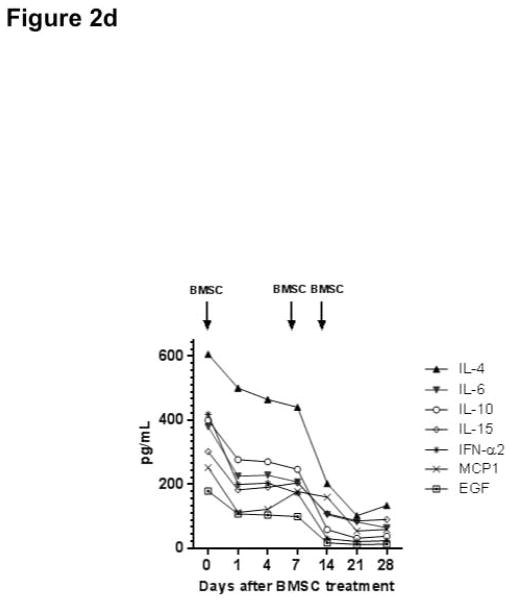
Responses to bone marrow mesenchymal stromal cell (BMSC) therapy. The dosages of tacrolimus and sirolimus were adjusted to a target level 10–15 ng/mL. The dose of cyclosporine was adjusted to a target level of 100–200 mcg/L. The dose of budesonide was 3 mg three times daily and mycophenolate 1000 mg twice daily. Figure 2a shows that the 5 patients with steroid-refractory acute GVHD achieved complete remission after receiving BMSC treatment. Figure 2b shows patient 1 achieved complete resolution of tissue injury after BMSC treatment. Arrows indicate air-filled areas resolving after MSC infusion. Figure 2c shows the 4 patients who did not achieve a response after BMSC treatment. Abbreviation: REG 3α, Regenerating islet-derived 3-α, CK18, Cytokeratin fragment 18, TPN: total parenteral nutrition. Figure 2d shows the rapid changes in cytokines in a responding subject (UPN#6)
Figure 2
Figure 2
Responses to bone marrow mesenchymal stromal cell (BMSC) therapy. The dosages of tacrolimus and sirolimus were adjusted to a target level 10–15 ng/mL. The dose of cyclosporine was adjusted to a target level of 100–200 mcg/L. The dose of budesonide was 3 mg three times daily and mycophenolate 1000 mg twice daily. Figure 2a shows that the 5 patients with steroid-refractory acute GVHD achieved complete remission after receiving BMSC treatment. Figure 2b shows patient 1 achieved complete resolution of tissue injury after BMSC treatment. Arrows indicate air-filled areas resolving after MSC infusion. Figure 2c shows the 4 patients who did not achieve a response after BMSC treatment. Abbreviation: REG 3α, Regenerating islet-derived 3-α, CK18, Cytokeratin fragment 18, TPN: total parenteral nutrition. Figure 2d shows the rapid changes in cytokines in a responding subject (UPN#6)
Figure 2
Figure 2
Responses to bone marrow mesenchymal stromal cell (BMSC) therapy. The dosages of tacrolimus and sirolimus were adjusted to a target level 10–15 ng/mL. The dose of cyclosporine was adjusted to a target level of 100–200 mcg/L. The dose of budesonide was 3 mg three times daily and mycophenolate 1000 mg twice daily. Figure 2a shows that the 5 patients with steroid-refractory acute GVHD achieved complete remission after receiving BMSC treatment. Figure 2b shows patient 1 achieved complete resolution of tissue injury after BMSC treatment. Arrows indicate air-filled areas resolving after MSC infusion. Figure 2c shows the 4 patients who did not achieve a response after BMSC treatment. Abbreviation: REG 3α, Regenerating islet-derived 3-α, CK18, Cytokeratin fragment 18, TPN: total parenteral nutrition. Figure 2d shows the rapid changes in cytokines in a responding subject (UPN#6)
Figure 2
Figure 2
Responses to bone marrow mesenchymal stromal cell (BMSC) therapy. The dosages of tacrolimus and sirolimus were adjusted to a target level 10–15 ng/mL. The dose of cyclosporine was adjusted to a target level of 100–200 mcg/L. The dose of budesonide was 3 mg three times daily and mycophenolate 1000 mg twice daily. Figure 2a shows that the 5 patients with steroid-refractory acute GVHD achieved complete remission after receiving BMSC treatment. Figure 2b shows patient 1 achieved complete resolution of tissue injury after BMSC treatment. Arrows indicate air-filled areas resolving after MSC infusion. Figure 2c shows the 4 patients who did not achieve a response after BMSC treatment. Abbreviation: REG 3α, Regenerating islet-derived 3-α, CK18, Cytokeratin fragment 18, TPN: total parenteral nutrition. Figure 2d shows the rapid changes in cytokines in a responding subject (UPN#6)
Figure 3
Figure 3
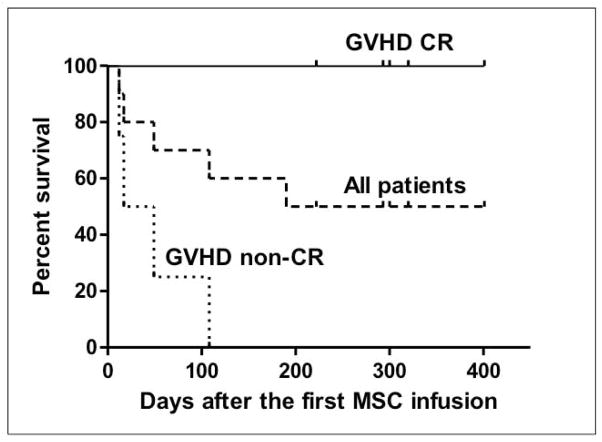
Survival in 10 patients who received bone marrow mesenchymal stromal cells (BMSC). Upper lane: 5 subjects with GVHD who achieved complete remission (patients # 6,7,2,4,9); middle lane: all 10 patients; lower lane: 4 subjects with GVHD who did not achieve a complete remission (patients # 5,8,1,3,10)
Figure 4
Figure 4
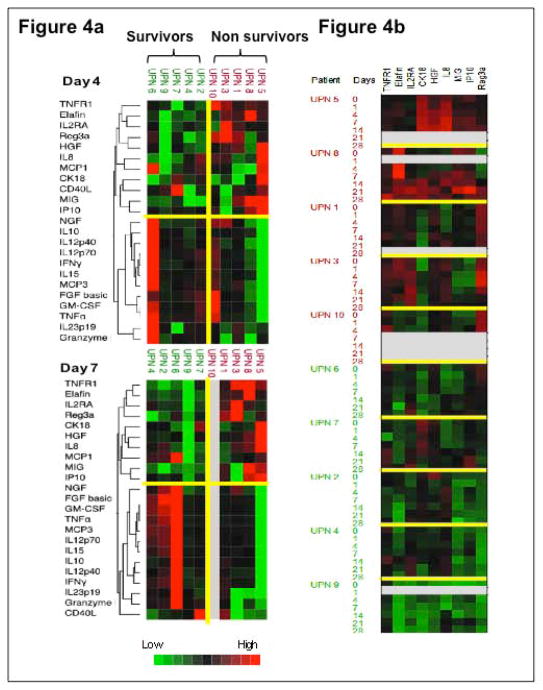
Cytokine/biomarker profiles in 10 patients who received bone marrow mesenchymal stromal cells (BMSC) treatment. Figure 4a shows the cytokine profiles on days 4 and 7 after the first dose of BMSC infusion. Two-way hierarchical cluster analysis was performed on log-transformed cytokine levels of patients’ samples using Ward’s method. The dendrogram on the left side of the figure classifies 2 clusters according to the proximities of cytokines. Two groups of patients (the dead or the alive) were separated based on their cytokine profiles. Figure 4b shows the cell plot of selected cytokines at all time points. The upper panel includes patients 5, 8, 1, 3, and 10 who showed up-regulated cytokines and GVHD biomarkers who had early mortality; the lower panel incudes patients 6, 7, 2, 4, and 9 who had prolonged survival showed down-regulated cytokines and GVHD biomarkers. Color scales represent cytokine levels (red indicates high levels; green, low levels). Gray indicates that the sample was not assayed for that protein. Color characters beside the plot represent patients’ survival status (red indicates the dead; green, the alive) and days post BMSC infusion.

References

    1. Jitschin R, Mougiakakos D, Von Bahr L, et al. Alterations in the cellular immune compartment of patients treated with third-party mesenchymal stromal cells following allogeneic hematopoietic stem-cell transplantation. Stem Cells. 2013 - PubMed
    1. Battiwalla M, Hematti P. Mesenchymal stem cells in hematopoietic stem cell transplantation. Cytotherapy. 2009;11:503–515. - PMC - PubMed
    1. Le Blanc K, Frassoni F, Ball L, et al. Mesenchymal stem cells for treatment of steroid-resistant, severe, acute graft-versus-host disease: a phase II study. Lancet. 2008;371:1579–1586. - PubMed
    1. Le Blanc K, Rasmusson I, Sundberg B, et al. Treatment of severe acute graft-versus-host disease with third party haploidentical mesenchymal stem cells. Lancet. 2004;363:1439–1441. - PubMed
    1. Prasad VK, Lucas KG, Kleiner GI, et al. Efficacy and Safety of Ex-vivo Cultured Adult Human Mesenchymal Stem Cells (Prochymal(TM)) in Pediatric Patients with Severe Refractory Acute Graft-Versus-Host Disease in a Compassionate Use study. Biol Blood Marrow Transplant. 2011 - PubMed

Publication types

MeSH terms