. 2014 Jun;21(3):327-39.
doi: 10.1093/dnares/dst060. Epub 2014 Jan 21.

Genome-wide evolutionary characterization and expression analyses of WRKY family genes in Brachypodium distachyon

Affiliations

Genome-wide evolutionary characterization and expression analyses of WRKY family genes in Brachypodium distachyon

Feng Wen et al. DNA Res. 2014 Jun.

Abstract

Members of plant WRKY gene family are ancient transcription factors that function in plant growth and development and respond to biotic and abiotic stresses. In our present study, we have investigated WRKY family genes in Brachypodium distachyon, a new model plant of family Poaceae. We identified a total of 86 WRKY genes from B. distachyon and explored their chromosomal distribution and evolution, domain alignment, promoter cis-elements, and expression profiles. Combining the analysis of phylogenetic tree of BdWRKY genes and the result of expression profiling, results showed that most of clustered gene pairs had higher similarities in the WRKY domain, suggesting that they might be functionally redundant. Neighbour-joining analysis of 301 WRKY domains from Oryza sativa, Arabidopsis thaliana, and B. distachyon suggested that BdWRKY domains are evolutionarily more closely related to O. sativa WRKY domains than those of A. thaliana. Moreover, tissue-specific expression profile of BdWRKY genes and their responses to phytohormones and several biotic or abiotic stresses were analysed by quantitative real-time PCR. The results showed that the expression of BdWRKY genes was rapidly regulated by stresses and phytohormones, and there was a strong correlation between promoter cis-elements and the phytohormones-induced BdWRKY gene expression.

Keywords: Brachypodium distachyon; WRKY; abiotic stresses; biotic stresses; evolution.


Figures

Figure 1.
Figure 1.
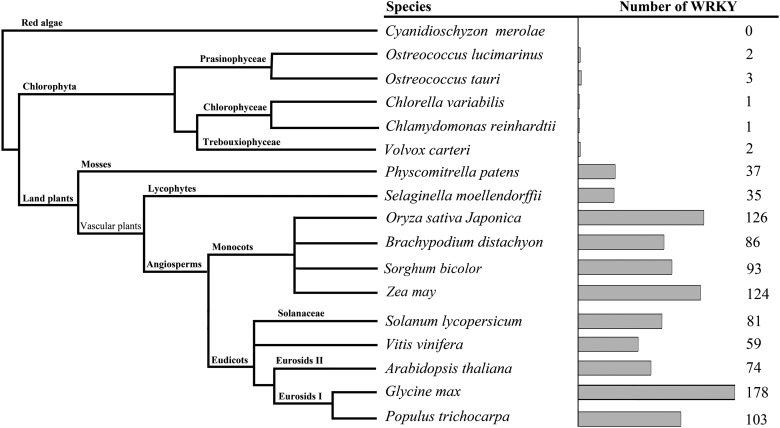
Distribution of the WRKY domain-containing proteins in Plantae. The total number of WRKY homologous genes found in each genome is indicated on the right.
Figure 2.
Figure 2.
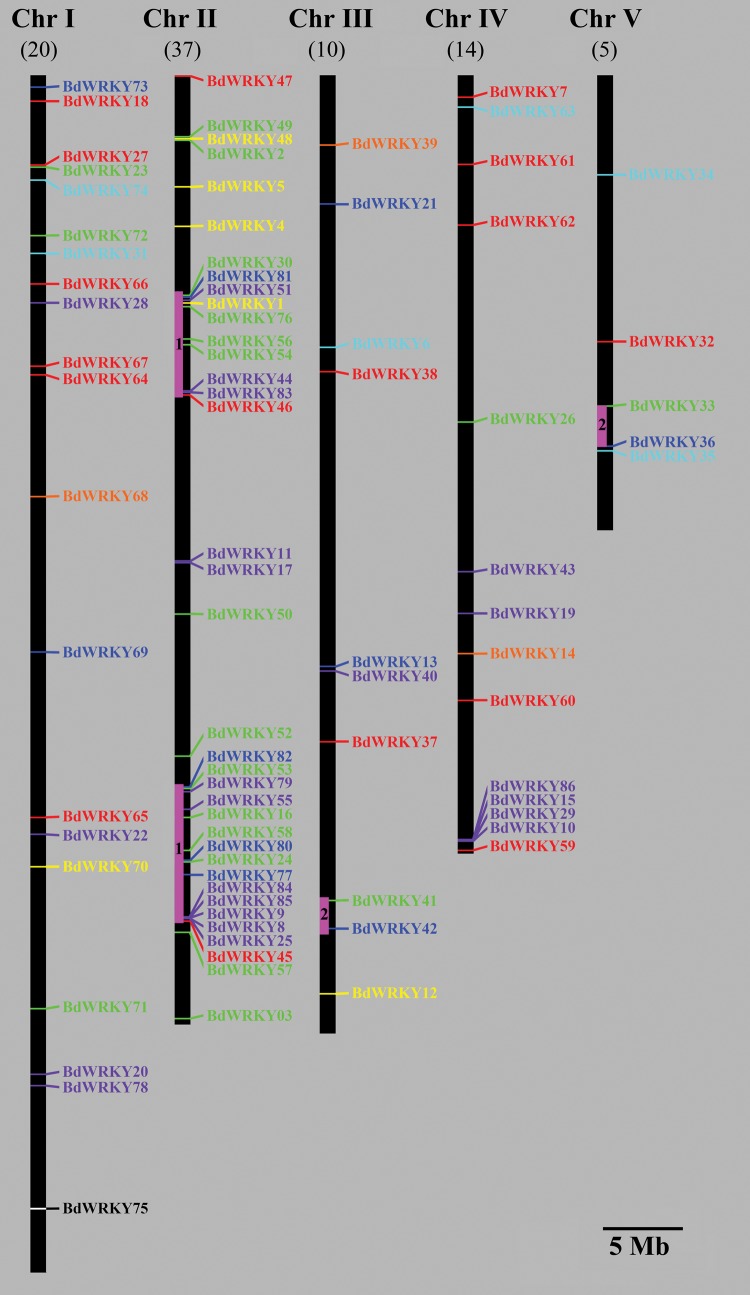
Chromosomal locations and regional duplication for B. distachyon WRKY genes. The chromosomal position of each BdWRKY was mapped according to the B. distachyon genome. The chromosome number is indicated at the top of each chromosome. The number below indicates the number of BdWRKYs in each chromosome. The scale is 5 Mb. The bars with numbers on the chromosomes indicate the four predicted duplication regions.
Figure 3.
Figure 3.
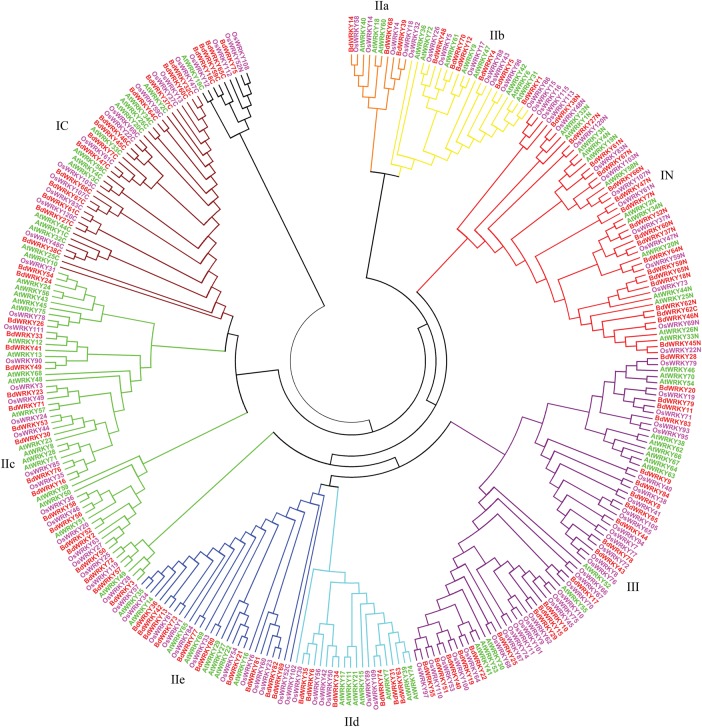
NJ analyses of 301 WRKY domains from O. sativa, A. thaliana, and B. distachyon, containing 262 plant WRKY proteins. The domains clustered into eight major subgroups, IN, IC, IIa, IIb, IIc, IId, IIe, and III.
Figure 4.
Figure 4.
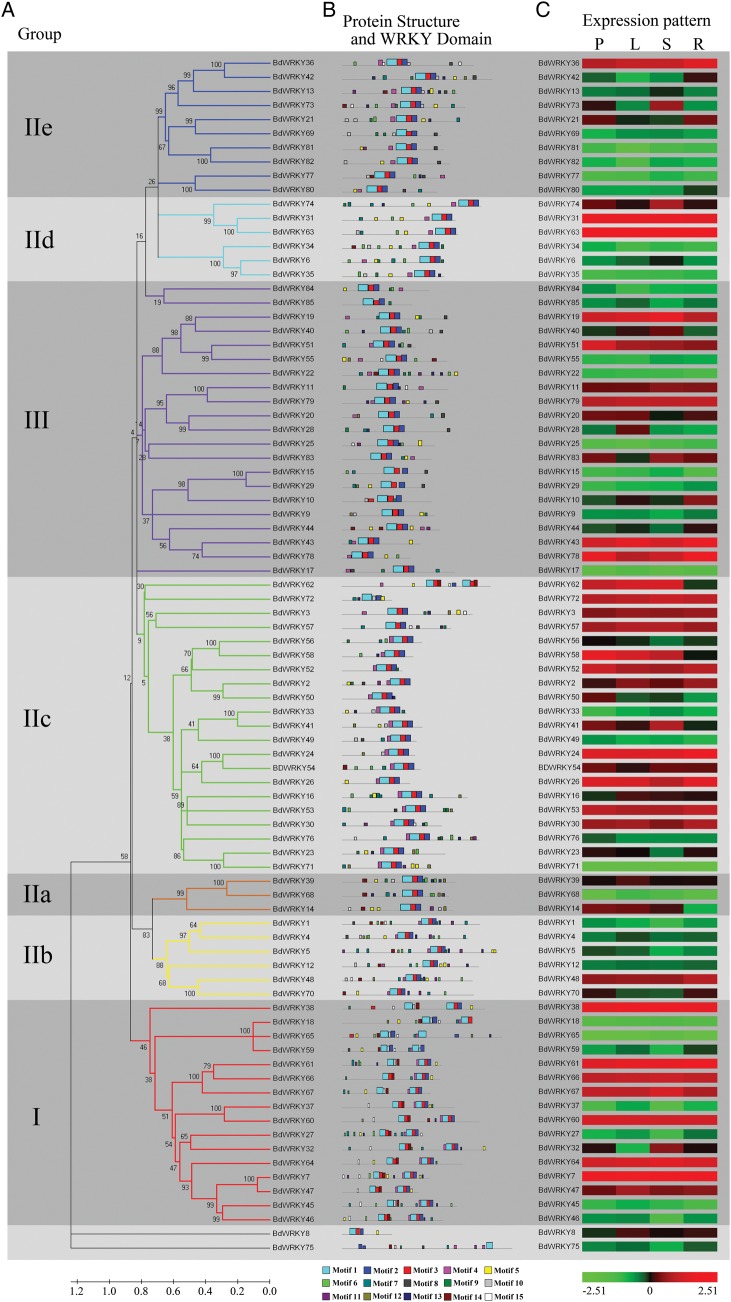
Phylogenetic relationships and subgroup designations in WRKY proteins with tissue-specific expression profile from B. distachyon. (A) The phylogenetic tree was constructed from the amino acid sequences using the NJ program from MEGA 5, representing relationships among 86 WRKY proteins from B. distachyon. The proteins are clustered into seven subgroups, which are designated with a subgroup number (e.g. IIe) and marked with a different background to facilitate subfamily identification with a high predictive value. The numbers beside the branches represent bootstrap support values (>50%) from 1000 replications. (B) Structure of WRKY proteins and the WRKY domains in B. distachyon. The details of sequence logo of motifs were shown in Supplementary Fig. S1. (C) Expression patterns of WRKY genes in B. distachyon in different tissues. P for seedling, L for leaf, S for stem, R for root. In this expression pattern analysis, the 2-week-old seedlings were used for harvesting different tissues including leaf, stem, and root. The BdWRKY array was constituted of 86 primer sets representing all members of the B. distachyon WRKY gene family. The expression values of the 86 BdWRKY genes were assessed upon the qPCR result analysis.
Figure 5.
Figure 5.
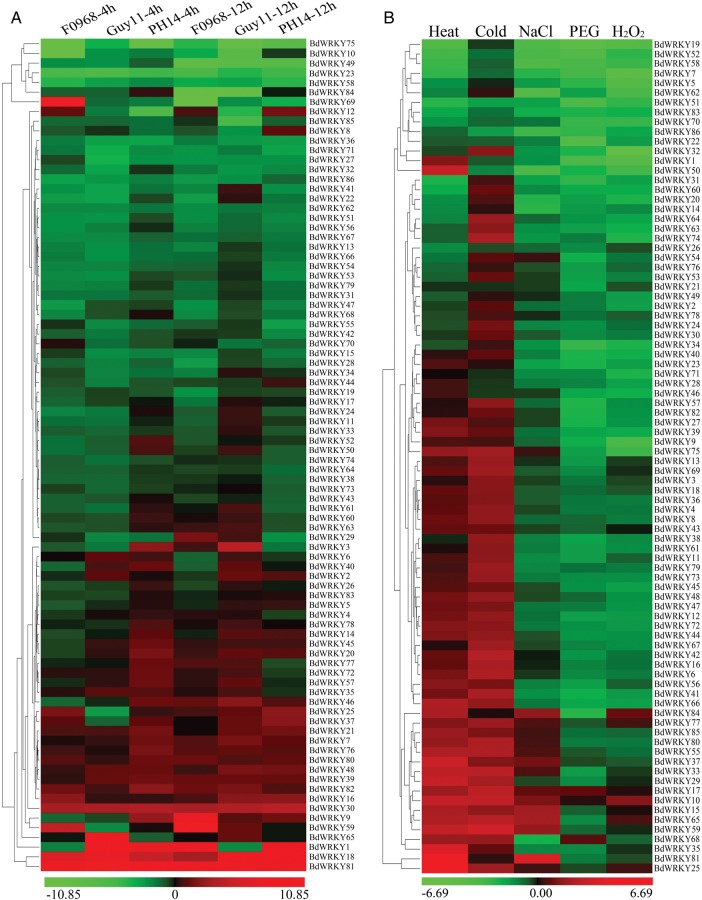
Expression profiles of BdWRKY genes under biotic and abiotic stresses. (A) The 2-week-old seedlings were sprayed with different pathogens. (B) Clustering of BdWRKY genes according to their expression profiles in the seedling of B. distachyon after different stress treatments. The BdWRKY array was constituted of 86 primer sets representing all members of the B. distachyon WRKY gene family. The expression of the 86 BdWRKY genes was assessed upon the qPCR result analysis.
Figure 6.
Figure 6.
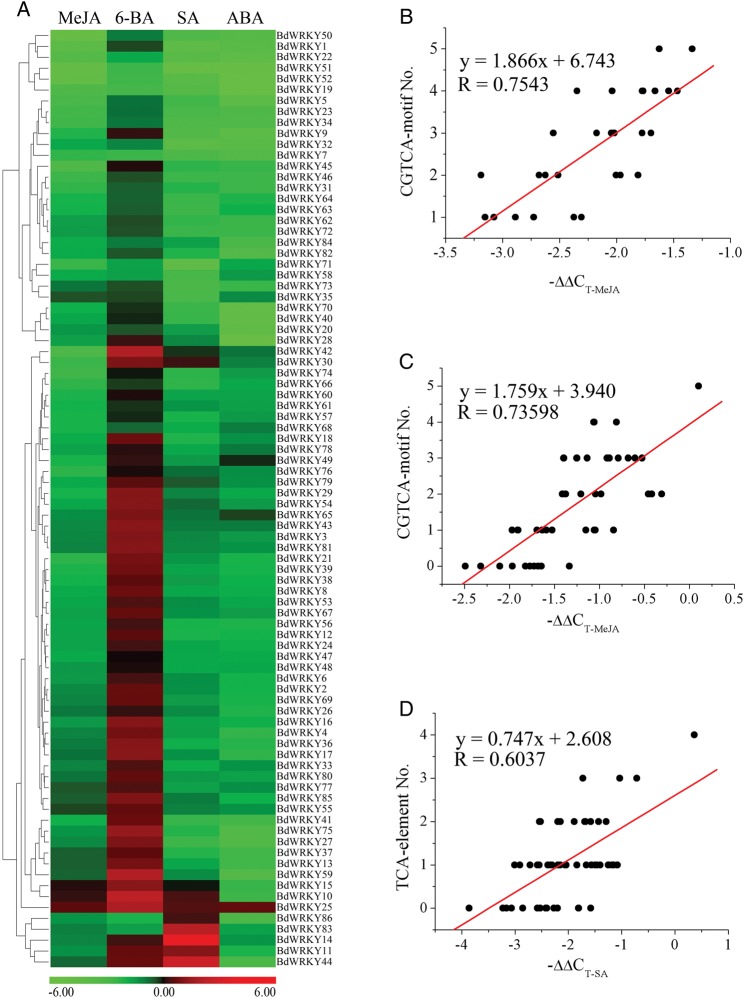
The expression profiles of BdWRKY genes under hormone treatment. (A) Clustering of BdWRKY genes according to their expression profiles in the seedling of B. distachyon after different phytohormone treatments. (B and C) The relevance analysis between MeJA-related elements and MeJA-induced BdWRKY gene expression. (D) The relevance analysis between SA-related elements and SA-induced BdWRKY gene expression.

References

    1. Bevan M.W., Garvin D.F., Vogel J.P. Brachypodium distachyon genomics for sustainable food and fuel production. Curr. Opin. Biotechnol. 2010;21:211–7. - PubMed
    1. Berri S., Abbruscato P., Faivre-Rampant O., et al. Characterization of WRKY co-regulatory networks in rice and Arabidopsis. BMC Plant Biol. 2009;9:120. - PMC - PubMed
    1. Chen L., Song Y., Li S., Zhang L., Zou C., Yu D. The role of WRKY transcription factors in plant abiotic stresses. Biochim. Biophys. Acta. 2012;18,19:120–8. - PubMed
    1. Eulgem T., Rushton P.J., Robatzek S., Somssich I.E. The WRKY superfamily of plant transcription factors. Trends Plant Sci. 2000;5:199–206. - PubMed
    1. Dong J.X., Chen C.H., Chen Z.X. Expression profiles of the Arabidopsis WRKY gene superfamily during plant defense response. Plant Mol. Biol. 2003;51:21–37. - PubMed

Publication types

LinkOut - more resources