


Utility of GenBank and the Barcode of Life Data Systems (BOLD) for the identification of forensically important Diptera from Belgium and France
- PMID: 24453564
- PMCID: PMC3890684
- DOI: 10.3897/zookeys.365.6027
Utility of GenBank and the Barcode of Life Data Systems (BOLD) for the identification of forensically important Diptera from Belgium and France
Abstract
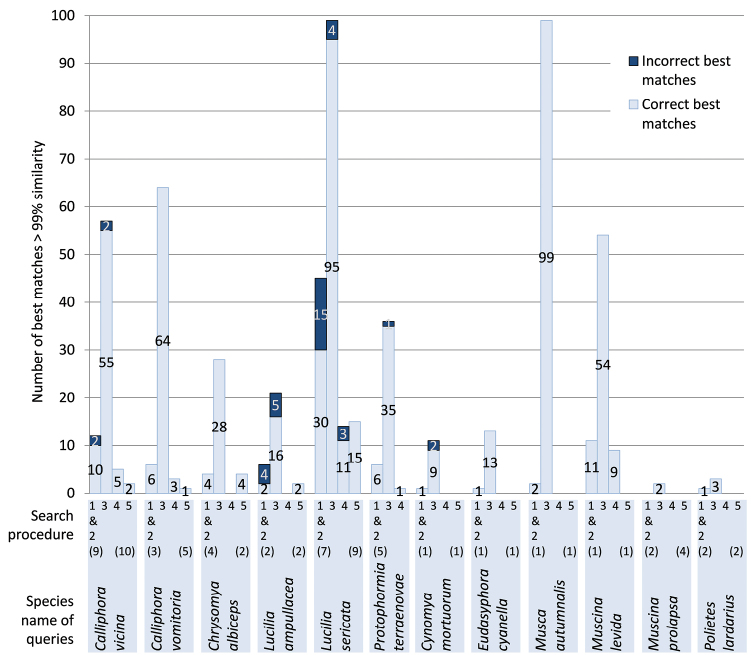
Fly larvae living on dead corpses can be used to estimate post-mortem intervals. The identification of these flies is decisive in forensic casework and can be facilitated by using DNA barcodes provided that a representative and comprehensive reference library of DNA barcodes is available. We constructed a local (Belgium and France) reference library of 85 sequences of the COI DNA barcode fragment (mitochondrial cytochrome c oxidase subunit I gene), from 16 fly species of forensic interest (Calliphoridae, Muscidae, Fanniidae). This library was then used to evaluate the ability of two public libraries (GenBank and the Barcode of Life Data Systems - BOLD) to identify specimens from Belgian and French forensic cases. The public libraries indeed allow a correct identification of most specimens. Yet, some of the identifications remain ambiguous and some forensically important fly species are not, or insufficiently, represented in the reference libraries. Several search options offered by GenBank and BOLD can be used to further improve the identifications obtained from both libraries using DNA barcodes.
Keywords: BLAST; COI; DNA barcoding; Forensic entomology.
Figures
References
-
- Beĭ-Bienko GI. (1988) Keys to the insects of the European part of the USSR fauna, Volume 5, Smithsonian Institution Libraries and the National Science Foundation, Washington D.C.
-
- Bergsten J, Bilton DT, Fujisawa T, Elliott M, Monaghan MT, Balke M, Hendrich L, Geijer J, Herrmann J, Foster GN, Ribera I, Nilsson AN, Barraclough TG, Vogler AP. (2012) The effect of geographical scale of sampling on DNA barcoding. Systematic Biology 61: 851–869. doi: 10.1093/sysbio/sys037 - DOI - PMC - PubMed
LinkOut - more resources
Full Text Sources
Other Literature Sources
Research Materials