


Characteristics and outcomes of elderly patients refused to ICU
- PMID: 24453879
- PMCID: PMC3886377
- DOI: 10.1155/2013/590837
Characteristics and outcomes of elderly patients refused to ICU
Abstract
Background: There are few data regarding the process of deciding which elderly patients are refused to ICU admission, their characteristics, and outcome.
Methods: Prospective longitudinal observational cohort study. We included all consecutive patients older than 75 years, who were evaluated for admission to but were refused to treatment in ICU, during 18 months, with 12-month followup. We collected demographic data, ICU admission/refusal reasons, previous functional and cognitive status, comorbidity, severity of illness, and hospital and 12-month mortality.
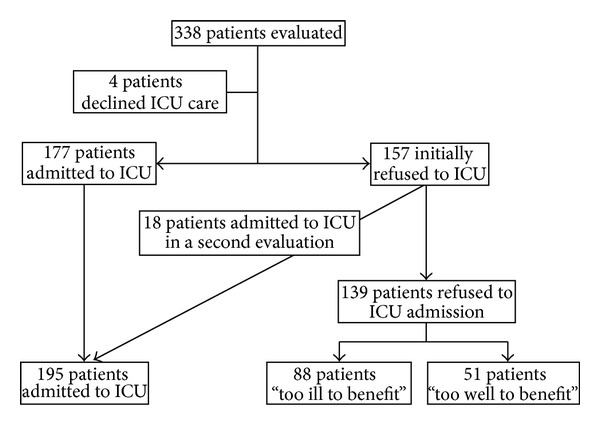
Results: 338 elderly patients were evaluated for ICU admission and 88 were refused to ICU (26%). Patients refused because they were "too ill to benefit" had more comorbidity and worse functional and mental situation than those admitted to ICU; there were no differences in illness severity. Hospital mortality rate of the whole study cohort was 36.3%, higher in patients "too ill to benefit" (55.6% versus 35.8%, P < 0.01), which also have higher 1-year mortality (73.7% versus 42.5%, P < 0.01). High comorbidity, low functional status, unavailable ICU beds, and age were associated with refusal decision on multivariate analysis.
Conclusions: Prior functional status and comorbidity, not only the age or severity of illness, can help us more to make the right decision of admitting or refusing to ICU patients older than 75 years.
Figures
References
-
- Sprung CL, Artigas A, Kesecioglu J, et al. The Eldicus prospective, observational study of triage decision making in European intensive care units. Part II: intensive care benefit for the elderly. Critical Care Medicine. 2012;40(1):132–138. - PubMed
-
- Ward NS, Levy MM. Rationing and critical care medicine. Critical Care Medicine. 2007;35(2):S102–S105. - PubMed
-
- Garrouste-Orgeas M, Montuclard L, Timsit J-F, et al. Predictors of intensive care unit refusal in French intensive care units: a multiple-center study. Critical Care Medicine. 2005;33(4):750–755. - PubMed
Publication types
MeSH terms
LinkOut - more resources
Full Text Sources
Other Literature Sources
