Cervical screening at age 50-64 years and the risk of cervical cancer at age 65 years and older: population-based case control study
- PMID: 24453946
- PMCID: PMC3891624
- DOI: 10.1371/journal.pmed.1001585
Cervical screening at age 50-64 years and the risk of cervical cancer at age 65 years and older: population-based case control study
Abstract
Background: There is little consensus, and minimal evidence, regarding the age at which to stop cervical screening. We studied the association between screening at age 50-64 y and cervical cancer at age 65-83 y.
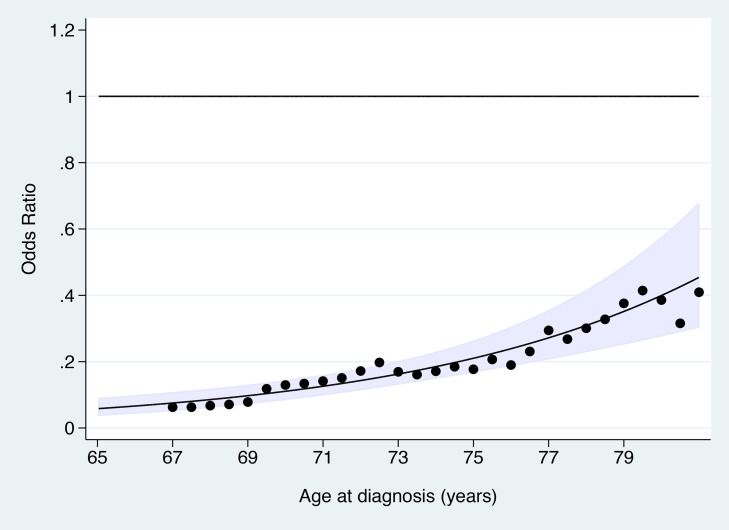
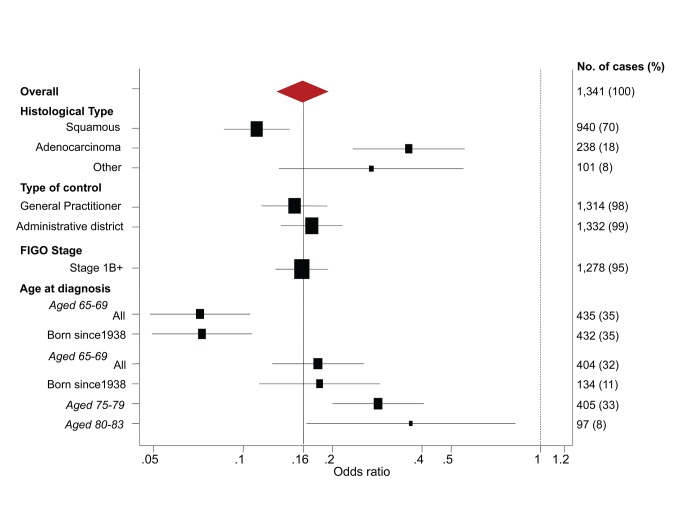
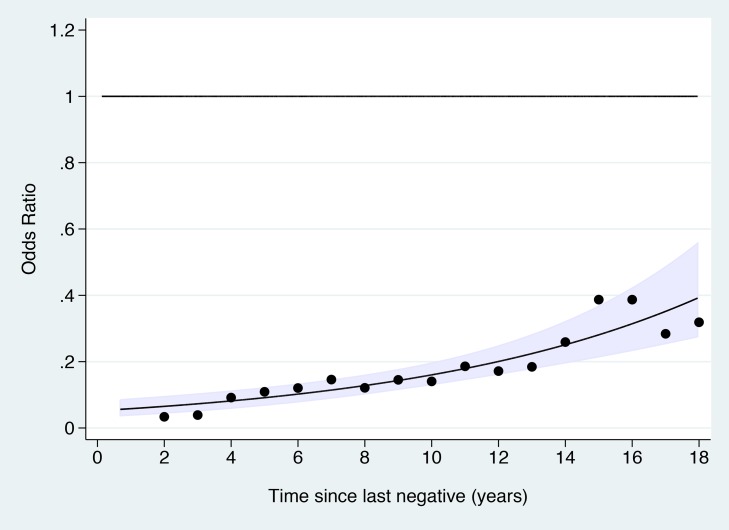
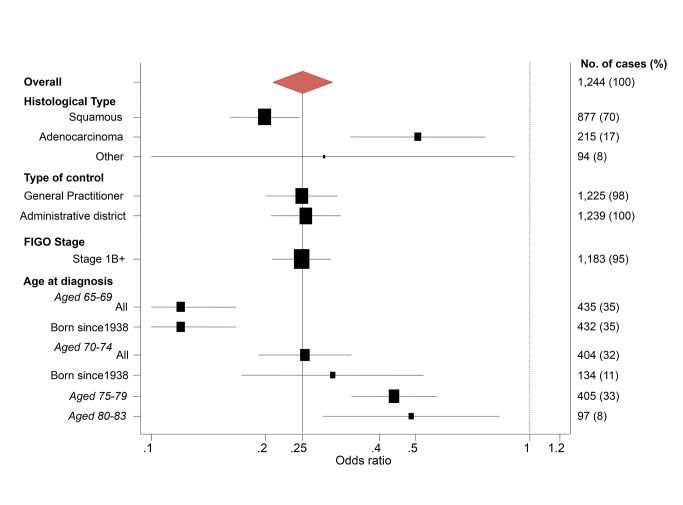
Methods and findings: Cases were women (n = 1,341) diagnosed with cervical cancer at age 65-83 y between 1 April 2007 and 31 March 2012 in England and Wales; age-matched controls (n = 2,646) were randomly selected from population registers. Screening details from 1988 onwards were extracted from national databases. We calculated the odds ratios (OR) for different screening histories and subsequent cervical cancer. Women with adequate negative screening at age 65 y (288 cases, 1,395 controls) were at lowest risk of cervical cancer (20-y risk: 8 cancers per 10,000 women) compared with those (532 cases, 429 controls) not screened at age 50-64 y (20-y risk: 49 cancers per 10,000 women, with OR = 0.16, 95% CI 0.13-0.19). ORs depended on the age mix of women because of the weakening association with time since last screen: OR = 0.11, 95% CI 0.08-0.14 at 2.5 to 7.5 y since last screen; OR = 0.27, 95% CI 0.20-0.36 at 12.5 to 17.5 y since last screen. Screening at least every 5.5 y between the ages 50 and 64 y was associated with a 75% lower risk of cervical cancer between the ages 65 and 79 y (OR = 0.25, 95% CI 0.21-0.30), and the attributable risk was such that in the absence of screening, cervical cancer rates in women aged 65+ would have been 2.4 (95% CI 2.1-2.7) times higher. In women aged 80-83 y the association was weaker (OR = 0.49, 95% CI 0.28-0.83) than in those aged 65-69 y (OR = 0.12, 95% CI 0.09-0.17). This study was limited by an absence of data on confounding factors; additionally, findings based on cytology may not generalise to human papillomavirus testing.
Conclusions: Women with adequate negative screening at age 50-64 y had one-sixth of the risk of cervical cancer at age 65-83 y compared with women who were not screened. Stopping screening between ages 60 and 69 y in women with adequate negative screening seems sensible, but further screening may be justifiable as life expectancy increases.
Conflict of interest statement
Authors declare no support from any organisation for the submitted work, no financial relationships with any organisations that might have an interest in the submitted work in the previous 3 years, and no other relationships or activities that could appear to have influenced the submitted work.
Figures
Comment in
-
Cervical cancer screening in older women: new evidence and knowledge gaps.PLoS Med. 2014 Jan;11(1):e1001586. doi: 10.1371/journal.pmed.1001586. Epub 2014 Jan 14. PLoS Med. 2014. PMID: 24453947 Free PMC article.
References
-
- Sirovich B, Gottlieb DJ, Fisher ES (2003) The burden of prevention: downstream consequences of PAP smear testing in the elderly. J Med Screen 10: 189–195. - PubMed
-
- Saslow D, Solomon D, Lawson HW, Killackey M, Kulasingam SL, et al. (2012) American Cancer Society, American Society for Colposcopy and Cervical Pathology, and American Society for Clinical Pathology screening guidelines for the prevention and early detection of cervical cancer. CA Cancer J Clin 62: 147–172. - PMC - PubMed
Publication types
MeSH terms
Grants and funding
LinkOut - more resources
Full Text Sources
Other Literature Sources
Medical
Miscellaneous