Review
. 2014 Jan 10:4:173.
doi: 10.3389/fpsyt.2013.00173.

Mindfulness training targets neurocognitive mechanisms of addiction at the attention-appraisal-emotion interface

Affiliations
Review

Mindfulness training targets neurocognitive mechanisms of addiction at the attention-appraisal-emotion interface

Eric L Garland et al. Front Psychiatry. .

Abstract

Prominent neuroscience models suggest that addictive behavior occurs when environmental stressors and drug-relevant cues activate a cycle of cognitive, affective, and psychophysiological mechanisms, including dysregulated interactions between bottom-up and top-down neural processes, that compel the user to seek out and use drugs. Mindfulness-based interventions (MBIs) target pathogenic mechanisms of the risk chain linking stress and addiction. This review describes how MBIs may target neurocognitive mechanisms of addiction at the attention-appraisal-emotion interface. Empirical evidence is presented suggesting that MBIs ameliorate addiction by enhancing cognitive regulation of a number of key processes, including: clarifying cognitive appraisal and modulating negative emotions to reduce perseverative cognition and emotional arousal; enhancing metacognitive awareness to regulate drug-use action schema and decrease addiction attentional bias; promoting extinction learning to uncouple drug-use triggers from conditioned appetitive responses; reducing cue-reactivity and increasing cognitive control over craving; attenuating physiological stress reactivity through parasympathetic activation; and increasing savoring to restore natural reward processing. Treatment and research implications of our neurocognitive framework are presented. We conclude by offering a temporally sequenced description of neurocognitive processes targeted by MBIs through a hypothetical case study. Our neurocognitive framework has implications for the optimization of addiction treatment with MBIs.

Keywords: addiction; automaticity; mindfulness; neurocognitive; reappraisal vs. suppression; reward; stress; substance dependence.


Figures
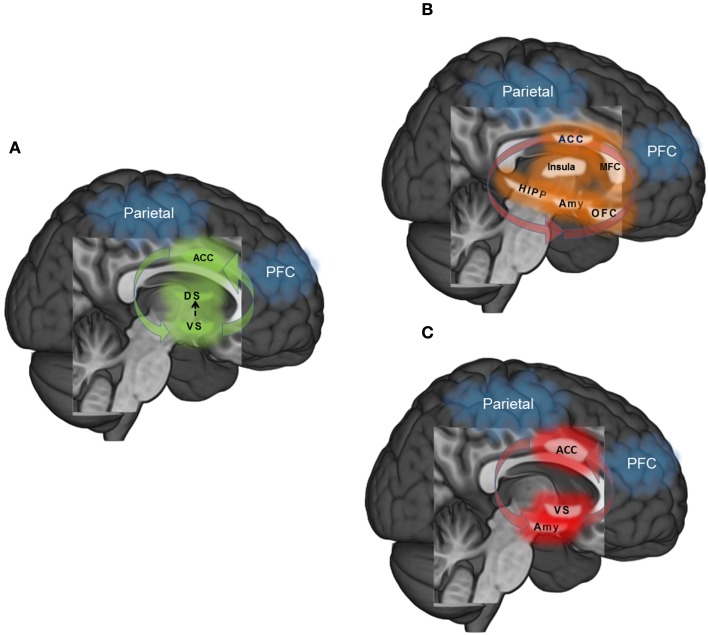
Figure 1
Figure 1
(A) Habit – automaticity: learning to approach rewarding stimuli (i.e., psychoactive drugs) is reinforced via dopaminergic innervation in the ventral striatum (VS). However, as the association between stimulus and reward becomes learned, memory and motor-related commands transition to dorsal striatum (DS). In the context of overlearned and automatized behavior such as drug addiction, fronto-parietal attentional networks that exert top-down modulatory control over behavior may become functionally disconnected with behavior. (B) Unregulated craving: drug craving is a multi-dimensional process that is elicited by internal and external triggers. Cues that trigger craving may elicit greater response in ACC during attentional monitoring, medial frontal cortex (MFC) during appraisal of the salience of the cue, amygdala (Amy) during emotional arousal, hippocampus (HIPP) during coding of context, insula during interoception and orbitofrontal cortex (OFC) in weighing the cost – benefit ratio of relieving craving through drug use or remaining abstinent. Functional disconnectivity of the fronto-parietal network with these regions may strengthen craving by dysregulating responses to craving triggers. (C) Unregulated affect: Dysregulated affect may ensue when there is inefficient or attenuated top-down control from fronto-parietal circuitry into the amygdala (Amy) in the context of negative emotions, and ventral striatum (VS) in the context of reward. Disconnectivity between the anterior cingulate cortex (ACC) and prefrontal cortex along with hyperconnectivity of the ACC and limbic-striatal regions may potentiate this dysfunction.
Figure 2
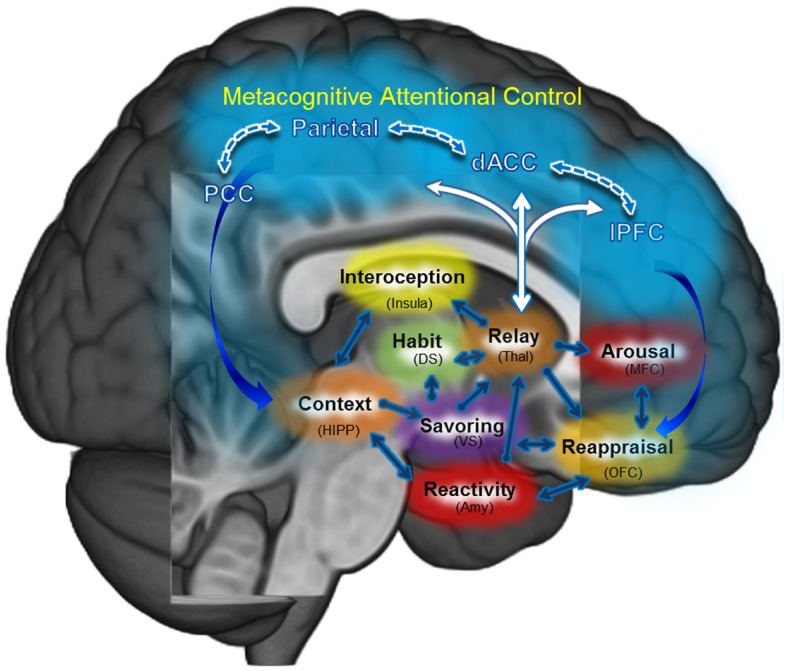
Figure 2
Mindfulness-centered regulation: the central tenet of this model posits that mindfulness-based interventions (MBI’s) may remediate dysregulated habit behaviors, craving, and affect primarily by way of strengthening functional connectivity: (1) within a metacognitive attentional control network (PFC, ACC, Parietal); and (2) between that metacognitive attentional control network and the (a) habit circuit, (b) craving circuit, and (c) affect circuit.

References

    1. Garland EL, Boettiger CA, Gaylord SA, West Channon V, Howard MO. Mindfulness is inversely associated with alcohol attentional bias among recovering alcohol dependent adults. Cognit Ther Res (2012) 36:442–5010.1007/s10608-011-9378-7 - DOI - PMC - PubMed
    1. Koob GF, Volkow ND. Neurocircuitry of addiction. Neuropsychopharmacology (2010) 35(1):217–3810.1038/npp.2009.110 - DOI - PMC - PubMed
    1. George O, Koob GF. Individual differences in prefrontal cortex function and the transition from drug use to drug dependence. Neurosci Biobehav Rev (2010) 35:232–4710.1016/j.neubiorev.2010.05.002 - DOI - PMC - PubMed
    1. Bowen S, Chawla N, Collins SE, Witkiewitz K, Hsu S, Grow J, et al. Mindfulness-based relapse prevention for substance use disorders: a pilot efficacy trial. Subst Abuse (2009) 30:295–30510.1080/08897070903250084 - DOI - PMC - PubMed
    1. Bowen S, Chawla N, Marlatt GA. Mindfulness-Based Relapse Prevention for Addictive Behaviors. New York: Guilford Press; (2010).

LinkOut - more resources