


Application of marginal structural models in pharmacoepidemiologic studies: a systematic review
- PMID: 24458364
- PMCID: PMC4043935
- DOI: 10.1002/pds.3569
Application of marginal structural models in pharmacoepidemiologic studies: a systematic review
Abstract
Purpose: We systematically reviewed pharmacoepidemiologic studies published in 2012 that used inverse probability weighted (IPW) estimation of marginal structural models (MSM) to estimate the effect from a time-varying treatment.
Methods: Potential studies were retrieved through a citation search within Web of Science and a keyword search within PubMed. Eligibility of retrieved studies was independently assessed by at least two reviewers. One reviewer performed data extraction, and a senior epidemiologist confirmed the extracted information for all eligible studies.
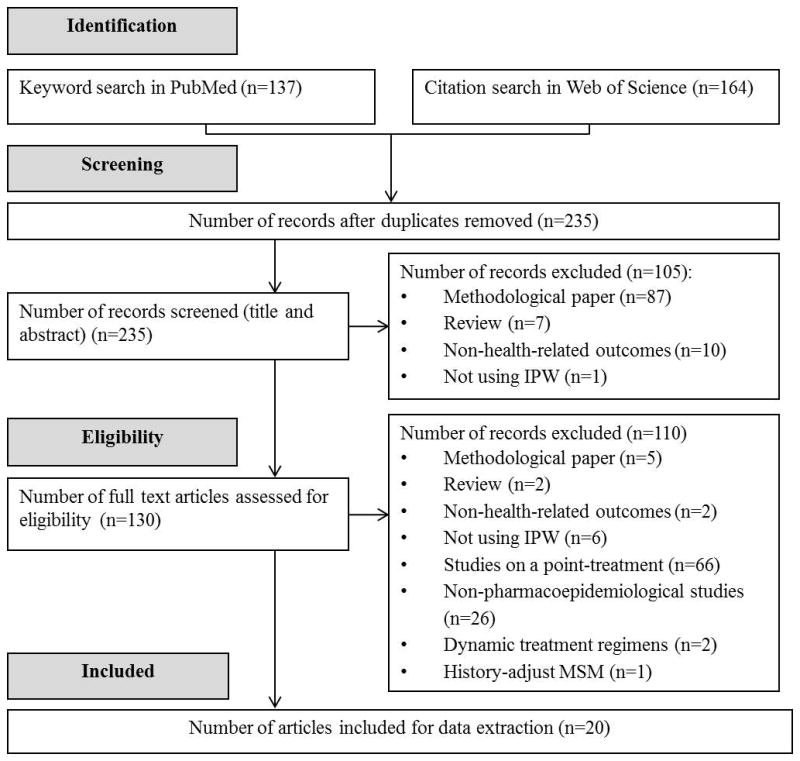
Results: Twenty pharmacoepidemiologic studies were eligible for data extraction. The majority of reviewed studies did not report whether the positivity assumption was checked. Six studies performed intention-to-treat analyses, but none of them reported adherence levels after treatment initiation. Eight studies chose an as-treated analytic strategy, but only one of them reported modeling the multiphase of treatment use. Almost all studies performing as-treated analyses chose the most recent treatment status as the functional form of exposure in the outcome model. Nearly half of the studies reported that the IPW estimate was substantially different from the estimate derived from a standard regression model.
Conclusions: The use of IPW method to control for time-varying confounding is increasing in medical literature. However, reporting of the application of the technique is variable and suboptimal. It may be prudent to develop best practices in reporting complex methods in epidemiologic research.
Keywords: inverse probability weighting; marginal structural models; pharmacoepidemiology.
Copyright © 2014 John Wiley & Sons, Ltd.
Conflict of interest statement
We have no conflicts of interest to declare.
Figures
References
-
- Robins JM. Association, causation, and marginal structural models. Synthese. 1999;121:151–179.
-
- Robins JM, Hernán MA, Brumback B. Marginal structural models and causal inference in epidemiology. Epidemiology. 2000;11(5):550–560. - PubMed
-
- Hernán MA, Hernández-Díaz S, Robins JM. A structural approach to selection bias. Epidemiology. 2004;15(5):615–625. - PubMed
-
- Robins JM, Finkelstein DM. Correcting for noncompliance and dependent censoring in an AIDS clinical trial with inverse probability of censoring weighted (IPCW) log-rank tests. Biometrics. 2000;56(3):779–788. - PubMed
Publication types
MeSH terms
Grants and funding
LinkOut - more resources
Full Text Sources
Other Literature Sources
