


An individual with blepharophimosis-ptosis-epicanthus inversus syndrome (BPES) and additional features expands the phenotype associated with mutations in KAT6B
- PMID: 24458743
- PMCID: PMC4414115
- DOI: 10.1002/ajmg.a.36379
An individual with blepharophimosis-ptosis-epicanthus inversus syndrome (BPES) and additional features expands the phenotype associated with mutations in KAT6B
Abstract
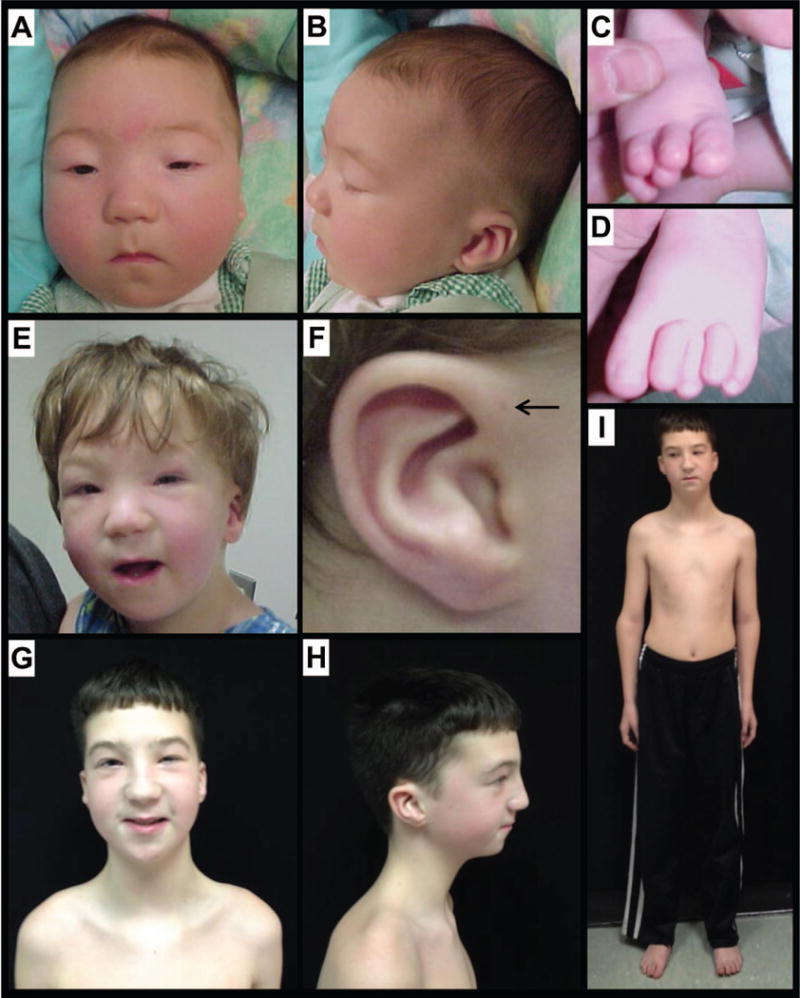
Blepharophimosis-ptosis-epicanthus inversus syndrome (BPES) is an autosomal dominant disorder caused by mutations in FOXL2. We identified an individual with BPES and additional phenotypic features who did not have a FOXL2 mutation. We used whole exome sequencing to identify a de novo mutation in KAT6B (lysine acetyltransferase 6B) in this individual. The mutation was a 2-bp insertion leading to a frameshift which resulted in a premature stop codon. The resulting truncated protein does not have the C-terminal serine/methionine transcription activation domain necessary for interaction with other transcriptional and epigenetic regulators. This mutation likely has a dominant-negative or gain-of-function effect, similar to those observed in other genetic disorders resulting from KAT6B mutations, including Say-Barber-Biesecker-Young-Simpson (SBBYSS) and genitopatellar syndrome (GTPTS). Thus, our subject's phenotype broadens the spectrum of clinical findings associated with mutations in KAT6B. Furthermore, our results suggest that individuals with BPES without a FOXL2 mutation should be tested for KAT6B mutations. The transcriptional and epigenetic regulation mediated by KAT6B appears crucial to early developmental processes, which when perturbed can lead to a wide spectrum of phenotypic outcomes.
Keywords: BPES; KAT6B; blepharophimosis; epicanthus inversus; ptosis; whole exome sequencing.
© 2014 Wiley Periodicals, Inc.
Conflict of interest statement
None of the authors has any conflict of interest to disclose.
Figures

References
-
- Basel-Vanagaite L, Dallapiccola B, Ramirez-Solis R, Segref A, Thiele H, Edwards A, Arends MJ, Miró X, White JK, Désir J, Abramowicz M, Dentici ML, Lepri F, Hofmann K, Har-Zahav A, Ryder E, Karp NA, Estabel J, Gerdin AKB, Podrini C, Ingham NJ, Altmüller J, Nürnberg G, Frommolt P, Abdelhak S, Pasmanik-Chor M, Konen O, Kelley RI, Shohat M, Nürnberg P, Flint J, Steel KP, Hoppe T, Kubisch C, Adams DJ, Borck G. Deficiency for the ubiquitin ligase UBE3B in a blepharophimosis-ptosis-intellectual-disability syndrome. Am J Hum Genet. 2012;91:998–1010. - PMC - PubMed
-
- Beysen D, Raes J, Leroy BP, Lucassen A, Yates JRW, Clayton-Smith J, Ilyina H, Brooks SS, Christin-Maitre S, Fellous M, Fryns JP, Kim JR, Lapunzina P, Lemyre E, Meire F, Messiaen LM, Oley C, Splitt M, Thomson J, Van de Peer Y, Veitia RA, De Paepe A, De Baere E. Deletions involving long-range conserved nongenic sequences upstream and downstream of FOXL2 as a novel disease-causing mechanism in blepharophimosis syndrome. Am J Hum Genet. 2005;77:205–218. - PMC - PubMed
-
- Beysen D, De Paepe A, De Baere E. FOXL2 mutations and genomic rearrangements in BPES. Hum Mutat. 2009;30:158–169. - PubMed
-
- Campeau PM, Kim JC, Lu JT, Schwartzentruber JA, Abdul-Rahman OA, Schlaubitz S, Murdock DM, Jiang M-M, Lammer EJ, Enns GM, Rhead WJ, Rowland J, Robertson SP, Cormier-Daire V, Bainbridge MN, Yang XJ, Gingras MC, Gibbs RA, Rosenblatt DS, Majewski J, Lee BH. Mutations in KAT6B, encoding a histone acetyltransferase, cause Genitopatellar syndrome. Am J Hum Genet. 2012;90:282–289. - PMC - PubMed
-
- Champagne N, Bertos NR, Pelletier N, Wang AH, Vezmar M, Yang Y, Heng HH, Yang XJ. Identification of a human histone acetyltransferase related to monocytic leukemia zinc finger protein. J Biol Chem. 1999;274:28528–28536. - PubMed
Publication types
MeSH terms
Substances
Supplementary concepts
Grants and funding
LinkOut - more resources
Full Text Sources
Other Literature Sources
